

The Election Commission Must Reclaim its Lost Moral Authority


It is often said that a team is only as strong as its weakest link. The Constitution guarantees a democratic form of governance for our nation. It promises so explicitly in the Preamble, and implicitly if one follows the scheme of the Constitution intently. The responsibility to ensure that democracy survives and thrives is incumbent upon the state as well as the citizens – this is the team. As per the Supreme Court, an important element of a democratic form of governance is the conduct of free and fair elections. The organ of the state that is responsible for the conduct of these free and fair elections is the Election Commission of India (ECI). The judiciary is barred from interfering with election matters given the time sensitivity of election issues. This is possibly why the Election Commissioners are given the equivalent rank of a Supreme Court judge.
However, when they appear to be working at the behest of one particular political party, it creates a trust deficit in these unelected umpires of elections. While the deteriorating standard of political discourse is writ large for each of us to see, the Prime Minister’s speeches are emblematic of this standard at the highest level of political leadership. In the run-up to the 2024 general elections, the Prime Minister has delivered many speeches vilifying the Muslim minority and asking others to vote for his government if they want to establish “Ram Rajya”, another invocation to religion, all of which is technically barred under the Model Code of Conduct.
When he continues to go unchecked, one is bound to ask where is the ECI?
The Model Code of Conduct is outdated
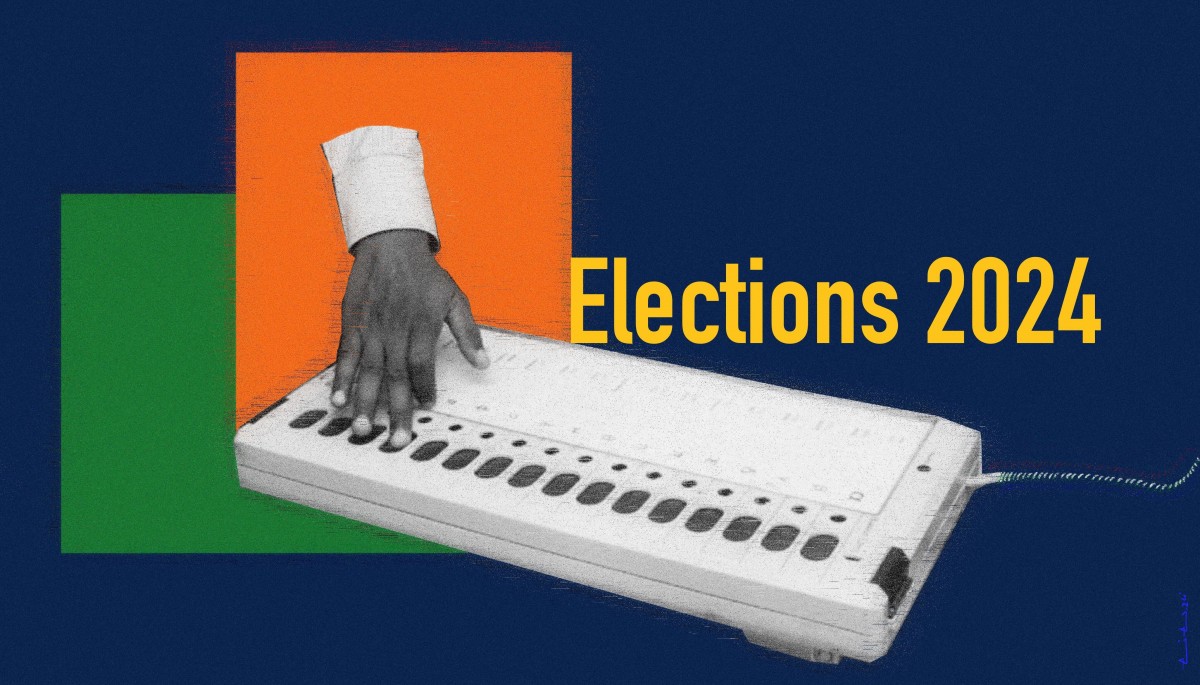
Illustration: Pariplab Chakraborty
The Model Code of Conduct (MCC) is a set of rules and guidelines of ‘dos’ and ‘don’ts’ for politicians and parties while campaigning for elections. The intent behind them is to ensure a playing field for all political actors, whether in government or opposition. One of the most important MCC guidelines, given the diversity of India, is that you cannot ask people to vote for you in the name of religion or caste. There are many reasons for this.
Firstly, allowing the solicitation of votes based on religion and caste would lead to the creation of permanent vote banks, a goal antithetical to our constitution drafter’s vision. Secondly, the scope for violence between competing factions of caste or religion is also against the purpose of a Constitution, which is to ensure an equitable and peaceful society. Thirdly, the animosity created by politicians for political benefit amongst different sets of people can slowly become permanent and create a deep fissure in the social fabric with implications beyond just election results.
The ECI has allowed the Prime Minister to continue unabated with his speeches where he constantly creates the illusive threat of Muslim domination. He has done so in speeches, and his party continues to do it, on their official social media handles. The ECI has been a mute spectator at best, an inactive enabler at worst.
The MCC has not been updated to take into account the fact that while the ECI may be able to stop public on-ground campaigning 48 hours before the voting, the content on social media continues to stay up online, and based on an individual’s algorithm can still be a potent tool of polarisation and campaigning for parties. It is not enough to say that this is a possibility that all political parties can exploit. No party should be allowed to exploit loopholes and it is the constitutional duty of the ECI to work towards closing these loopholes. The ECI has either chosen not to close this loophole or has been unable to, neither of which bode well for the peaceful conduct of elections.
Also read: 'A New Low, No Longer an Umpire': Political Scientists Decry Election Commission
What the PM says is it really against the MCC?
In an election rally in Rajasthan, the PM made the following remark, “When they [the Congress] were in power, they said Muslims have first right over resources. They will gather all your [Hindus] wealth and distribute it among those who have more children.” Not only did this speech vilify the already marginalised minority of Muslims within India by making them the enemies of the large Hindu majority, but it also was a blatant misrepresentation of what Manmohan Singh, former PM had said in his speech which the current PM chose to twist, decontextualise and use to create animosity.
What did the ECI do? For the first few days, it refused to comment. Then they issued a show cause notice. However, they also issued a show cause notice to Rahul Gandhi in the same announcement, ensuring that the headlines could run with both their names, taking the sting out of it. What was the PM’s response to the show cause notice or what penalty was imposed on him is not known to anyone. The ECI has taken no follow-ups on this.
In another, more recent incident, the PM has posted a clip of his election rally video on X (formerly Twitter) where he asks his audience about whether they would choose – Ram Rajya or Vote Jihad. Now, he might have not mentioned the names of the religions, but it is clear as night and day, that he is asking people to choose between Hindu pride and Muslim domination.
What did the ECI do? Nothing so far.
The ECI as the weakest link
Coming back to the first thought that we started with – a team is only as strong as its weakest link. The team that assembles before each election cycle to ensure free and fair elections and a peaceful transition of democratic governance includes regular citizens, civil society organisations and the ECI. The judiciary is constitutionally limited, and the political executive and legislature have a vested interest in tilting the balance of scales in their favour. This tripartite team is only as strong as the resolve of the ECI to ensure transparency and impartiality. If the current trend is to be followed, the ECI is upholding neither.
Right before the elections, the parliament overturned the Supreme Court’s judgment on the method of appointment of election commissioners. The SC had envisaged a three-person panel with the PM, the Leader of Opposition and the Chief Justice of India (CJI) to choose, by a vote of majority, the chief election commissioners and other election commissioners. However, the Parliament, in a bill passed with minimal debate replaced the CJI with another minister appointed by the PM. This gives the government a 2:1 majority and the Leader of Opposition becomes immaterial.
Given that two of the three members of the ECI were appointed right before these general elections, in a process mired with controversy over allegations by the Leader of the Opposition about the lack of due consideration and discussions on the recommendations before the three-member appointment commission he was a part of, the ECI needed to a do a better job to ensure its authority and the sanctity of the election results.
It is not living up to the examples set by its preceding Commissions. It is not enough that the ECI sends show cause notices, it must also act on them. If the violator does not rectify, they must be prohibited from campaigning. If they still do not desist, they must be barred from contesting elections. There are precedents for all these actions, including at the highest level. If the citizens of India who are observing these (in)actions of the ECI are to celebrate the result of the elections, the authority conducting them must reclaim its moral authority.
Sahibnoor Singh Sidhu is a constitutional law teacher and writer.
This article went live on May twelfth, two thousand twenty four, at fifty-nine minutes past eleven in the morning.The Wire is now on WhatsApp. Follow our channel for sharp analysis and opinions on the latest developments.


