

‘They Gave No Prior Notice’: With Electricity Cut Off, Residents of Delhi’s Jai Hind Camp Now Fear Eviction


New Delhi: Thousands of people residing in the Jai Hind Camp near Vasant Kunj in Delhi, are living in fear and uncertainty for the past few days. On Tuesday, July 7, the electricity supply to their homes was disconnected without any prior notice. The families, many of whom have lived in the settlement for more than 25 years, now face the threat of eviction.
Nearly 8,000 people live in this camp. A private provider was supplying electricity in this area and the residents were paying monthly bills as per the readings on the meter. However, around 1PM on Tuesday, the electricity connections were suddenly disconnected in the presence of Delhi Police personnel, leaving many children, women and elderly suffering in the scorching heat.
Milan, a resident of the Jai Hind Camp, says, "I have lived in this camp with my family since I was a toddler. But we are not getting the basic rights we deserve. People should have access to water, electricity and roads, but we don't have any of that here. We were paying Rs 10 per unit for the electricity, yet they cut off the power supply on Tuesday.”

Residents of Jai Hind Camp are shifting their electric appliances after the power supply was cut off. Photo: Atul Howale
“During elections, politicians come and promise not to demolish the slum, but once the elections are over, no one comes back. In this scorching heat of Delhi, children are unable to sleep, and there are a lot of mosquitoes here, which makes living here extremely difficult," he adds.
The residents of Jai Hind Camp are mainly migrant workers from West Bengal, a majority of whom belong to the Muslim community. The area’s unsanitary conditions are particularly concerning, with garbage strewn everywhere. There are no proper roads, no clean water facilities and overall, the administration has completely neglected the camp.
Motiyar Rahman, a resident, says, "I have been living in this camp for the past 25-26 years, and since the beginning, I have worked collecting garbage from nearby housing societies and dumping it at the landfill. On Tuesday, I was at work when I received a call from a family member saying that electricity in the camp had been cut off. Everything was suddenly shut down without any prior notice. That night, due to the heat and mosquitoes, I couldn't sleep at all, and the next day, I couldn't even go to work."
It has been three days since the administration has cut off power supply in the settlement.
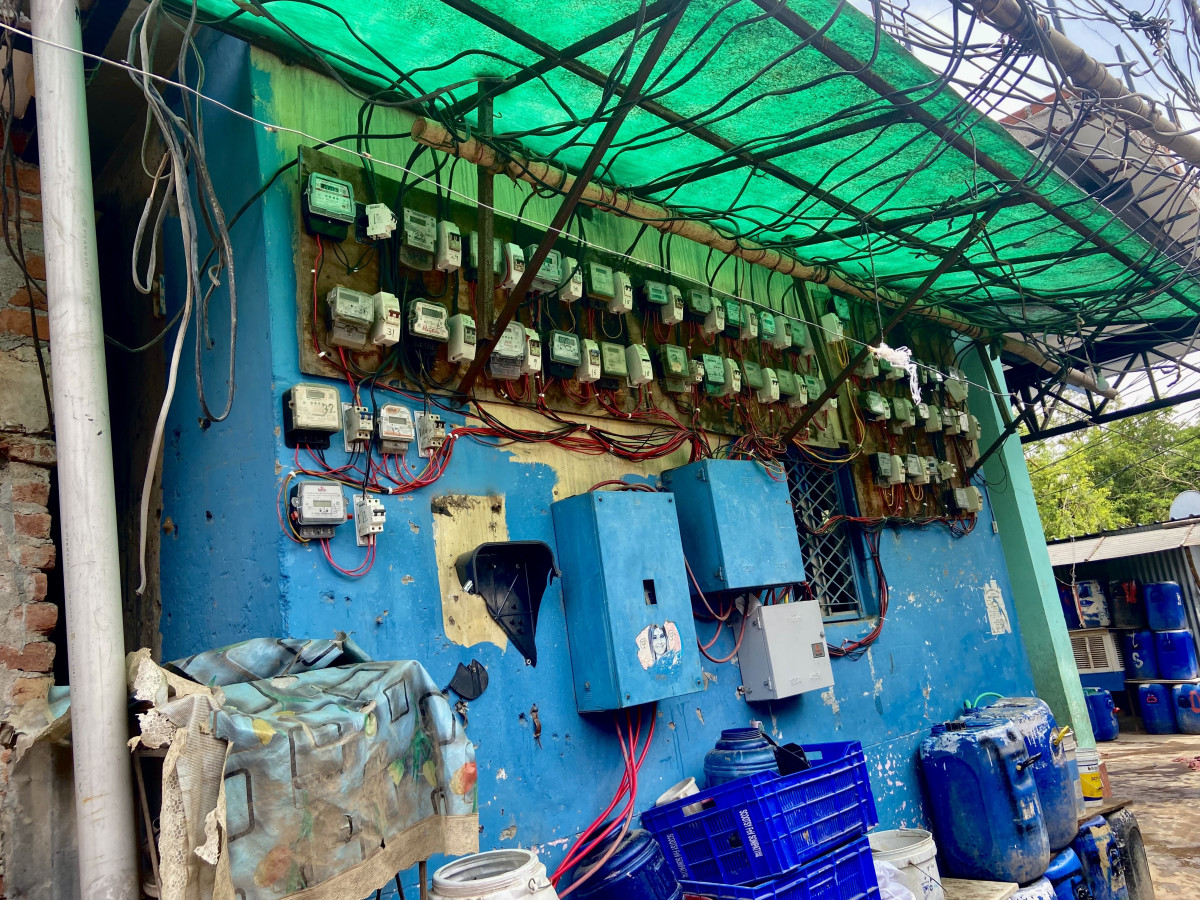
An electricity meter mounted on the wall of a temple in Jai Hind Camp, Delhi, is now disconnected. Photo: Atul Howale
He adds, "Now that the electricity has been cut, we are also dependent on water tankers, which come only once every four or five days. We store water in plastic containers and cans, but if it falls short, we have to buy it for Rs 20 each time. The fear now is that today, they cut the electricity, what if they stop the water supply next? Where will we go then? Our children are studying in nearby schools. If we are evicted from here, their schooling will stop too."
Fatima, who has also been living here for 25 years, works as a domestic helper in nearby residential societies to support her family. According to her, since a lot of the migrant workers there are Bengali-speaking Muslims, they are constantly under pressure to prove that they are Indian Muslims and not Rohingya Muslims.
Fatima tells The Wire, "There are small children in our homes, and many women are pregnant. How much suffering are they going through in this extreme heat? What kind of justice is this from the government? We are human beings. We have been living here for 20-25 years. Our children were born here, and go to school nearby…in a couple of days, they might stop the water too, just so that we leave this place on our own."
She says, "When elections come, politicians say, 'Brothers, sisters, give us your vote, and we'll provide you with all the facilities.' We vote for them. That same government is now trying to evacuate us. We are harassed by being called 'Bangladeshi' or 'Rohingya,' even though we have voter ID cards and all the necessary documents proving we belong here.”
“When it's time to vote, we are Indians, but when we ask for our rights, we are labelled as outsiders and Rohingya. The local police even went to our villages (in Bengal) for verification and didn't find a Bangladeshi. This government just wants to remove Muslims from here," she adds.
Like Fatima, Mahidul Sheikh is also a resident of Jai Hind Camp who migrated from Bengal and has lived here for over 15 years. He too says that they are forcibly labelled as “Bangladeshi”, even though they can prove they are not. “We have submitted all our local identity documents. The police here even went to our village in Bengal and spoke to the local MLA and MP to verify that we are from there. We have submitted all those documents to the police station,” he says.
"Still, yesterday, around 15-20 police personnel and others came and cut off our electricity supply. When we tried to ask them why, they gave us no explanation; they don't want to talk to us; they only want to use force," Mahidul says.
While the residents of Jai Hind Camp endure darkness and extreme heat without electricity, there is also a looming fear that bulldozers might soon arrive at their homes.
Since the Bharatiya Janata Party (BJP) came to power in Delhi, there has been a continuous demolition drive targeting slum encroachments. Areas like the Madrasi Camp in Jangpura, Bhoomihin Camp in Kalkaji, and several others have already faced bulldozer action over the last few months.
This article went live on July tenth, two thousand twenty five, at fourteen minutes past four in the afternoon.The Wire is now on WhatsApp. Follow our channel for sharp analysis and opinions on the latest developments.


