

Two Bengal Seats, 72,000 ECI Appeals, One Timestamp: 99% of Target Voters Are Muslim


Kolkata: Two constituencies in West Bengal’s border belt show the two routes by which the Special Intensive Revision (SIR) has taken voters off the rolls, and how they end up in the same place. In Samserganj, in Murshidabad, judicial officers marked 74,775 voters not eligible, more than in any other seat in the state. In Sujapur, in Malda, the judges struck off far fewer. But there, the Election Commission has filed appeals against the inclusion of 61,066 of the voters the judges cleared, the most of any seat in the state.
Appeal records collected and verified by the Civic Research Group and provided to The Wire show that in both seats, almost every voter the commission is now trying to remove has a name commonly associated with Muslims. They also show that nearly all of these appeals were lodged at the time, on April 5, 2026, only two days before the electoral roll was frozen for the Assembly election.
Two routes, one destination
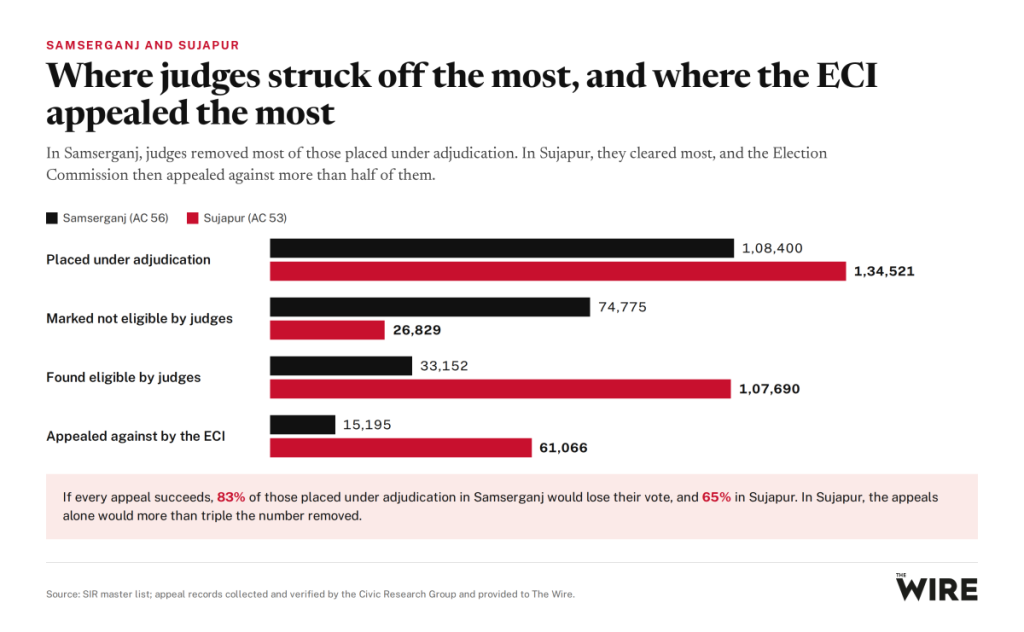
In Samserganj, judges deleted 69% of the 1,08,400 voters placed under adjudication, and cleared 33,152. The commission has appealed against 15,195 of those, 47.6%.
In Sujapur, judges deleted just 20% of the 1,34,521 placed under adjudication, and cleared 1,07,690. The commission has appealed against 61,066 of them, 56.7%. That is more than twice the number the judges themselves removed.
If every appeal succeeds, the two seats end up in much the same place. Samserganj would lose 83% of the voters placed under adjudication, and Sujapur 65%. In Sujapur, the appeals would more than triple the number of adjudicated voters removed, from 26,829 to 87,895.
The records for Sujapur cover all 1,07,690 voters the judges found eligible. For Samserganj, they cover 31,896 of 33,152, about 96%. So far, the tribunals have decided 89 of the Sujapur appeals and 16 of the Samserganj ones.
Who is being appealed against
In Samserganj, 15,177 of the 15,195 voters the commission has appealed against have recognisably Muslim names, or 99.9%. In Sujapur, the figure is 60,823 of 61,066, or 99.6%.

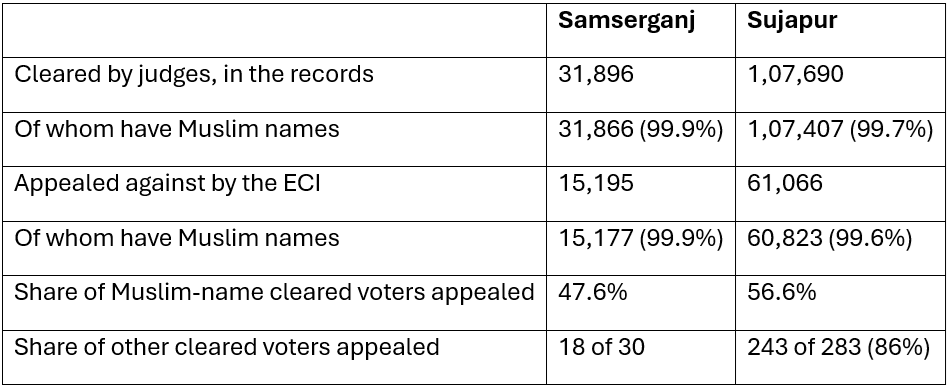
These figures need careful reading. The commission did not single out Muslim voters from among those the judges cleared. In both seats, almost everyone the judges cleared has a name typically associated with the Muslim community, although minorities make up about 72% of Samserganj’s population and 75% of Sujapur’s population.
The skew happened earlier, at the point of entry. In April, The Wire found that in Samserganj, booths where Muslims made up half or more of the population had an average of 467 voters each placed under adjudication, against 65 in other booths. Those who emerged on the other side were almost all Muslim, and so are those now being appealed against.
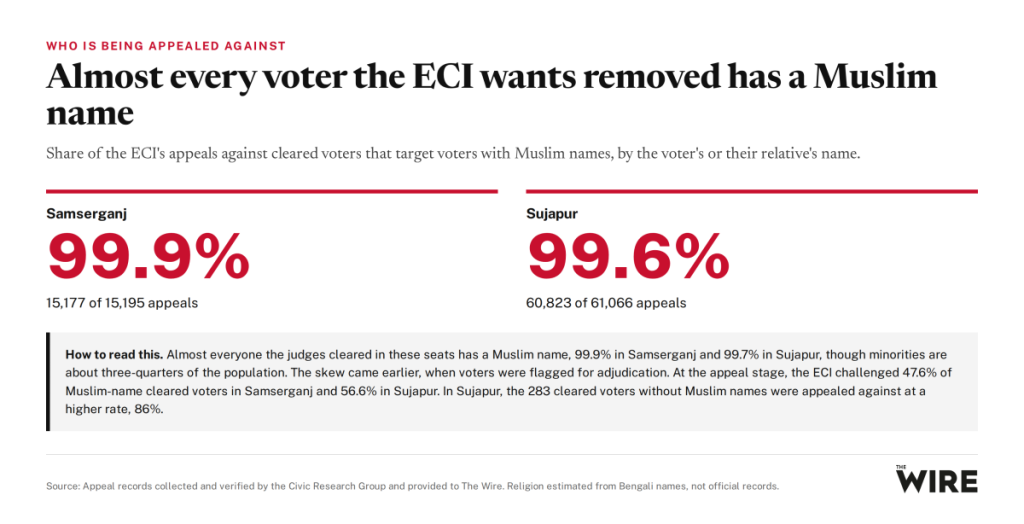
In Sujapur, the few cleared voters who did not have names associated with Muslims were appealed against at a higher rate, 86% against 57%. They are concentrated in nine roll parts, which hold 225 of the 283 and 219 of their 243 appeals.
In those parts, the commission appealed against almost every cleared voter, whatever their name. In part 2, it appealed against all 13. In part 244, it appealed against 40 of 43, and in part 250, 68 of 78. That points to appeals filed in bulk, part by part, not to voters picked out one by one.
One evening in April
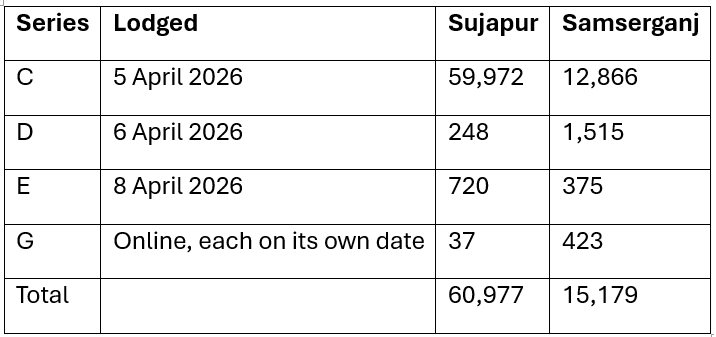
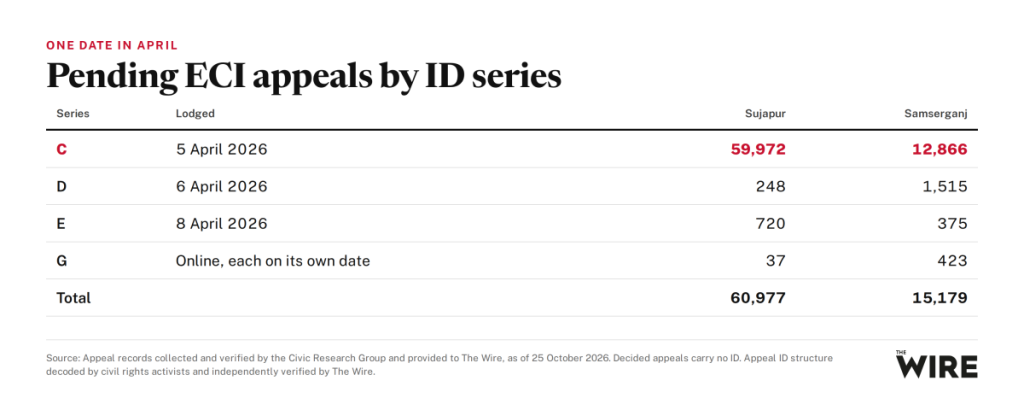
Every pending appeal carries an ID. Civil rights activists working on the SIR have decoded the structure of these IDs, and The Wire has independently verified their reading. One letter in the ID fixes the date and time a batch of appeals was lodged. Decided appeals no longer carry an ID, so this analysis covers the 60,977 pending appeals in Sujapur and the 15,179 in Samserganj.
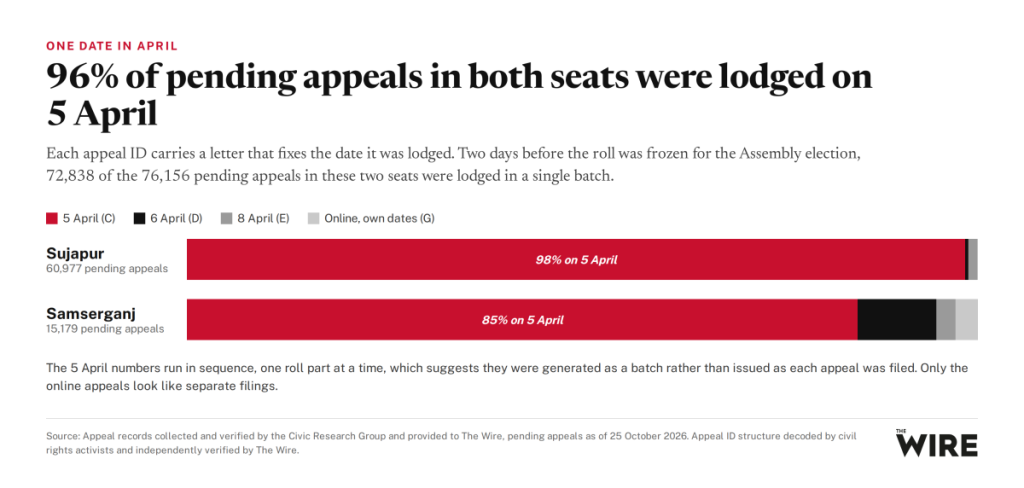
Of these 76,156 appeals in total, 72,838, or 96%, share a single timestamp on April 5, 2026. In Sujapur, that is 59,972 appeals, 98% of the total. In Samserganj it is 12,866, or 85%.
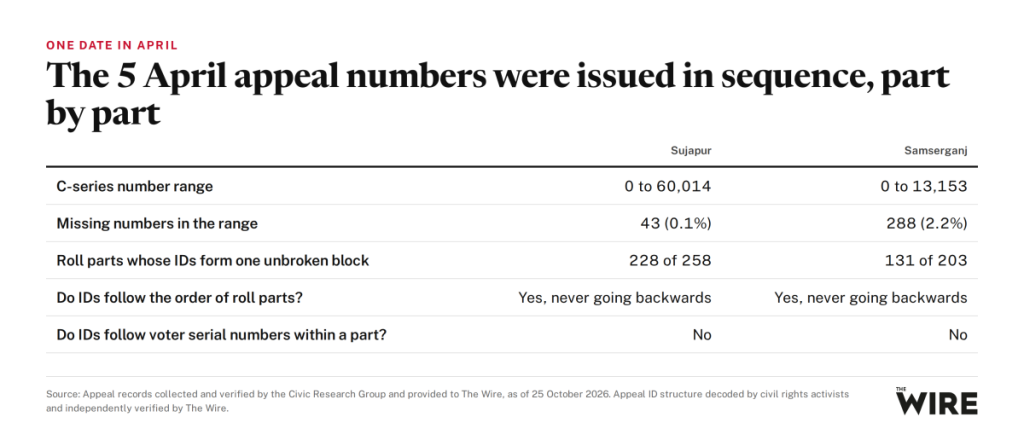
The C-series numbers were issued in sequence, one roll part at a time. In Sujapur, they run from 0 to 60,014 with only 43 numbers missing. In Samserganj, they run from 0 to 13,153 with 288 missing.
When sorted by ID, the part number never goes backwards. All of part 1 comes first, then part 2, and so on until the last part. Within each part, the IDs follow neither the voters’ serial numbers nor the dates on which they were rejected.
Instead, the IDs appear to have been generated in batches, part by part, not issued one by one as each appeal was filed.
The smaller D and E series, and the online G series, are not sequential. The G series appeals, filed online on individual dates, are the only ones that look like separate filings. In Samserganj, there were 423 of them, most between April 1 and 8, peaking at 82 on April 3. In Sujapur there were 37.
Part by part
The appeals reach into every corner of both seats. In Samserganj, there are appeals in all 230 roll parts with cleared voters in the records. In Sujapur, there are appeals in 261 of 262. In part after part, the commission has appealed against roughly half or more of the voters that judges cleared, and the largest numbers are where the judges cleared the most people.
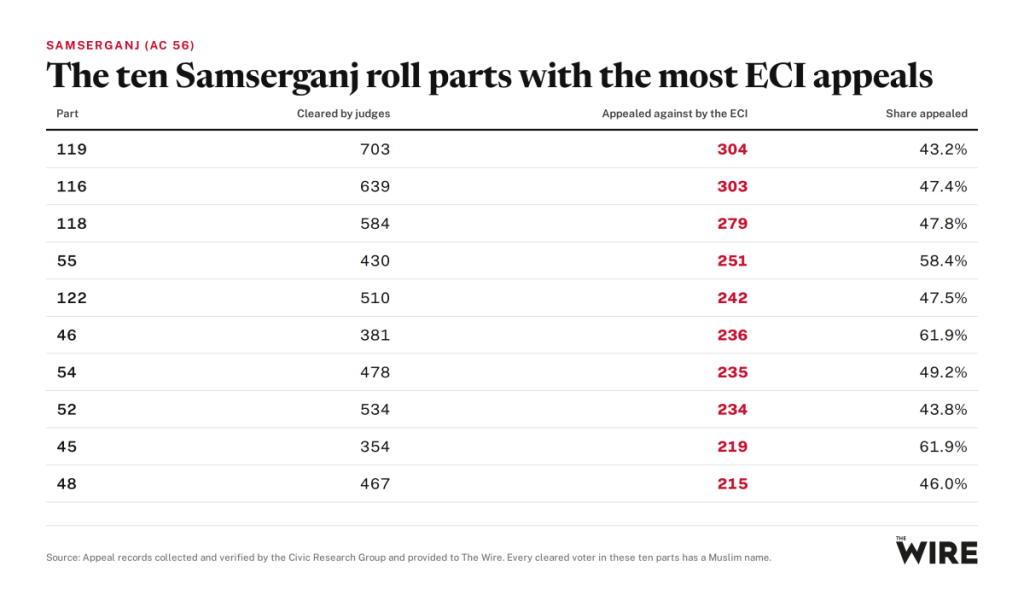

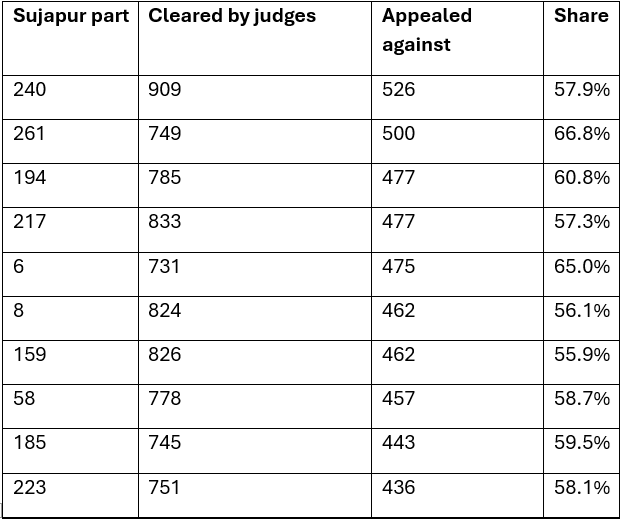
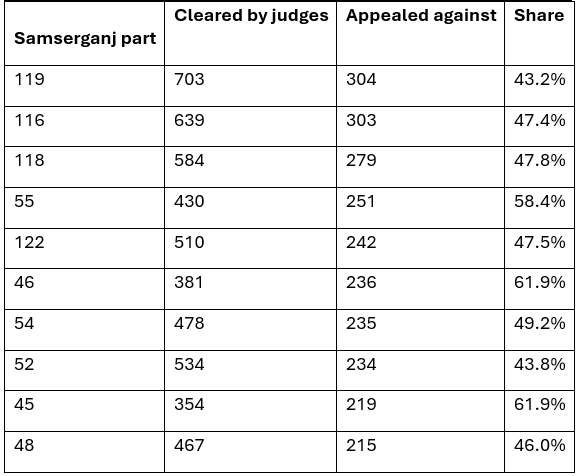
In all 20 parts, every cleared voter in the records has a Muslim name.
Among parts with at least 100 cleared voters, the highest rate in Sujapur is in part 25, where the commission appealed against 134 of 182, or 73.6%. Parts 151, 152 and 179 follow, at 72.5%, 71.5% and 71.5% appealed against, respectively. In Samserganj, the highest is part 41, at 139 of 203 appealed against – 68.5%.
What is at stake
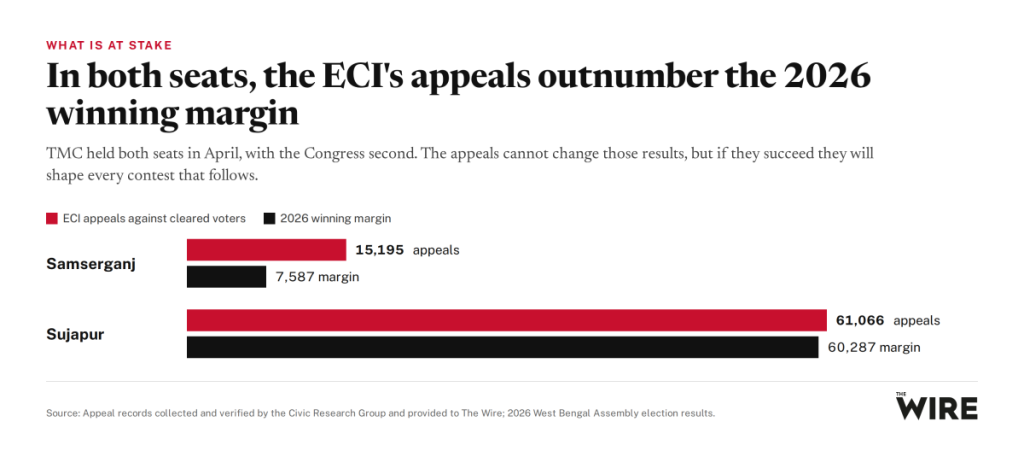
Both seats stayed with the Trinamool Congress (TMC) in the April Assembly election, and on both seats, the Congress came second. In Samserganj, Mohammed Noor Alam won by 7,587 votes, and the commission’s appeals cover twice that number of voters.
In Sujapur, Sabina Yeasmin won by 60,287, and the appeals cover 61,066 voters, slightly above her margin of votes. In 2021, TMC had won Samserganj by more than 26,000 and Sujapur by more than 1.3 lakh votes.
While the April results are now sealed, if these appeals succeed, they will determine how every future contest on these constituencies will shape up. This will begin with the municipal elections, whose schedule is expected to be announced i nNovember.
Just to get an idea of the potential impact, in Sujapur, the commission’s appeals alone amount to almost a quarter of the constituency’s entire draft roll, consisting of 2,56,276 voters.
Barely heard
Of the 76,261 appeals in the two seats, the tribunals have decided 105 – 89 in Sujapur and 16 in Samserganj. The rest are pending before tribunals in Kolkata, hundreds of kilometres away. Since September 21, no tribunal has been able to upload an order at all, after judges refused an ECI portal requirement to log in with their Aadhaar credentials.
The commission has not said on what grounds it is challenging these voters, all of whom have already proved their eligibility twice – once before a Booth Level Officer (BLO), and then before a judicial officer. Nor has it said whether each case was reviewed before an appeal was filed, why so many appeals share a single timestamp or why it has appealed against roughly half or more of those cleared in both seats, as it has across the state.
For our full coverage on the SIR and the issues it has brought to citizens, click here.
This article went live on October twenty-eighth, two thousand twenty six, at fifty-three minutes past ten at night.The Wire is now on WhatsApp. Follow our channel for sharp analysis and opinions on the latest developments.


