

After Dubai, HAL’s 'Internal' Shortcomings Are Now Thrust Under Global Spotlight


Chandigarh: The Tejas Mk-1 Light Combat Aircraft (LCA) crash at the Dubai Air Show on November 21 has reignited long-standing concerns over the indigenous fighter programme, repeatedly flagged by domestic government watchdog agencies over its operational capabilities and the performance of Hindustan Aeronautics Limited (HAL), its manufacturer.
In the aftermath of the Dubai accident, witnessed by a global audience, including prospective buyers, several of these alarmingly adverse audit findings had acquired new urgency, with calls from analysts and industry officials for a ‘swift, credibly comprehensive and promptly publicised ’ inquiry into the mishap.
They warned that anything less than a thorough, transparent investigation by the Indian Air Force-led court of inquiry risked allowing long-standing official criticisms of Tejas to harden into accepted perception, permanently crippling the fighter’s export prospects and further eroding HAL’s credibility as a rising combat-aircraft manufacturer.
Systemic weaknesses
Meanwhile, for several air forces from Africa, Southeast Asia, and Latin America – who were evaluating Tejas as a potential purchase at the Dubai show, the world’s third-largest after Paris and Farnborough – last week’s crash, in which its pilot Wing Commander Namansh Syal died, was not just a setback: it was a body blow to Tejas’s credibility and export prospects.
Online news reports subsequently indicated that many of these prospective customers, after offering condolences, quietly walked away from Tejas to explore alternative options. Their departure underlined HAL’s fragile export appeal, as buyers who had hoped Tejas might have overcome its long-standing reliability concerns, had little choice but to reconsider in the wake of its fatal crash.
In the fiercely competitive, and relatively narrow, global fighter market – where operational reliability, performance, and the manufacturer’s reputation matter as much as price – the Dubai crash, in hindsight, did far more than ignite doubts about Tejas: it emphatically confirmed, in the most public and dramatic manner, multiple concerns that India’s watchdog institutions had been flagging for decades over the indigenous fourth-generation fighter programme, initiated in 1981.
Hence, these shortcomings that HAL and associated agencies had long treated as internal, manageable issues had now been thrust into the international spotlight, exposing systemic weaknesses in the fighter's design, production, and oversight.
Also read: Dubai Crash May Further Dim Export Prospects For a Tejas Already Vulnerable Over Imported Parts
A former HAL official admitted that for already-cautious buyers, evaluating a first-generation, un-blooded in combat fighter, the combination of a high-profile accident and a series of damning domestic audits was “highly damaging and potentially difficult to recover from.” Every delay, design flaw, and misstep associated with Tejas was now unfolding in full public view,” he added, declining to be named.
'Poor coordination, no liaison group'
Air Vice Marshal Anil Golani, a senior IAF fighter pilot veteran and former Director General of the Centre for Aerospace Power and Strategic Studies in New Delhi, said that the reputational loss to India after the Tejas crash, irrespective of the accident cause, would be difficult to restore. In his op-ed in The Tribune on November 28, he further declared that the onus was now on HAL to not only ‘redeem its reputation, but also the trust the country had reposed on its (fighter-making) capability.”
For decades, parliamentary defence committees, including the Public Accounts Committee and the Comptroller and Auditor General (CAG), had, separately and in unison, periodically raised alarms and concerns over the LCA's troubled path from design and development to its series production.
The CAG’s 2023 audit, for instance, highlighted “serious design lapses” in Tejas and an “incorrect assessment of the (fighters) required thrust,” while the parliamentary Public Accounts Committee in February 2021 was even more blunt. Other than castigating the overall LCA programme for “inexplicable delays”, spanning more than three decades, it criticised the “casual approach” of its monitoring agencies and the lack of coordination among numerous stakeholders involved in the project.
It noted that, despite the involvement of major defence and financial agencies, coordination among them remained poor, and lamented the absence of a dedicated LCA liaison group that could have resolved many of the Mk 1’s recurring glitches. But all these ombudsman committees had repeatedly and unanimously demanded a more formal mechanism-a liaison-like group or oversight body-involving HAL, the IAF and multiple other agencies associated with the programme to augment accountability and urgency, but to no avail.
“Most such inadequacies ended up being rationalised by the Ministry of Defence (MoD) and other departments associated with Tejas as being part of an inevitable developmental cycle,” said another senior IAF veteran, familiar with the LCA project. He maintained that over time, this justification had, over time, ended up becoming a ‘convenient alibi’ which shielded deeper structural failures in the project from scrutiny.
“In this, HAL was backed not just by official rhetoric, but by a sympathetic media environment and a host of veterans, who prioritised nationalist sentiment over atmanirbharta or self-reliance in materiel, over strict professional standards,” he stated, declining to be named. Hence, legitimate concerns and criticisms over safety, quality control and delays were routinely castigated and dismissed as ‘anti-national’ or unfair to an indigenous programme, creating an echo chamber in which technical drawbacks were softened, criticism discouraged, and accountability diluted, he added.
This became starkly evident in July 2016, when the IAF commissioned its first Tejas Mk-1 squadron — No. 45 Flying Daggers — five years late and equipped with 18 aircraft that had only Initial Operational Clearance-II (IOC-II). Remarkably, this IOC-II — a locally devised authorisation that, in retrospect, reflected the long-delayed programme’s acute developmental and certification pressures — carried 53 waivers, 20 of which at the time were to remain permanent, officials said.
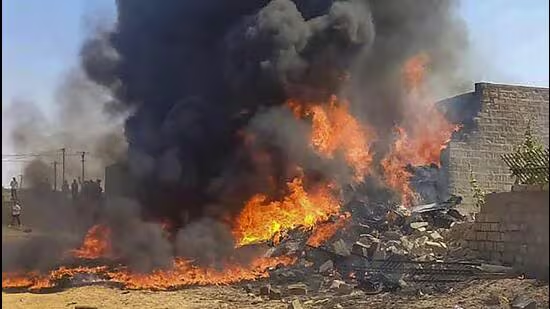
File image of the Jaisalmer Tejas crash site. Photo: PTI/File.
In fighters, IOC indicates the platform was safe to fly, but limited in combat roles, while Final Operational Clearance (FOC) certified full mission readiness, including complete weapons integration, aerodynamic refinements, and performance standards needed for unrestricted deployment. It was only the second Mk-1 squadron, No. 18 Flying Bullets, that received 18-odd FOC-standard aircraft, once more underscoring how protracted and troubled the platform’s maturation had been.
Also read: The Dubai Tejas Crash Is More Than a PR Embarrassment – It Threatens to Deepen a Credibility Gap
Against such a backdrop, aviation industry officials in Bangalore and Delhi argued that unless these systemic flaws were addressed, similar setbacks would continue, regardless of how individual accidents such as the Dubai crash or the earlier Jaisalmer incident in March 2024 were explained. Preliminary findings in the Jaisalmer Tejas crash, in which the pilot ejected safely, Air Marshal Golani noted in his aforementioned Tribune analysis, pointed to an ‘oil-system malfunction that led to engine failure’-or in short a manufacturing glitch.
Consequently, what began in 1981 as an ambitious national effort to field a 4th-generation fighter to rapidly replace the IAF’s ageing Soviet-era MiG-21s slowly devolved, over decades, into an almost interminable struggle – marked by shifting design baselines, ever-evolving technological targets, and repeated slippages in critical milestones.
Each change – and there were innumerable, affected weight, balance, systems integration and certification timelines – issues repeatedly highlighted in government audits, which the Dubai crash abruptly pulled back into focus, giving these warnings over design flaws, production delays and HAL’s uneven performance, a renewed and sharp relevance.
Once Tejas entered series production around 2014-15, the government overseer committees critiqued inconsistent quality standards, tardy and fragmented certification procedures that prevented a steady flow of airframes, and production lines that never achieved the promised numbers.
For years, HAL struggled – and still does – to deliver even a modest number of Tejas’s, forcing the IAF to revise induction timelines and extend the service life of hopelessly outdated and unsafe MiG-21s, whose last two squadrons were finally retired in September 2025, after a global record 62 years of squadron service.
Watchdog reports also highlighted inadequate risk-assessment mechanisms within the programme — from poorly anticipated supply-chain vulnerabilities, to the absence of contingency planning for critical components. Coordination between HAL, the Aeronautical Development Agency (ADA), responsible for designing Tejas, the IAF and multiple other agencies involved, was episodic rather than institutionalised, resulting in misaligned expectations, delayed feedback loops and avoidable redesign cycles.
These reports had also repeatedly underscored Tejas’s intrinsic vulnerabilities, especially its heavy reliance on imported systems — about 40% of its components — like its US-origin General Electric GE F404-IN20 afterburning turbofan engine and the Israeli EL/M-2052 radar, amongst other systems, as well as weaknesses within HAL’s broader manufacturing ecosystem. These ranged from uneven supplier quality to recurring difficulties in achieving consistent production standards.
Culpability
Parliamentary defence committees also made it clear over years that the IAF too bears culpability for the programme’s chronic delays, as its repeated and shifting Qualitative Requirements or specs for Tejas, forced time-consuming redesigns of core airframe and systems architecture.
What started off as a lightweight point-defence fighter, was gradually reshaped at the IAF’s insistence into a far more complex, multirole platform, requiring structural strengthening, avionics overhauls, aerodynamic refinements, and fresh certification cycles. Each change, however operationally justified, cascaded through HAL, ADA, Defence Research and Development Organisation (DRDO) laboratories, Centre for Military Airworthiness and Certification (CEMILAC) and private suppliers, compounding slippages and overwhelming the programme’s limited engineering bandwidth.
The consequences were predictable: developmental drift, shifting goalposts, and mounting frustration across all stakeholders. “It is convenient—and politically risk-free—to pin blame solely on HAL, but the truth is more uncomfortable” admitted a former MoD official. The country’s military-industrial culture suffers from fragmented accountability, diffused authority, and a habit of altering requirements mid-stream, without institutional discipline or programme-level stability. Tejas became a victim of this structural dysfunction” he said, also requesting anonymity.
The Dubai accident also chillingly recalled HAL’s maiden export venture in 2008–09, when it sold seven Dhruv Advanced Light Helicopters to the Ecuadorian Air Force (EAF), of which four crashed — leading Quito to terminate the contract in 2015. The EAF alleged inadequate post-sale support, chronic shortages of spares, and sluggish technical response times, while HAL insisted that at least some of the accidents were attributable to pilot error and poor maintenance practices.
This episode became an enduring cautionary tale within the closed-door global military-aviation community. For many potential buyers, it signalled that HAL’s challenges were not confined to individual platforms, but reflected deeper structural weaknesses — in after-sales support, supply-chain reliability, and customer responsiveness — all of which had harshly resurfaced after the Dubai crash.
In parallel, the IAF's long-standing dissatisfaction with HAL only added to the problems and negativity surrounding the public sector behemoth that enjoyed a near-monopoly in domestic military aircraft manufacture, having provided all three Indian armed forces several thousand fighters, transport and rotary wing platforms, mostly licence built, over the past six decades.
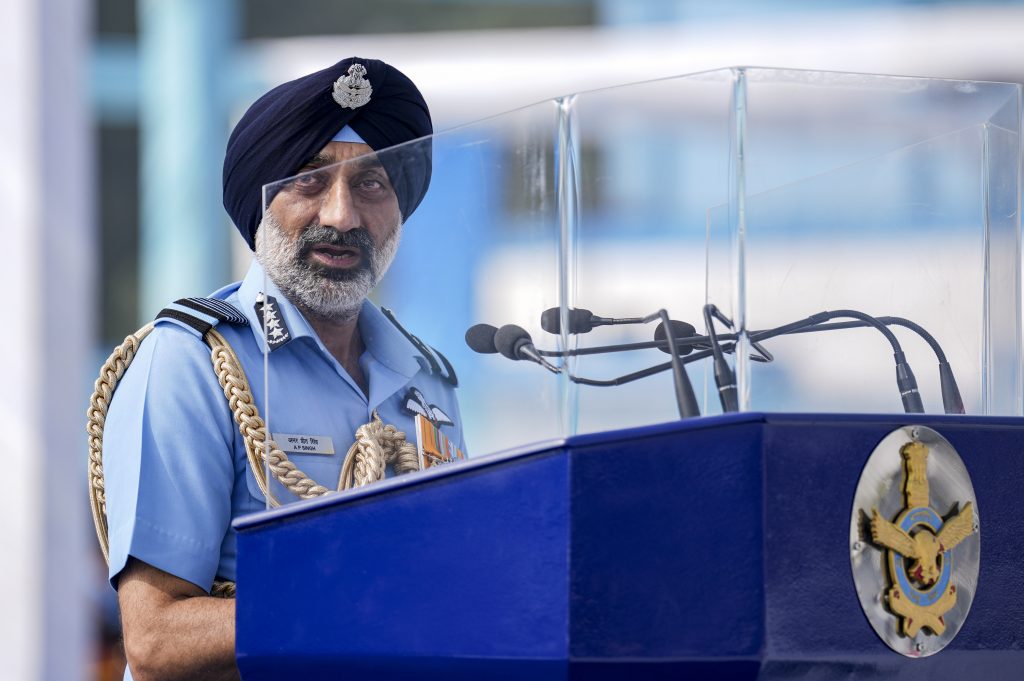
Chief of the Air Staff Air Chief Marshal A. P. Singh addresses the gathering during the 93rd Indian Air Force Day celebrations, at Hindon Air Force Station, in Ghaziabad, Wednesday, Oct. 8, 2025. Photo: PTI
As recently as February 2025, Air Chief Marshal A.P. Singh had publicly berated HAL for its chronically slow Tejas production rate and said that he was not confident about HAL. “I find that HAL is just not in mission mode,” the ACM said at the Bangalore Air Show. His predecessors too had similarly castigated HAL, indicating that several Tejas’s delivered to the IAF had necessitated rectification or modification at base depots.
A cross-section of IAF veterans said the root of the friction lay in the two organisations “speaking different languages”: the IAF, they said, operated in operational mode-driven by mission readiness, timelines, and flight safety, while HAL functioned in ‘fille mode’, shaped by bureaucratic processes, paperwork cycles, and production formalities. This cultural mismatch, they contended, repeatedly slowed decision-making, blurred accountability, and prevented urgent operational concerns from being addressed with the speed the service and evolving security situations necessitated.
Besides, despite being HAL’s largest and ‘dedicated’ customer, the IAF had no permanent representation on the company’s board — a gap briefly addressed between 2014 and 2017, when the Force’s Deputy Chief served as ex officio member. But a HAL spokesperson confirmed earlier this week that this practice had long been discontinued, leaving HAL without a direct operational voice from the service that flies, maintains, and evaluates every aircraft it produces.
The Dubai crash, reinforced by official appraisals and oversight reports, exposed HAL’s fragile global credibility and the fact that India’s first-generation combat aircraft Tejas can no longer rely on spoken reputation alone: it must prove itself through rigorous testing, sustained operational readiness, dependable performance in varied conditions, and robust after-sales support.
Only then can HAL hope to turn export scepticism into some modicum of international success, unlike its earlier, ill-fated helicopter venture that ended in crashes and contract cancellations.
This article went live on November twenty-ninth, two thousand twenty five, at fifty-six minutes past ten in the morning.The Wire is now on WhatsApp. Follow our channel for sharp analysis and opinions on the latest developments.


