

A Partitioned Subcontinent Comes Together in Stockholm


Can a Pakistani, Indian, Bangladeshi and Afghan walk into an old, historic venue on a crisp summer day in Stockholm and reunite in stories that affirm solidarity, allyship and radical friendships transcending borders and boundaries? The answer is always yes!
That is what happened recently on July 13, 2025, in Sweden’s capital city, when scholars, writers, artists, filmmakers and musicians from seven countries across borders descended in Gamlastan, the old, historic city of Stockholm, in an effort to rethink old traumas of the Partition of the Indian subcontinent in 1947. The event was a one-of-a-kind workshop organised by Mela Nordic, a South Asian organisation initiative that is founded by a group of activists, scholars and professionals with the goal of reformulating polarised South Asian narratives surrounding Partition discourses. Talat Bhat, a Kashmiri-Swedish and one of the main founders of the organisation, opened the day’s event stating:
"Mela Nordic, through events like the '78 Years of Partitioned Voices', creates a crucial platform for dialogue among South Asian communities in the Nordic region. By bringing together individuals from Hindu, Muslim, Indian, Pakistani, and other backgrounds, Mela Nordic uses art and culture to bridge differences and foster empathy. These gatherings allow for the sharing of stories, reflection on historical events like Partition, and celebration of South Asian heritage. In a world where divisions can deepen easily, such cultural dialogues are essential for building trust and challenging stereotypes."
The one-day workshop was thus aimed at a dialogue at a time when South Asian nation-states dominated by renewed India-Pakistan conflict have intensified “us vs them” rhetorical salvos. To be sure, the speakers of this workshop, comprising academics, writers and artists, were not always in consensus and agreement. As will be discussed later, the divergent topics and themes were in themselves a testament to pluralist perspectives beyond any hegemonic and monolithic ideas about once Partitioned lands. Instead, what was especially crucial was how the speakers from seven countries – Pakistan, India, Bangladesh, the UK, Sweden, the US and Australia – set forth a dialogue that highlights the need of the hour for such critical and radically transforming spaces in coming together.
The venue of this workshop was one of the most prestigious locations in the historic part of Stockholm: a film collective called Filmcentrum Riks, located in a 17th century grand building converted into a film auditorium holding space for indie and foreign film screenings, along with multicultural socio-cultural events. The spatial dynamics of this setting in Stockholm is itself of significance, since it allowed long-Partitioned South Asian countries to come together in a third space contact zone, which increasingly has become impossible in recent times with visa surveillance and cross-border austere policies. But what was remarkably important was the energy, camaraderie and voices that emerged from this event.
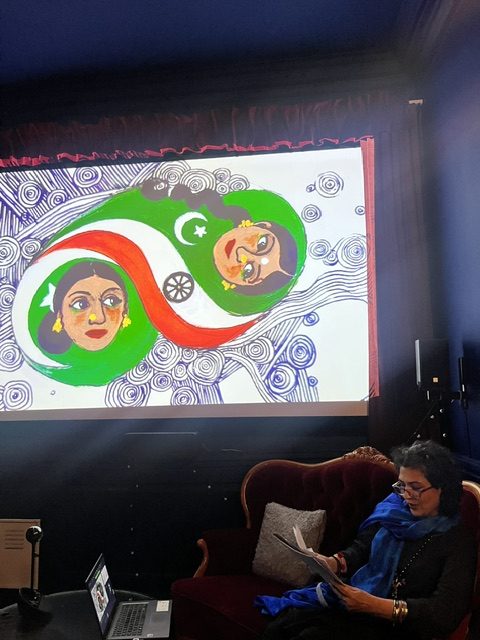
Hamama Tul Bushra with her art. Photo: Amrita Ghosh
The range of topics discussed included a Marxist reading of Partition, in the context of Pakistan, by renowned Pakistani Australian doctor turned writer-activist Saulat Nagi. Scanning Partition and post-Partition Pakistan through the Gramscian lens, he argued that the postcolonial elite as an exploiting class has replaced the colonial administration, but modes of oppression remain rather similar. Pakistani American artist Hamama Tul Bushra presented a moving art-talk titled “A Story Beyond Borders” that encapsulated India and Pakistan coming together in poignant moments and histories beyond statist control. Bushra’s vibrant paintings specifically set the tone of how to locate human stories of love, bonding and cross-border friendships that defied nationalisms on all sides. Her art also showcased a feminist bent with women shrouded by two flags where beginnings or ends enmeshed ying-yang style in a swirl of Indo-Pakistani colors.
Amongst scholars of South Asia and postcolonial studies, Indian-American scholar Amrita Ghosh (one of the authors of this article) spoke of visual cultures and how ‘postmemories’ of Partition can inform alliances and ethical futures towards hope. As a third generation Partition subject removed from the immediate historical rupture, Ghosh spoke of the important task that present generation subjects across borders and in the diaspora have – to build communities through a ‘convivial joy’ in coming together. Pakistani-Swedish scholar Farooq Sulehria (the co-author of this article) initiated a different approach towards theorising Partition. Partition, he observed, “should be conceptualised as a three-stage process: the colonial-rule as a context that paved the way for partition; the event (in 1947) as a colonial exit strategy; and its memorialisation by way of its reproduction”.
Pakistani-British author Aamir Butt offered yet another important angle to rethink the Partition. Speaking to the workshop via Zoom, Butt shared several examples of Sahir Ludhianvi’s poetry and the songs that emerged from them, and emphasised Sahir's pivotal role in the Progressive Writers Association. Pakistani-American writer Usman T. Malik’s freewheeling discussion on syncretic pasts touched upon the now forgotten genesis of the term ‘Hindustan’ from the Persian word, Indus, and the original pointer to the Indus River and the cultures and old civilisation that emerged from it. His bold claim that this partitioned history encompasses all “our people” reverberated through the auditorium as he stated, “These are all my people, and I will not forget that” – a reminder that when we fragment ourselves into minutiae we separate ourselves from each other.
Admittedly, these talks and discussions did not go unchallenged; painful histories, memories and traumatic legacies were mentioned in the discussions, along with marginalised and oft forgotten Afghan people’s stories under dominant Partition narratives, with differences in understanding political affect, change and how to forge ahead. And yet, one thing was clear from this event: that change is afoot, and that the people of once divided lands envision futures that may have varied perspectives and focus, but the urge to be in relationality with each other through a shared commonality was striking. This is not a call for all Partitioned voices to come in agreements or unison or a reminder of the ‘economy of sameness,’ rather the day in Stockholm emphasised what Dutch thinker and theorist Mieke Bal calls a “mode of living and being in-between” – that is, living with a promise to achieve relationality with each other. This being in relationality enables a new imagination that can shift entrenched epistemes and accustomed ways of thinking embedded within the context of colonised and official histories of Partition taught through schools, media and other mechanisms of public thought.
The workshop ended with two academic-musicians Kevin Meehan and Amrita Ghosh singing their original song composed with Pakistani musician Sana Illahe: 'Ek Dhaaga/A Calling'. Lyrics in Urdu and English ushered in a reminder of the message echoing throughout the day that there is a calling to resist polarising divisions if “we could only hear it”. Perhaps we romanticise here a little, given 78 years of fractured socio-politics have led us to where we are in the highly splintered present. Still, this day in Stockholm, and the post workshop chats in Urdu, Hindu, Punjabi, Bengali sharing laughter, and multiple stories from a ‘home’ left behind, the common pasts of people whose roots were intertwined in the pre-partitioned lands, only reiterates that another world, and another world-view, is possible. After all, is not this imagination itself an act of radical hope? And is not that radical hope already sparking tiny seeds of transformation?
Amrita Ghosh is an Assistant Professor of English at University of Central Florida, US. She is the author of Kashmir’s Necropolis: Literary, Cultural and Visual Texts and the co-author of India’s Imperial Formations: Cultural Perspectives.
Farooq Sulehria is an Assistant Professor of Liberal Arts at BeaconHouse National University in Lahore, Pakistan. He is the author of Media Imperialism in India and Pakistan and has co-edited several anthologies on the Partition, and media and television in South Asia.
This article went live on July twenty-second, two thousand twenty five, at fifty-seven minutes past three in the afternoon.The Wire is now on WhatsApp. Follow our channel for sharp analysis and opinions on the latest developments.


