

Bangladesh Reckons With Khaleda Zia’s Legacy


As this piece is being written, Bangladesh is in the midst of an emotional drama that can rival a Bollywood tearjerker. Life’s vicissitudes are in the way of a son reaching his dying mother and a nation is holding its collective breath. The story resonates with every family in Bangladesh as everyone has a relative abroad who may face the same dilemma.
Of course, the family in concern is not just any other Bangladeshi one. The mother in question is Begum Khaleda Zia, prime minister between 1991 and 1996 and then from 2001 to 2006. Suffering from liver complications aggravated by years of ill treatment and incarceration by the despotic regime that was overthrown by the July 2024 popular uprising, she has been in hospital since November 28. Her son and presumptive political heir, Tarique Rahman, was tortured by the military in its last stint at political interference in 2007 and exiled. He lives in London.
A general election is expected in Bangladesh in February 2026, the first free and fair one in 17 years. Rahman is the presumptive front runner according to opinion polls. But there is speculation that he faces grave security risks. Subcontinental elections are no strangers to violence. However, if the tragic fates of Rajiv Gandhi and Benazir Bhutto were to befall Tarique Rahman, Bangladesh’s long awaited democratic transition could well be delayed by years if not decades.
To resolve the complication, the interim government ruling the country since August 2024 has announced that the former prime minister and her family will be given maximum state security. As the piece is being written, Rahman is expected to return to Dhaka. This would be a bittersweet ending that may resonate with every subcontinental family, and one last service to Bangladesh from Khaleda Zia.
After three rigged elections, a reign of torture and violence for 15 years, and political uncertainty undermining the economy in the past couple of years, only a peaceful democratic transition through a free and fair election can allow Bangladesh to heal. As it happens, this will not be the first time that the former prime minister has played a vital role in democratic transition.
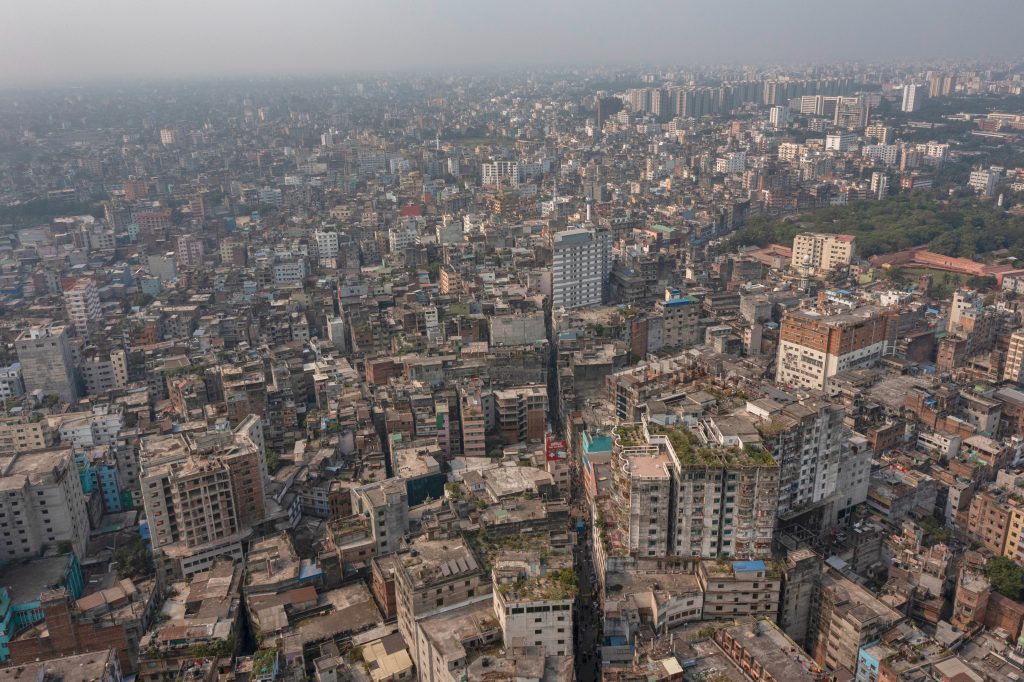
A general aerial view of an old city where roofs and walls collapsed after an earthquake in Dhaka, Bangladesh, Friday, Nov. 21, 2025. Photo: AP/PTI.
Back in 2008, in spite of the military having tortured and exiled her son, Khaleda Zia had participated in an election she knew she was going to lose because the playing field was tilted against her. Perhaps she believed that even a flawed election and a poorly performing but elected government would be better than undemocratic rule.
A dozen years earlier, she had codified a system of a non-partisan, election-time caretaker government into the constitution, a provision that was rescinded in 2011 to pave the way for years of misrule that ended last monsoon.
In 1991, Zia had worked with political parties to restore the parliamentary form of government, even though she herself was the presumptive frontrunner in a potential presidential election and thus could have ruled as an imperial president.
Of course, history is seldom linear. Bangladeshi democracy faltered in the early 2010s. By the end of that grim decade, Khaleda Zia had become the symbol of resistance. She had risked her own life but by refusing to go into exile and it was not the first time that she had assumed that role.
Compared with the violence and plunder that was unleashed repeatedly by the fallen regime, the military government that ruled Bangladesh in the 1980s now appears benign. Nonetheless, Khaleda Zia’s steadfast refusal to participate in any election under the junta denied it political legitimacy, and helped her win the 1991 election.
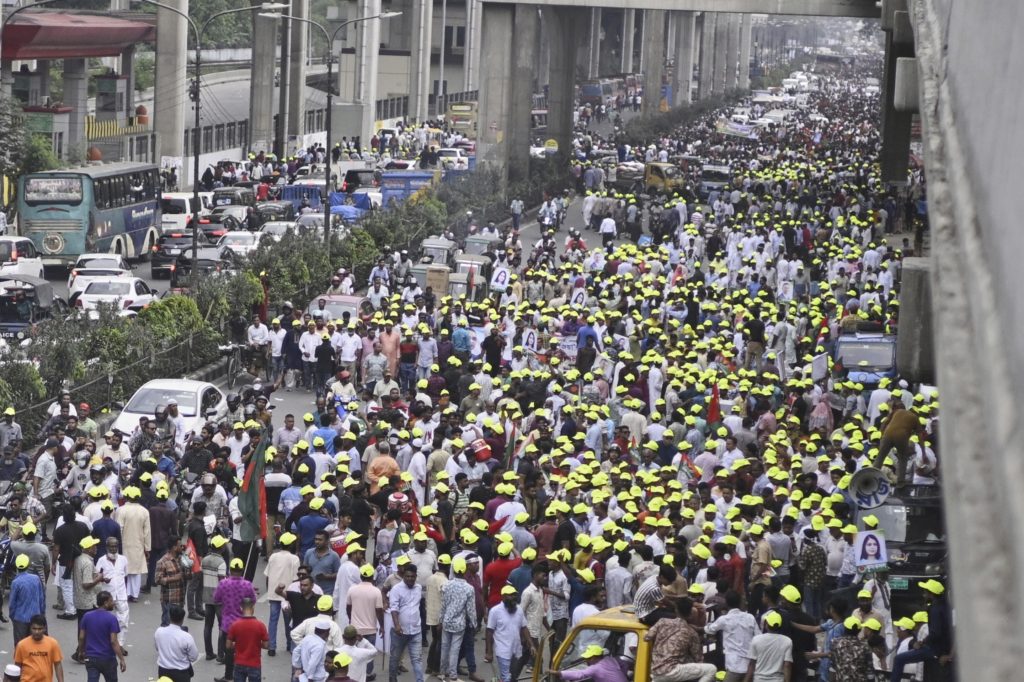
Supporters of Bangladesh's ailing former Prime Minister Khaleda Zia march on a road as they welcome her arrival from London, in Dhaka, Bangladesh, Tuesday, May 6, 2025. Photo: AP/PTI.
After the fall of the Hasina regime on August 5, 2024, in a meeting of pro-democracy politicians, civil society representatives, and youth revolutionaries who led the uprising, it was unanimously decided that Khaleda Zia would be released unconditionally and all cases against her would be withdrawn. Since her release, Zia has urged for peace and stability, and shunned vengeance and retribution.
Bangladesh has been suffering from post-euphoric blues over the past 15 months. The election pits Zia's moderate democratic party against various Islamist outfits, and a motley crew of new and old parties. The economy remains moribund. Law and order is yet to be restored fully.
Born two years before the freedom that came at midnight, Khaleda Zia's life paralleled that of her country. Her dreams, like those of her countrypeople, would come crashing down in the subsequent years. She was kept in detention with her sons while her husband was a commander of the Mukti Bahini in 1971. Her initial refusal to enter politics was transformed by the assassination of her husband and a military coup. She was repeatedly tested through elections and stints in and out of government.
The rise, fall, and apotheosis of Khaleda Zia is an epic tale. Perhaps she has lived long enough to die the hero that Bangladesh needs and deserves.
Jyoti Rahman is executive editor of Counterpoint.
This article went live on December second, two thousand twenty five, at thirty-six minutes past two in the afternoon.The Wire is now on WhatsApp. Follow our channel for sharp analysis and opinions on the latest developments.


