

Special | In Myanmar, the Struggle Is to Emerge From Underneath Rubble and Silence


Mandalay/Yangon (Myanmar): At midday on March 28, 2025, a powerful 7.7-magnitude earthquake struck central Myanmar, with its epicentre near Mandalay – Myanmar’s second-largest city, a renowned centre of Buddhist learning, and a historically significant hub for Indian-origin communities.
It was one of the most devastating earthquakes to strike the country in a century. The destruction was swift, merciless, and deeply tragic. The military regime – already notorious for its secrecy and lack of transparency – began downplaying the true scale of the disaster. In a calculated move to control the narrative, the junta swiftly suspended journalist visas, effectively shutting out the international media and limiting independent reporting on the ground, relying on its most familiar tool: intimidation.
How we reached ground zero
When the earthquake struck Myanmar, we happened to be in neighbouring Thailand – with valid Myanmar visas already in hand. Within hours, trusted sources inside the country alerted us that the military junta – long known for its opacity – was preparing to suspend all tourist visas.
But this was no ordinary reporting trip.
Mandalay Airport was rendered inoperable, grounding all commercial flights – flying into the city was no longer an option. Instead, we entered Myanmar through Yangon. From there, aided by a trusted contact and local rescue workers, we embarked on a long, discreet overland journey to quake-hit Mandalay. For security reasons, we cannot disclose the exact route we took. But we made it – within days of the disaster, just as global attention was beginning to fade.
As our sources had warned, the junta officially suspended all tourist visas on April 3. One of our sources – a devoted Buddhist with deep ties to the monastic community in Mandalay – managed to arrange our stay at a Buddhist monastery located in the heart of the city.
It was truly heartening. Despite being severely battered by the earthquake, both the monastery and its monks welcomed us with open arms.
And what we saw was beyond words.
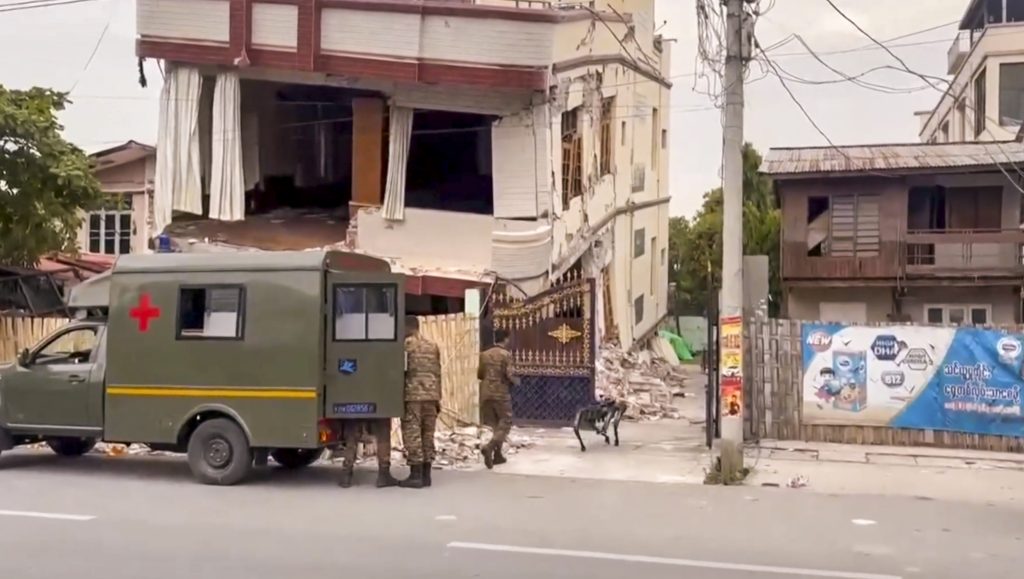
Indian Army personnel deploy robotic mules and nano drones for rescue operation in earthquake-hit Myanmar, Friday, April 11, 2025. Photo: PTI
Mandalay after the quake
When we reached Mandalay it felt like stepping into the aftermath of an apocalypse. A once-flourishing cultural and commercial centre that had prompted both India and China to establish consulates now lay in ruins.
According to satellite imagery analysis conducted by UNOSAT, approximately 4,764 structures have been confirmed as destroyed or damaged across an area of 2,100 square kilometres encompassing Mandalay and Sagaing. Of these, 1,076 structures fall within the Mandalay City boundary. In addition, the analysis identified 4,369 potentially damaged structures, with 519 located inside Mandalay City limits. The findings underscore the widespread structural impact of the 7.7-magnitude earthquake, particularly in urban centres already struggling with collapsed infrastructure and limited relief access.
The Myanmar military junta officially reported 3,649 deaths. However, local sources and international rescue workers in Mandalay strongly dispute that figure. Multiple independent assessments suggest the actual death toll could exceed 10,000, with some estimates reaching as high as 15,000.
“Entire families have been buried together,” one local resident told us. “In my neighborhood alone, three families were wiped out. There’s no one left to report them missing.” Similar accounts from across affected areas indicate that thousands of deaths may have gone unrecorded simply because no survivors remain to report them. Many believe the junta’s official figures are intended more for diplomatic optics to secure aid than to provide transparency.
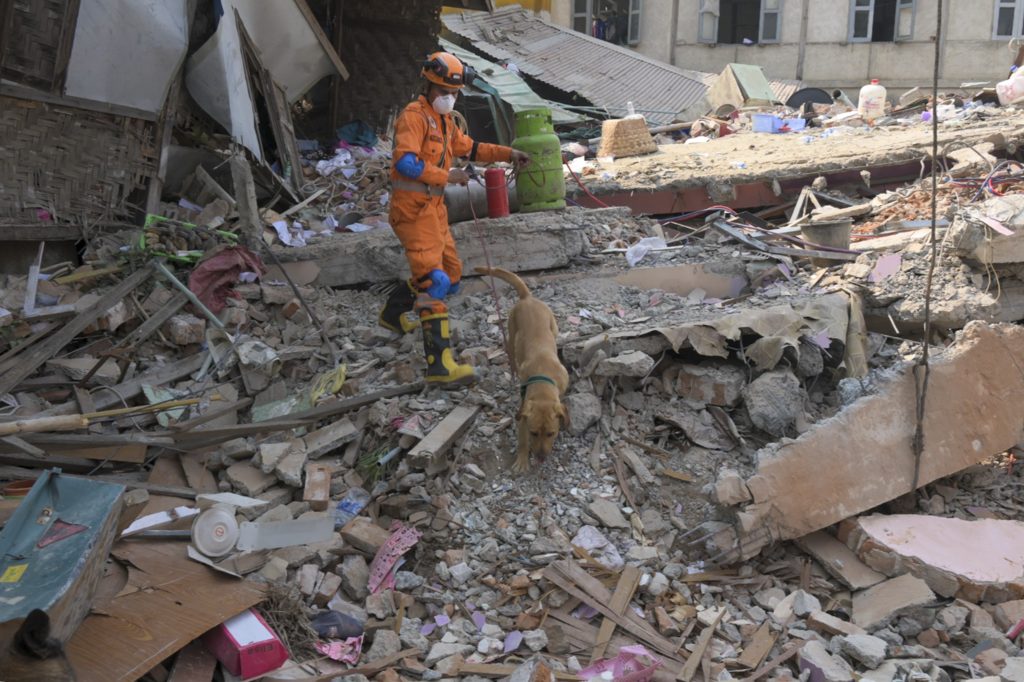
In this image released by @NDRFHQ via X on April 2, 2025, NDRF personnel are seen during a search and rescue operation at an earthquake-affected site, in Mandalay, Myanmar. Photo: X/@NDRFHQ via PTI photo.
With little to no access to heavy machinery, rescue efforts remained heartbreakingly rudimentary. Locals and volunteers dug through the debris with their bare hands and makeshift tools, desperate to find survivors. As of now, only a few people have been pulled out alive. The rest never made it.
When we arrived, the city resembled a vast open-air refugee camp. Nearly everyone was outside. Many of Mandalay’s 1.5 million residents were sleeping on the streets, in parks, and on temple grounds – either because their homes had collapsed or out of fear that aftershocks would bring down the already-weakened structures. Wild rumours swept through the city – whispers of an even more powerful quake on the way. Even those whose homes remained intact refused to go inside.
In the stifling April heat – when temperatures soared to 39-41°C – survivors and first responders laboured under unbearable conditions. Occasional nighttime rains brought no relief – only added misery. Yet no one dared return indoors. “We would rather be drenched and bitten by mosquitoes than buried under bricks,” said Muthu, an elderly Tamil man, huddled beneath a tarpaulin sheet.
The relatively well-off slept outdoors under mosquito nets, while the poor lay on bare ground with only a thin cloth – or nothing at all. But fear erased social divides. Ironically, everyone – from the affluent to the destitute – was united by the catastrophe.
'Anytime, an Epidemic'
A local relief worker told us that delivering aid to everyone in need was “a near-impossible task.” The scale of the devastation was overwhelming. “There aren’t enough tents, not enough food or clean water. Women and children are especially vulnerable,” he said, visibly exhausted. Many families lacked basic hygiene kits, sanitary products, and baby formula.
With sanitation systems completely broken down, open defecation was becoming increasingly common, and access to clean water was dangerously limited. “If this continues,” warned another aid worker, “we could be facing a deadly outbreak of cholera or other waterborne diseases.”
He added grimly, “An epidemic could strike Mandalay any day now.”
The human cost of an unprepared system
“There’s too much rubble, and no proper rescue teams have come for us,” sobbed a woman digging through the debris in search of her missing relatives.
Speaking to us, a resident recounted the harrowing experience of a friend who became trapped beneath a collapsed structure. “His upper body was free, but one of his legs was pinned under a slab of concrete,” he said. “He was conscious and calling for help. He kept saying he could make it if someone could just get his leg out.”
According to the witness, local rescue workers eventually arrived but were ill-equipped and lacked the medical expertise needed for a high-risk extraction. “A trained team could have performed a field amputation. It would’ve been brutal – but it might have saved his life,” he added. “Instead, he was left there. He died slowly, waiting.”
Such accounts are not isolated. Multiple survivors and volunteers in Mandalay described similar situations where victims succumbed to injuries that might have been survivable – had emergency responders received proper training in trauma care or structural extrication techniques.
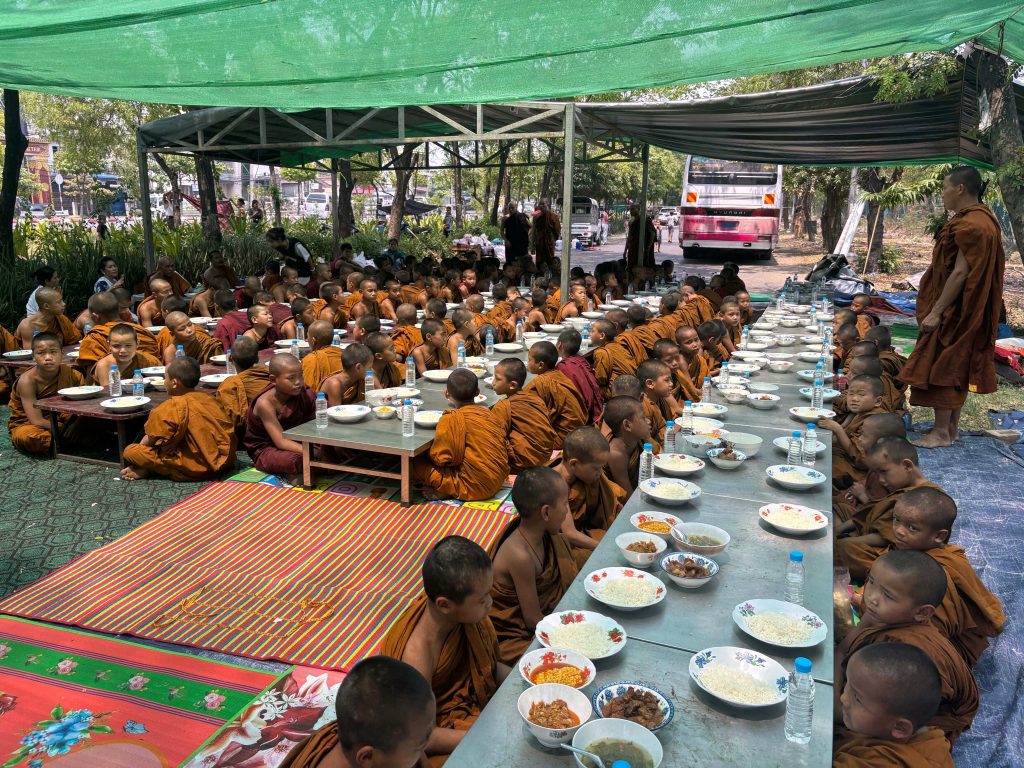
Buddhist novice monks sit to have their alms under temporary shelter near a road in the aftermath of Friday's earthquake in Mandalay, Myanmar, Wednesday, April 2, 2025. Photo: AP/PTI.
'Don't expect world-class rescue from a broken system'
A senior professor at a leading university in Yangon, who spoke to us on condition of anonymity for obvious reasons, painted a bleak picture of Myanmar’s capacity to handle emergencies.
“Myanmar ranks among the lowest in Southeast Asia in terms of education, healthcare, and public infrastructure,” he said. “Our universities lack even basic facilities. Hospitals are underfunded and ill-equipped. Many urban schools don’t have reliable electricity or clean water.” He argued that decades of military rule – from General Ne Win’s 1962 coup to the current junta – have systematically eroded public institutions. “The junta’s only real priority is maintaining power. The lion’s share of national spending goes to the military. There’s virtually no budget allocated for developing local infrastructure or improving emergency services.”
He stressed that the absence of trained local rescue workers during the earthquake was no accident – it was the direct outcome of a broken system. “If someone holds the title of ‘rescue worker’ here, don’t expect international standards,” he said bluntly.
Indeed, international development indicators support his claims. According to the UNDP and World Bank, Myanmar ranks lowest in ASEAN in terms of healthcare spending as a percentage of GDP. Its public education system has been chronically underfunded for decades.
In education, Myanmar is falling far behind. The Global Knowledge Index 2024 ranks the country 123rd out of 141, with a score of just 34.8 – far below the global average. Medical education is a major bottleneck: only six medical schools serve a population of over 50 million, with an annual intake of just 1,500 students. This contributes to a critically low doctor-to-population ratio of 0.568 per 1,000 – well below the regional average.
Healthcare follows a similar trajectory. Public health spending has hovered around just 3.4% of general government expenditure. Rural populations – who make up 70% of the country – face severe barriers to access. Even basic disease control programs, such as malaria prevention, are lagging. Out-of-pocket medical expenses remain high due to the weak public health system.
Infrastructure is equally fragile. According to the Asian Development Bank, 20 million people lack road access, and 60% of the country’s highways are in poor condition.
'A truthquake'
The military junta effectively banned foreign journalists from entering the country and intimidated local reporters into silence. To justify the ban on international media, the junta issued what can only be described as a cruel excuse.
In an official statement, the military claimed that, since “there is no proper accommodation or food facilities in the affected areas,” journalists would not be permitted entry – as if foreign correspondents were arriving for a luxury retreat amidst the ruins.
But the real reason behind the ban is not logistical – it is political. We learned that the junta’s true fear is scrutiny, not shortage. A Yangon-based journalist, speaking on condition of anonymity due to obvious safety concerns, told us: “The junta is afraid that if foreign journalists are allowed in, they will head straight to the conflict zones and expose the brutal human rights violations being committed by the military.”
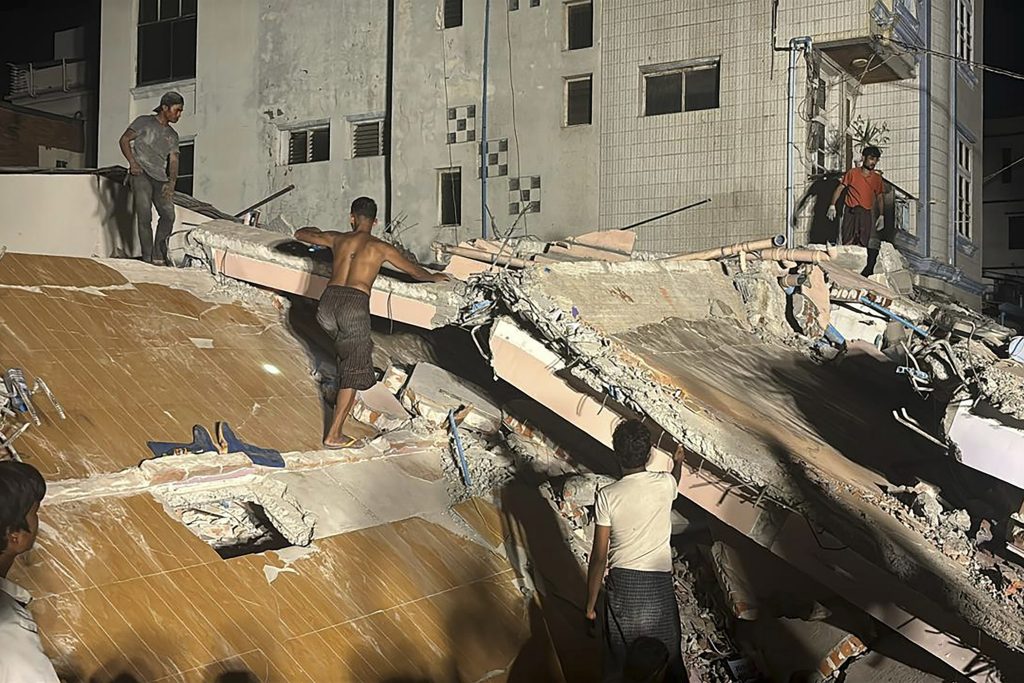
Rescuers work to find survivors in a house that collapsed after an earthquake in Mandalay, Myanmar, Saturday, March 29, 2025. Photo: AP/PTI.
Military MIA
Despite commanding a vast share of the national budget, Myanmar’s powerful military was notably absent or minimally involved in post-earthquake rescue operations, we found. While the armed forces did deploy personnel in some areas, their level of participation has been described as limited – especially when compared to the robust disaster responses seen from militaries in other countries during similar crises.
“In most countries, the military is the backbone of large-scale disaster response,” one international relief coordinator told us. “In Myanmar, their involvement was patchy at best. The junta prioritises control, not care.”
Powerless in an energy-rich nation
Myanmar is one of Southeast Asia’s key natural gas exporters, with major offshore fields like Yadana and Shwe supplying energy through transnational pipelines to Thailand and China. These pipelines span thousands of kilometers and generate billions of dollars annually in revenue. Yet, despite this strategic energy wealth, Myanmar’s own people remain in the dark – literally.
According to the World Bank, nearly half of the country’s population still lacks access to the national power grid, and even those connected face frequent outages. While energy flows reliably across borders to foreign markets, entire communities within Myanmar endure chronic blackouts.
“We produce energy for others, but we don’t have it for ourselves,” said a local journalist based in Mandalay. “The only places with 24/7 electricity are military bases and the junta’s private residences.”
According to data from Enerdata 2025 and the World Bank, Myanmar’s per capita electricity consumption stands at around 300 kWh, which is 80% below the ASEAN average. Even in Yangon, the capital, residents receive electricity in two limited phases totalling just 8 hours a day. In Mandalay, where the recent earthquake has devastated infrastructure, power was cut entirely – and even before the disaster, the city had only limited daily electricity.
The disparity has fuelled public anger. Despite earning over $1.4 billion annually from natural gas exports (as reported in the Extractive Industries Transparency Initiative or EITI report), much of the revenue remains unaccounted for, with allegations that a significant portion is funnelled into military spending and the personal coffers of junta leaders.
Forced military conscription threat
As Mandalay reels from the devastation of the recent earthquake, a new and deeply disturbing fear has gripped its residents – forced military conscription.
Parents who once hid their children indoors to avoid recruitment squads now find themselves sleeping outside in makeshift shelters, vulnerable and exposed. “I don’t even fear the aftershocks anymore,” said one local youth. “I fear the sound of boots approaching in the dark.”
The military junta in Myanmar remains deeply embroiled in internal conflicts with more than 20 armed rebel groups across the country. Among the most prominent are the Kachin Independence Army (KIA) in the north, the Karen National Union (KNU) in the southeast, and the Arakan Army (AA) in the west. These insurgent movements, along with many others, are fighting for autonomy, ethnic rights, and federal reform in a nation long dominated by Bamar-Buddhist nationalism.
Following the military coup in February 2021, the resistance intensified as urban youth and civilians formed the People’s Defense Forces (PDFs), waging a fierce and determined guerrilla war against the junta. This multi-front conflict, experts say, has severely strained the military’s manpower, prompting the regime to reactivate a controversial 2010 conscription law in early 2024. Under this draconian law, all men aged 18 to 35 and women aged 18 to 27 can be forcibly recruited into military service.
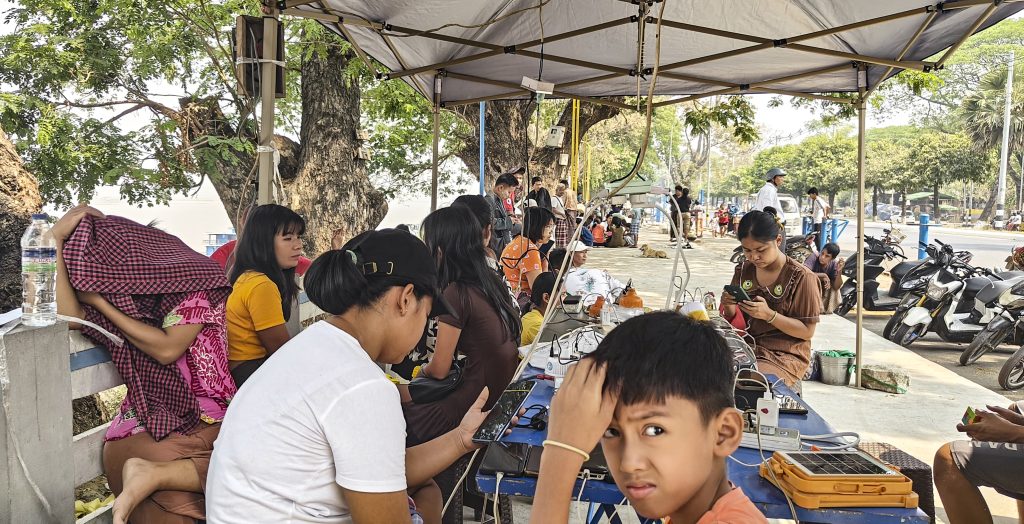
Mandalay: People seeking shelter wait under the shadow of trees after the recent earthquake, in Mandalay, Myanmar. Photo: PTI.
An anti-junta activist who spoke with us described the move as “a desperate attempt to replenish a crumbling force that has lost both legitimacy and morale.” A youth who is still managing to evade forced conscription told us, “Most young people see conscription as a betrayal – not just because of the battlefield dangers, but because joining the junta means turning your back on the people’s struggle for freedom.” According to locals, widespread public sympathy lies with the resistance, while the junta retains support mainly from those who benefit directly from its power.
A Mandalay-based journalist told us, “The military has now resumed door-to-door raids to forcibly enlist young men. While women were previously included, they’ve been temporarily exempted after public outcry. But no one is safe – not even quake victims.”
The UN Special Rapporteur on Myanmar warned in March 2024 that forced conscription was being carried out in a “systematic and violent manner,” especially in regions under firm junta control. According to Human Rights Watch, hundreds of young men have been taken from markets, homes, and even refugee camps, without legal process.
“They train the recruits for just 3 months and send them straight to the frontlines,” the Mandalay youth added.
The fear is palpable. The enforcement of the conscription law in 2024 triggered a mass exodus, with credible sources estimating that around 400,000 young people fled Myanmar – many even swimming across rivers into Thailand. Today, locals fear that the earthquake may serve as a smokescreen for the military to escalate forced enlistment, exploiting the chaos and displacement to seize more bodies for war.
“To survive the quake only to be forced into uniform – it’s a second disaster,” said a parent in Mandalay. “We’re not just sleeping under the stars. We’re sleeping with fear.”
Buddhism, nationalism, and tragedy
Another hard-hit casualty of the quake is Myanmar’s Buddhist monasteries. Buddhism is the official religion of the country, with approximately 88% of its 54 million citizens identifying as Theravāda Buddhists, according to the Pew Research Center. As in other majority-Buddhist nations like Sri Lanka, Buddhism in Myanmar has not only shaped the spiritual fabric of society but has also played a defining role in the country's political and cultural identity – often intertwining with nationalist rhetoric.
In recent years, this fusion has taken a troubling turn. The rise of the ultranationalist Buddhist movement Ma Ba Tha (the Association for the Protection of Race and Religion), established in 2013, has fuelled anti-Muslim sentiment across Myanmar. Backed by influential monks such as Ashin Wirathu – often referred to as the "Burmese Bin Laden" – the movement has been linked to inciting violence, including deadly lynch mobs targeting Muslim communities. These attacks, widely condemned by the international community, were often carried out with the moral sanction of hardline monks.
Before the devastating earthquake struck central Myanmar, Mandalay was home to an estimated 60,000 Buddhist monks and thousands of monasteries, many of them centuries old. Now, much of that religious infrastructure lies in ruins. “We don’t know the exact number of monks who have died – many were buried under the rubble,” said U Zawta, a senior monk in Mandalay. He elaborated that, at the time of the quake, hundreds of monks had gathered at a religious hall to take advanced monastic examinations required to ascend to higher clerical ranks. “The hall collapsed completely. We fear many were killed, but rescue efforts are ongoing,” he added.
In Myanmar, monks' allegiances often reflect the political realities of their surroundings. Those in junta-controlled areas are more likely to support the military, while monks in rebel-held territories often align with the anti-junta resistance. Yet, there have been notable exceptions – monks who dared to speak truth to power. Figures such as Ashin Gambira (a leader of the 2007 Saffron Revolution), Ashin Issariya, and U Pannya Vamsa have all taken bold stands against military oppression, risking imprisonment, defrocking, and worse.
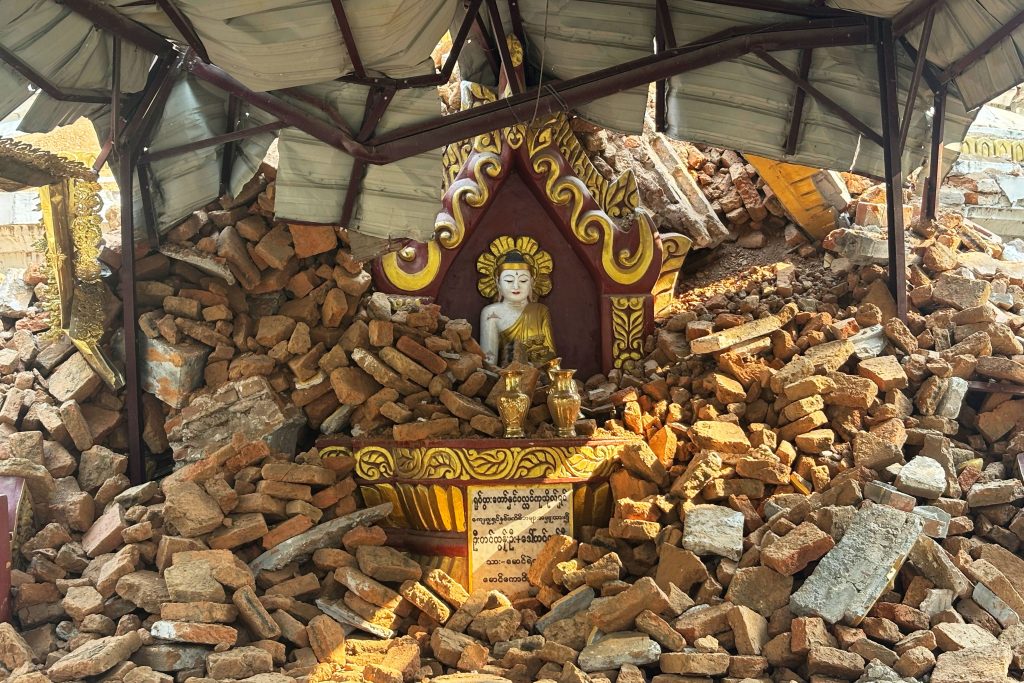
Damaged pagoda is seen in the aftermath of the earthquake in Amarapura township, Mandalay, Myanmar, Wednesday, April 2, 2025. Photo: PTI/AP.
Despite political divisions, monks remain deeply respected across Myanmar. They are not only religious leaders but also social anchors – offering shelter, education, and food, especially in times of crisis. Among the many monasteries reduced to rubble in Mandalay were the Old and New Masoeyein Monasteries, long regarded as Buddhist universities.
It was within the Masoeyein compound that Ma Ba Tha was originally formed – a movement that quickly aligned with the military junta and became a powerful vehicle for religious nationalism. The monastery itself was heavily damaged in the earthquake, with several monks confirmed dead and many others still missing.
In Mingun, the iconic Hsinbyume Pagoda – an architectural marvel and major pilgrimage site – was largely destroyed, with its main tower collapsing almost completely. The nearby Mingun Pahtodawgyi, the world's largest unfinished brick stupa, also suffered significant structural damage.
In Sagaing, a nunnery experienced a structural collapse, resulting in the death of its principal and injuring over 100 students and residents. Monastic institutions bore the brunt of the quake’s fury: Zinaydaya Monastery reportedly trapped over 600 people beneath its ruins; Laykyun Myay Ot Monastery, over 300. Myat Sing Kyaw and Tipitaka Maha Gandawin Nikaya monasteries also crumbled, burying unknown numbers beneath layers of debris.
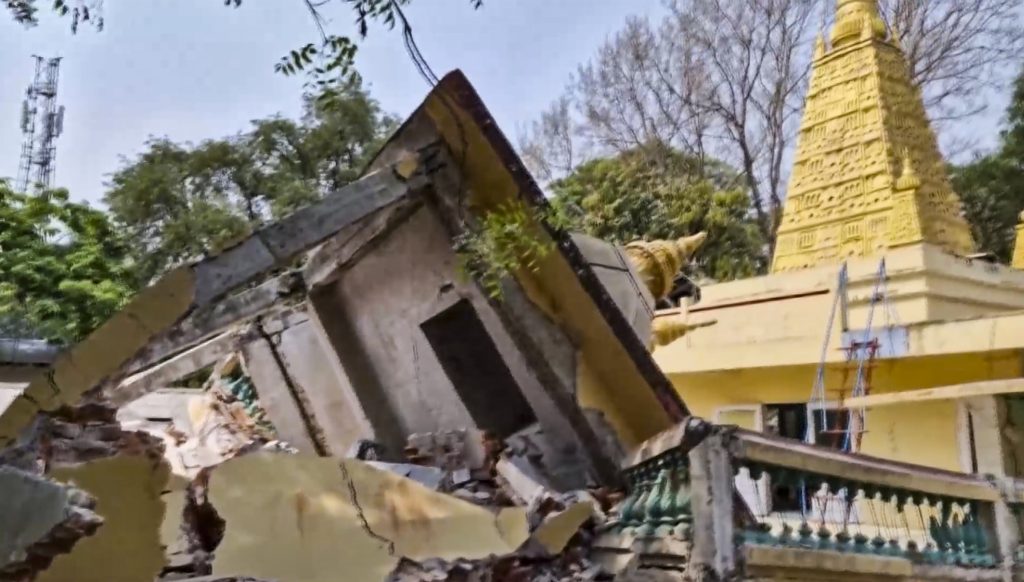
Ganga Ghat Hindu temple damaged after the recent earthquake, in Mandalay, Myanmar, Wednesday, April 2, 2025. Photo: PTI
Muslim places of worship were also severely affected. In Sagaing, the Min Lan Mosque collapsed entirely, with fears that up to 100 worshippers may be trapped beneath the rubble. The Myodaw Mosque saw even graver tragedy, with over 200 believed to have perished in the collapse. Several other mosques, including Myoma Mosque and Masjid Jamae, also sustained serious damage.
Yet even amid the devastation, some monks turned inward, drawing strength from timeless Buddhist teachings. “In Buddhism, we are taught that all things are impermanent,” said U Zawtika, standing beside the ruins of his temple. “Temples rise and fall. Even life itself is not meant to be clung to.” His words echoed the Dhammapada: “All conditioned things are impermanent – when one sees this with wisdom, one turns away from suffering.” (Dhammapada, verse 277)
Another monk offered a similar reflection. “The shaking of the earth is not a punishment,” he said quietly. “It is a reminder – that even the most sacred ground is subject to change.” He was invoking the Buddha’s final instruction before his death: “All compounded phenomena are subject to decay. Strive on with diligence.” (Mahāparinibbāna Sutta, DN 16)
In the face of overwhelming loss, the monks became gentle reminders themselves – of a philosophy that does not seek to resist suffering, but to transcend it by accepting impermanence as the natural order of all things.
Myanmar’s military drops bombs instead of aid
Since the February 2021 military coup – in which the junta seized power from Myanmar’s elected government – the country has been plunged into a nationwide civil conflict. Fierce resistance has emerged across multiple regions, most notably in Sagaing, Chin, Kayah, and the Karen States. The junta’s counterinsurgency campaign has been marked by aerial bombings, extrajudicial killings, the burning of entire villages, and deliberate attacks on civilian infrastructure, including schools and hospitals.
The military’s brutality has not paused – even in the face of a humanitarian disaster. A Myanmar journalist based in Mandalay told us that in Sagaing – one of the regions hardest hit by the earthquake – the junta bombed an area where civilians were actively rescuing people trapped beneath collapsed buildings. “People were digging through the rubble to save others when the bombs fell,” the journalist said. “It was chaos. The junta didn’t care if they were hitting survivors or volunteers.”
Multiple reports by the United Nations and international human rights organisations have accused the Tatmadaw – the official name of Myanmar’s military – of committing war crimes and crimes against humanity. The regime has aggressively sought to suppress this reality by tightly controlling the flow of information, arresting more than 150 journalists since the coup, and forcing nearly all independent media outlets to shut down, flee the country, or operate in hiding.
Myanmar has a long and troubling history of blocking journalists and humanitarian workers – even in the wake of catastrophic natural disasters. In 2008, when Cyclone Nargis devastated the Irrawaddy Delta and killed an estimated 138,000 people, the military regime shocked the world by denying international aid agencies access during the critical early weeks of the crisis. Thousands of lives were lost due to delayed assistance.
The pattern repeated in 2023, after Cyclone Mocha – a powerful storm that battered Rakhine State and other western regions. Despite widespread destruction and displacement, the junta once again barred international humanitarian workers from reaching affected areas. Even the United Nations issued a rare public condemnation, urging the regime to permit lifesaving relief operations.
“This time, however, is a little different,” a local civil society leader told us In the aftermath of the March 2025 earthquake, the junta – for the first time in recent memory – issued an open call for international assistance. “They had no choice,” he explained. “The destruction was too massive, and they simply lacked the capacity to respond on their own.”
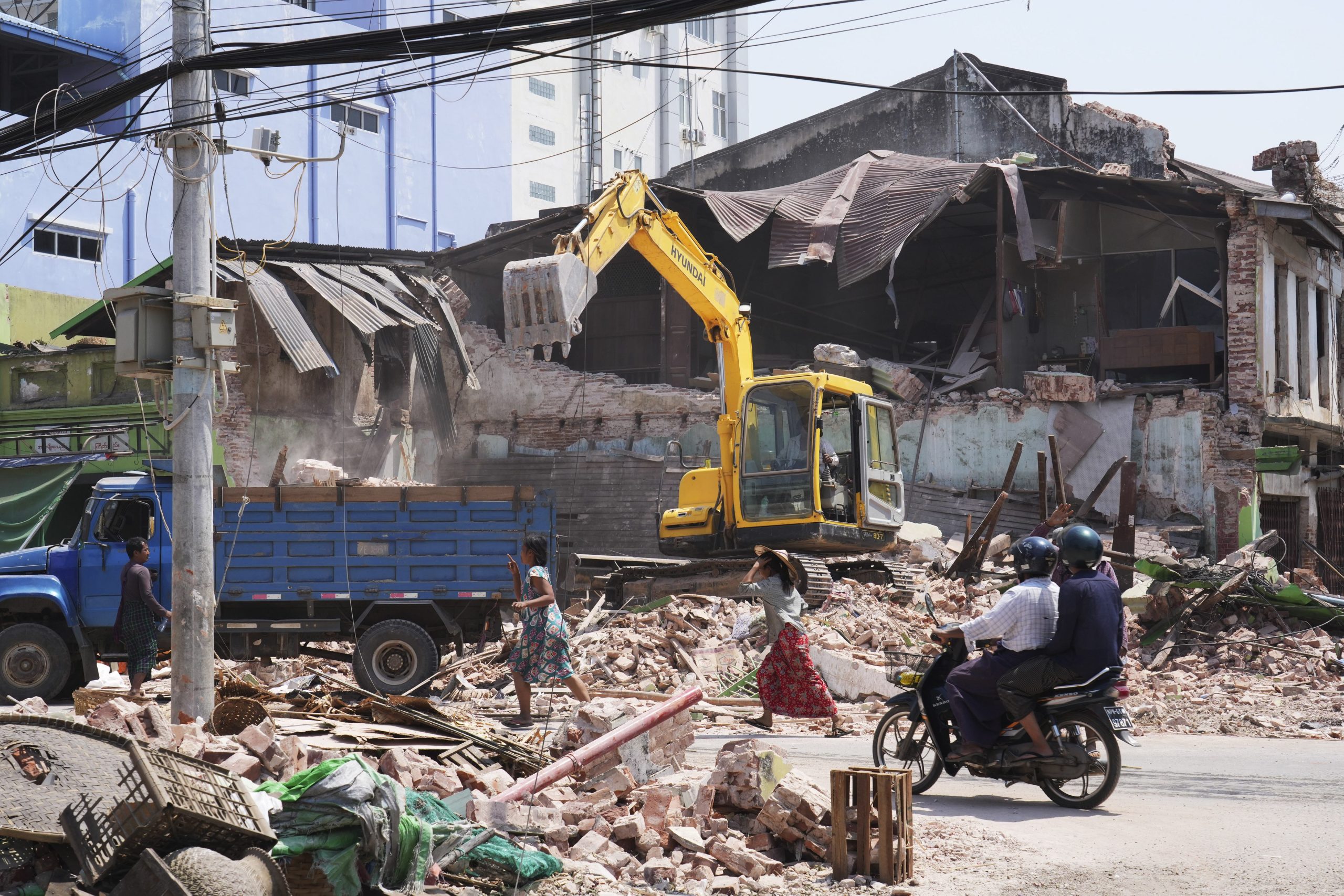
Local residents ride motorbikes while rescuers clean debris from damaged buildings in the aftermath of Friday's earthquake in Naypyitaw, Myanmar, Wednesday, April 2, 2025. Photo: AP/PTI.
As a result, emergency responders from the United Nations and several international NGOs were granted limited access – but only to areas firmly under military control. Rebel-held regions such as parts of Sagaing, Chin, and Kayah remained off-limits.
In Mandalay itself, some neighbourhoods had slipped from the junta’s grasp and were under the control of anti-junta resistance forces. Just across the Irrawaddy River, Sagaing had become one of the most intense battlegrounds in the ongoing civil conflict. While we were still in Mandalay, we heard the unmistakable sound of an airstrike – this time targeting civilian areas in earthquake-ravaged Sagaing. According to local sources, the junta had launched the attack as part of its continued military campaign against the People’s Defence Forces (PDF), a decentralszed resistance movement formed in response to the 2021 coup.
To make matters worse, the junta blocked all humanitarian aid to rebel-held areas, halting relief efforts completely. Entire villages – already reduced to rubble by the earthquake – were denied even basic emergency support such as food, water, and medical supplies.
Most of the People’s Defence Forces – composed largely of young, inexperienced fighters – operate under the command of the National Unity Government (NUG), a parallel government-in-exile formed by ousted lawmakers, ethnic minority leaders, and civil society representatives. While the junta brands the NUG and the PDFs as “terrorists,” many Burmese view them as the legitimate voice of resistance and hope.
Tamil community endures
India’s connection to Myanmar runs deep, shaped by centuries of cultural exchange and migration. By the time of World War II, nearly one million Indians were living in Burma (as Myanmar was then known), according to British colonial records. Many among them – particularly Tamil-speaking Chettiars from South India – played a dominant role in the country’s economy. The Chettiar community served as the primary moneylenders and financiers in rural Burma, effectively managing much of the agricultural credit and landholding systems during British rule.
In fact, so central was their role that British civil servant J.S. Furnivall once noted: “The Chettiars held the key to Burma’s agrarian economy – villagers borrowed from them, land passed through them, and British banks operated through them.” By 1930, according to British records, Chettiars controlled nearly 60% of rural credit in Burma.
However, their prominence also fuelled resentment. Following Burma’s independence from Britain in 1948, nationalist sentiments intensified. A major flashpoint came with the first military coup in 1962, led by General Ne Win, who justified the seizure of power by claiming that “foreigners,” especially Indians, had dominated and distorted the Burmese economy. The new regime swiftly nationalised all major industries and banks, and thousands of Indian families were stripped of their properties and businesses under the Enterprise Nationalisation Law of 1964. What followed was a mass exodus – over 300,000 Indians were forced to return to India, many with nothing more than a single suitcase.
Today, Tamils form the largest subgroup within Myanmar’s Indian-origin population, which makes up roughly 4-5% of the national demographic. Tamil is the most widely spoken Indian language in the country. Many Tamil families are now in their fourth or fifth generation in Myanmar and have preserved key aspects of their heritage – from Hindu temples and Tamil schools to traditional festivals – while integrating into broader Burmese society.
Mandalay remains one of the central hubs of this community. Tamil traders and craftsmen have for decades run businesses ranging from textiles and spices to jewellry and tea shops. In the historic old town alone, around 500 Tamil families have built a vibrant, close-knit community. The area is also home to two prominent Tamil temples: the Siddhi Vinayaka Temple (popularly known as the Ganesh Temple) and the Sri Muneeswaran Temple. Remarkably, both emerged unscathed from the recent earthquake – a fact many locals regard as nothing short of divine intervention.
But the surrounding Tamil quarters were not so fortunate. Dozens of homes and shops were flattened. Once-busy tea stalls, saree shops, and temple courtyards now lie buried beneath rubble.
Tamil Christian communities in nearby areas have also suffered deeply. In Chin Nyaung Pin Thar, a village outside Mandalay, the Calvary Prayer Hill and surrounding Christian settlements sustained extensive damage during the quake, leaving many injured and displaced.
“As with their Burmese neighbours, Tamil families have been left homeless and are struggling to secure even the most basic necessities – clean water, food, and medicine,” said a retired schoolteacher and community elder. His own home in Mandalay’s 26th Street Tamil quarter was destroyed. “My daughter and grandchildren are sleeping under a tree in the temple compound. We haven’t received any formal aid. Everything we’re eating now comes from what the community cooks together in large pots,” he told us.
A Yangon-based Tamil aid coordinator confirmed the lack of organized relief in several neighborhoods across Mandalay. “Many areas have yet to be reached by aid agencies,” she said. “The Tamil enclaves in Mandalay are among them. Most residents are relying entirely on grassroots, community-driven solidarity.”
Still, amid the devastation, resilience prevails. Community members – regardless of ethnicity – have come together to share what little they have. Volunteers like 19-year-old Arulmurugan from the Tamil Youth Forum have been delivering food packets and boiled water from makeshift kitchens. “We don’t ask if someone is Tamil or Bamar,” he said. “We just ask, ‘Have you eaten?’”
Aid stalled, fear spreads
For a brief period following the earthquake, Myanmar’s military junta eased roadblocks and allowed limited humanitarian access. But during our time in Mandalay, we witnessed a reversal: roadblocks and military checkpoints were swiftly re-established, restricting the movement of both local and international relief workers.
While foreign rescue teams from neighbouring countries were technically permitted entry, their operations remained tightly controlled. Teams from India, China, Thailand, Singapore, Laos, Malaysia, and Russia were escorted by the military and confined to designated zones within Mandalay.
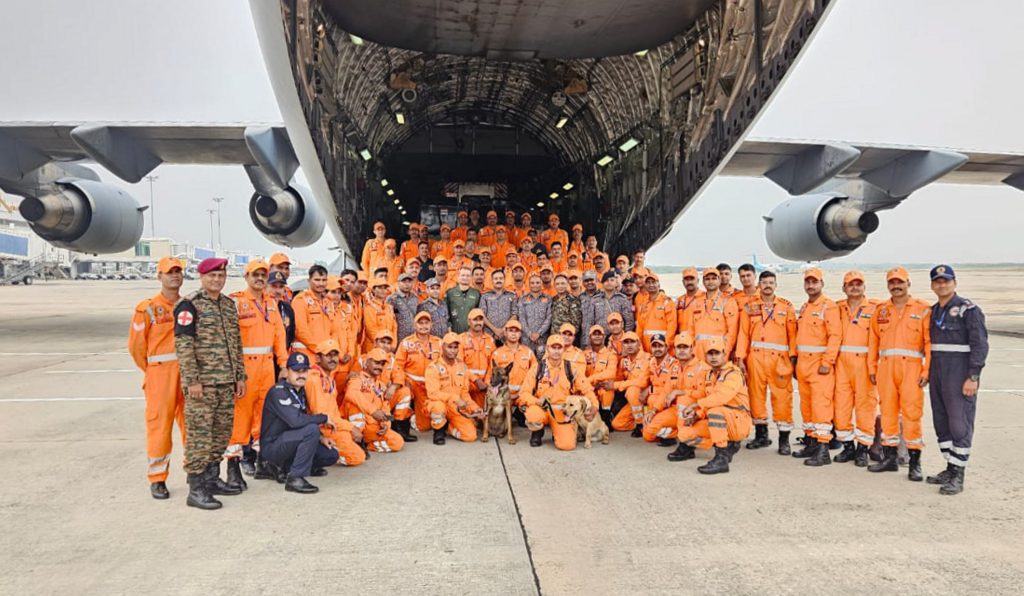
On April 6, 2025, the NDRF team is seen posing for a group photograph before departing for India after assisting in rescue operations in the earthquake-hit Myanmar. Photo: X/@IndiainMyanmar.
Among the international presence, Russian rescue workers stood out. According to a local anti-junta activist who spoke to us, “Russia is the junta’s main facilitator – offering moral, financial, and even military support.” Two Russian aircraft landed in Mandalay, carrying more than 300 rescue workers. Yet despite their numbers, one Russian relief worker privately admitted they had rescued only a single person alive from the debris.
Clandestine aid
Though the military junta has banned relief work in rebel-held areas – and continues relentless shelling even as civilians remain trapped under debris – we learned that some courageous local organisations are still carrying out humanitarian operations in these zones, albeit clandestinely.
“We call them low-profile operations,” said one aid worker who managed to enter the rebel-controlled territories. Speaking under strict anonymity, he described the situation as “unexplainable, almost medieval.” Hospitals have been destroyed or abandoned, and even the most basic medical supplies – antibiotics, painkillers, bandages – are nearly impossible to find. “No outsiders are allowed in, and the military doesn’t want the world to know what’s happening here,” he added.
The current crisis bears an unsettling resemblance to a dark chapter in recent history – the final months of Sri Lanka’s civil war in 2009 – when tens of thousands of Tamil civilians were trapped between an unrelenting military offensive and the rigid extremism of the LTTE, with no access to humanitarian assistance or safe passage. “What we are witnessing now is disturbingly similar,” a Tamil aid worker told us. “As in Sri Lanka, it is the ordinary civilians – not the decision-makers – who are caught in the crossfire.”
Another relief worker echoed the tragedy: “Most of these people were already victims of war – displaced, impoverished, traumatised. Now the earthquake has shattered what little they had left.”
Doubt over aid
Given the deeply corrupt nature of Myanmar’s military junta, relief workers who spoke with us expressed serious skepticism about how much of the international aid will actually reach those most in need.
Members of several relief agencies now argue that humanitarian assistance should be channeled through a coordinated humanitarian network, including civil society organisations.
An aid worker recalled how, in the past, multiple governments had sent direct assistance to the military regime following natural disasters – only to later find that much of the aid never reached the public. “Some of it ended up in the homes of military leaders,” he said, “and the rest was being sold openly in local markets.” Having witnessed this firsthand, he questioned the logic of repeating the same mistake. “Now again, some countries are sending aid directly to the junta, bypassing proper humanitarian channels. How can they be sure it won’t be exploited just like before?”
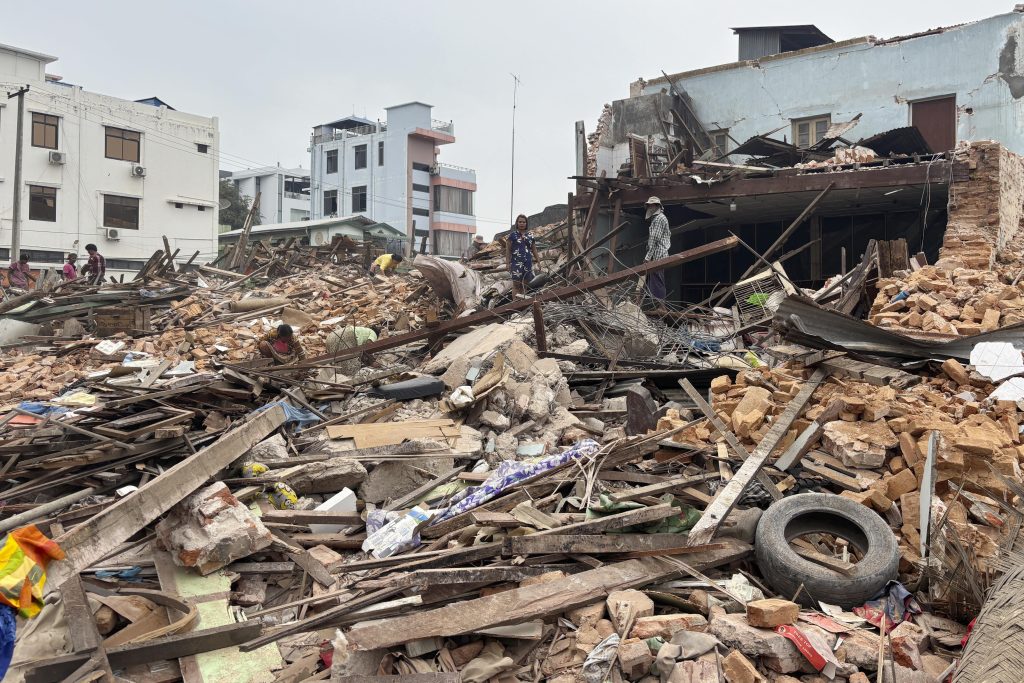
People clean debris from damaged buildings in the aftermath of an earthquake on March 28, in Naypyitaw, Myanmar, Monday, April 7, 2025. Photo: AP/PTI.
The United States was once a prominent funder through USAID, supporting everything from disaster preparedness to community health initiatives,” said a local rescue worker. “There were allegations of mismanagement and corruption, yes – but despite that, the aid did reach people and made a difference. That funding has now almost completely dried up under the new administration. This decline has crippled the operations of many NGOs that could have played a vital role in the earthquake response,” he added.
“Many countries have offered help,” another aid worker told us. “But the real question is – how much of it actually reaches the people?” With corruption in the junta being well-documented, and in the absence of transparency or independent oversight, there is growing fear that a significant portion of the aid is being diverted, politicised, or simply disappearing without a trace.
Aruliniyan Mahalingam is a senior journalist and writer based in Sri Lanka. He reports on conflict, culture, and regional geopolitics, with a focus on underreported stories from South and Southeast Asia.
This article went live on April nineteenth, two thousand twenty five, at zero minutes past twelve at noon.The Wire is now on WhatsApp. Follow our channel for sharp analysis and opinions on the latest developments.


