

No Answers, No Justice, Only the Unending Disappearance of Rashid Baloch


Manguchar, Balochistan: The journey to Manguchar in Balochistan’s Kalat district began at 7:45 in the morning. It was supposed to be a three-hour ride from Quetta on a small, worn-down minibus. After an hour on the road, as we reached Mastung Cross, the vehicle was stopped by the Frontier Corps (FC) stationed there. The conductor opened the door; he had kept it shut because November’s winter air cut through like a blade.
An FC soldier, face masked, climbed in. The conductor instinctively stood in the middle, a small, nervous pillar between authority and the busload of silence. One FC inspected the passengers; another rummaged through the goods piled in the back. Then came the question:
“Kahan jaa rhy ho?” Where was the vehicle heading? The conductor said, “Quetta,” when he should have said Manguchar. The FC in an angry tone said, “Abbay pagal, tum Quetta ki taraf se aa rhy ho… jaa kahan rahay ho?” (You madman, you’re coming from Quetta, where are you going now?)
The man could only spit out, “Sir, Urdu,” as if he had to inhale his whole fear before pushing those two words out of his mouth. Nobody else in the bus spoke. The conductor didn’t know Urdu; the driver was about to answer, when the FC grabbed the conductor’s hand. “Pagal, tum hamarey sath aaao.” (Madman, you come with me).
Everyone stared out the windows. Moments later, the conductor returned, shut the door and sat back in his seat.
The driver asked what had happened. In Brahui, he explained that the FC had made an eshara – a gesture showing that they knew he was coming from Quetta. And with another eshara, they asked again where the bus was heading. He said Manguchar. And the FC let him go.
“Allah gark karay,” (May God destroy him), he muttered, as the vehicle moved on.
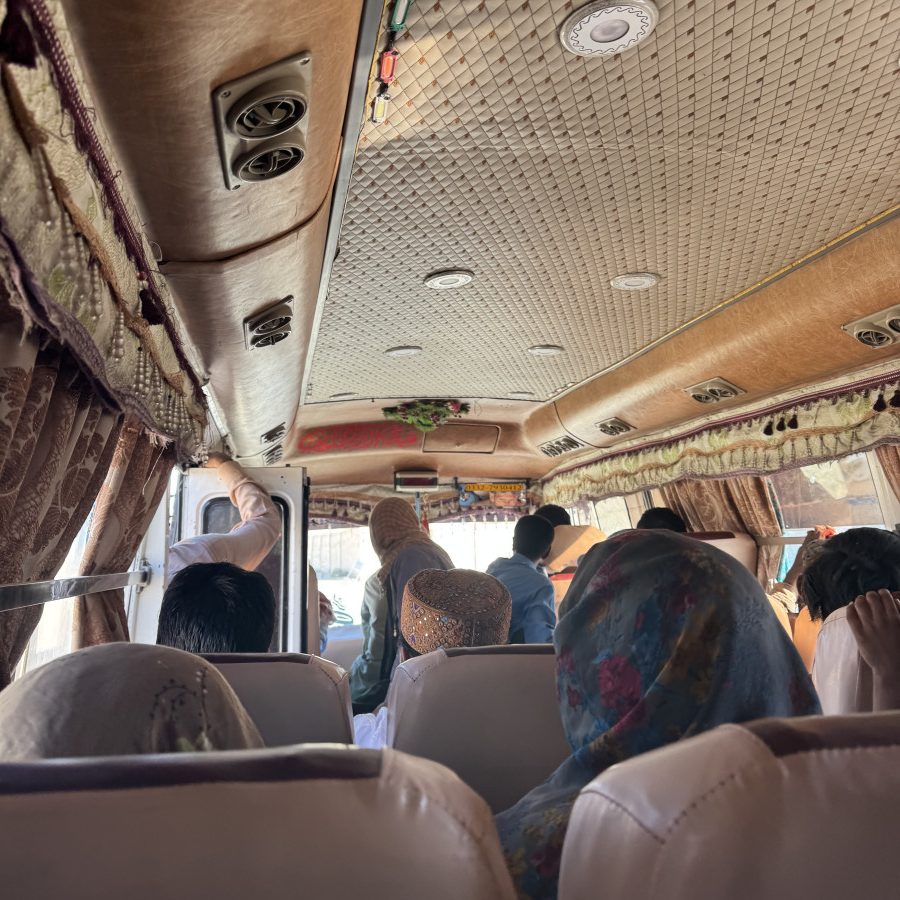
A minibus that was searched by Frontier Corps men. Photo: By arrangement.
After almost two hours, we reached the point at Manguchar Cross, where a newly built checkpost now stands. Locals said that it has been built due to a recent increase in attacks by Baloch pro-independence groups. An FC man entered the bus. He inspected everyone, his eyes sweeping past rows of faces, then stopping. A passenger sitting behind us – he alone – was asked for his CNIC, the computerised national identity card issued to Pakistani citizens.
Since it was cold, the man was wearing a jacket. He seemed anxious, maybe because he had been singled out in a crowded bus, maybe because he suddenly couldn’t remember whether his CNIC was in the pocket of his pashk shirt or in the jacket. I looked back. His hands were trembling as he searched, slipping in and out of pockets.
The FC snapped, “Tum kya kar rha hai? CNIC jaldi do!” (What are you doing? Just give the CNIC fast). The man finally managed to hand over the card. The FC checked it, and his voice rose, sharp enough to jolt every face into tension. “Hum tum ko pagal lagta hai? Yeh CNIC expire kiun hai?” (Do I look insane to you? Why the hell is this CNIC expired?)
Silence. As if the entire bus feared the same outcome that the man would be forcibly disappeared in front of our eyes.
My friend, who had accompanied me and spoke Brahui, held my hand so tightly that her fingers trembled against mine. I looked at her; I was anxious too. We both whispered, “Allah,” at the same time. I don’t know why, but it felt like everyone in the vehicle believed the man was suddenly in danger.
He grew even more tense. We didn’t look at him anymore, but then I saw a small, white, photocopy-like slip rise before our eyes. A token. It meant he had given his CNIC to NADRA for renewal. The FC inspected it, still scowling, then growled about why it had taken so long. The man stayed silent. The FC finally left.
(NADRA is the National Database and Registration Authority, the government body that issues CNICs and maintains Pakistan’s citizens’ database.)
When the door shut behind him, the bus exhaled. Sighs. Shukar. A kind of fragile, momentary solidarity between strangers who had been breathing the same fear. People who didn’t know each other looked at the man and smiled but he was still processing whatever had just happened.
I told my friend, “I should have taken a picture when the token was being handed over. That was so emotional to me.”
“Oh, you want to get into trouble for a picture?” she asked.
I laughed and told her, “That’s exactly why I couldn’t take the picture, though I wanted to.”
Around 10:30 am, we finally reached Manguchar’s main bazar. The first thing you notice is the huge FC vehicle, different from the ones on the road. It is stationed right in the heart of the bazar, a hulking metal presence with cameras fitted on all sides. You cannot see what’s inside, only the reflections of a city under watch. Around it, FC men stand posted like shadows.
People move, but strangely, as if the air itself reminds them they are being watched. Everyone behaves the way people do under surveillance. My friend warned me not to take out my mobile to photograph the vehicle or this scenario; here, situations can turn difficult without warning. I agreed. FC men were stopping anyone, following anyone.
The local transportation in Manguchar is a chinchi-type vehicle, open entirely from the top. There is mud everywhere, but you sit anyway. These vehicles carry everything – rations, cattle, people. We took one and headed to the house where I had to cover the story of enforcedly disappeared Rashid Baloch.
A mother waiting in silence
Inside the house, a woman sits in a room that is part kitchen, part shelter. She is crouched near a stove, pieces of wood arranged carefully inside it. The fire crackles; smoke curls into the air, stinging her eyes, but it doesn’t matter. The cold in Manguchar is just unbearable.
She greets us. In front of her, she is making sulemani chaa – black tea – on the same fire she uses to warm the room. She hands us water, then the chai. After the greetings, after the warmth of the cup and the smoke that makes your eyes watery, you tell her the purpose of your visit.
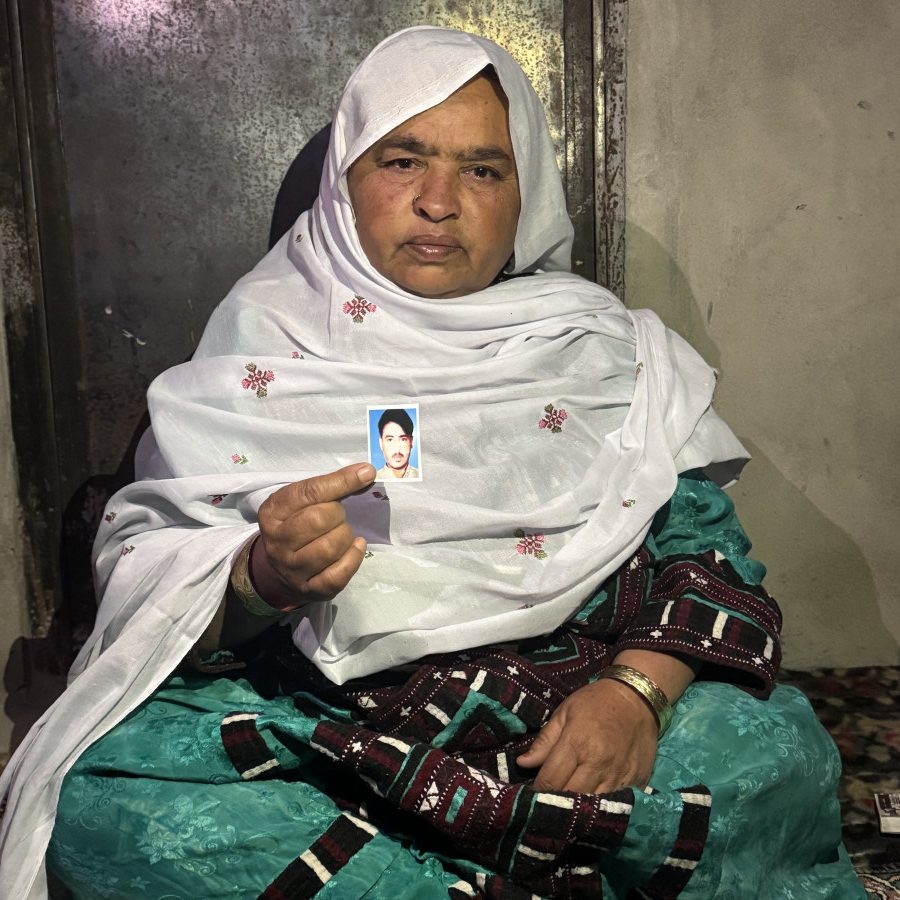
Rashid would tell his mother, Shakira, pictured above: 'I will study and serve my people.' Photo: Hazaran RahimDad.
And then her eyes shift. The numbness now isn’t from smoke. She is crying quietly. You see her lips twitch, fighting the pull of more tears. Then, with a small, breaking smile, she asks if this will help bring her son home.
You have no answer. There is guilt, and the weight of it shapes your breath. Finally, you manage the words: may your son come soon. In return, she says, softly, “Ameen.”
The night they took him
Seventeen-year-old Abdul Rashid Langov, a resident of Manguchar, had travelled with his father, a government school teacher, to Quetta, to his chacha’s house in Jinnah Town. They were there to pick up his younger brother, Atta-ur-Rehman, who was studying at Balochistan Residential College in class seven and was coming home for winter vacation. BRC begins from class 7.
Rashid himself was a second-year student at Manguchar Boys College. On the night of November 27, 2012, around 2:30 am, while everyone was asleep, the quiet of the house shattered: loud knocks, then the sudden sight of FC men all over the home. They asked where Rashid was. Once they found him, they took him outside into the street. For thirty minutes, they stood there with him, while others searched the entire house. They found nothing and stopped the search.
While this was happening, Rashid’s chachi, Gwari, rushed to the room where he had been sleeping before the FC stormed in. She grabbed his pashk and his chawat (sandals) because he had been wearing only a vest and was barefoot and ran outside toward him. The FC followed her.
“I am just going to give the shirt and his chawat—he can’t go like that,” she said.
Behind her, one of them laughed, “Pagal aurat,” insane woman.
Still, she managed to give them, and Rashid was allowed to wear them.
Rashid’s father says, “We resisted when they were taking Rashid and, in response,, they just told us, “Chup raho, beto.” Stay silent.
How a system fails
Once Rashid was enforcedly disappeared, no FIR was registered for six months. The police kept repeating, “We don’t lodge FIR on [against] state institutions.” It was only when Manzoor Ahmed filed a case in the high court that something moved. Justice Iftikhar Chaudhary passed an order, and the FIR was finally lodged against the FC.
The police came, took the family from the court, and recorded the FIR in the hudood of Jinnah Town, where Rashid had been enforcedly disappeared.
For seven years, Rashid’s case was heard by the Commission on Missing Persons, and for three of those same years it ran parallel in the high court. For the last six years, the family has stopped appearing before any legal forum.
“Ma mayuus buta,” his father said. We are disappointed by the justice system.
FC personnel would appear before the court and simply say, “We never picked this guy.”
I wondered what it means for a father, who saw with his own eyes his son being pulled away by FC, their vehicles, their personnel and then to listen to them denying the very act he witnessed.
“Am I bitten by a dog,” he said, “that every month, sometimes every week, in winter or in heat, I travel from Manguchar to Quetta to be present before court just to hear FC say nothing ever happened? When he went missing, I had no heart to even call him ‘begwaah’ (missing). This word itself is a torture. And denying it is the worst torture ever.”
He paused, then said, “I left Rashid’s case”.
During one hearing, he told the judge that he is withdrawing from the case. “I felt pained; felt I had failed as a father to quit the fight for my son. But this justice system has entirely failed,” he said.
“We are poor people. My salary as a school teacher barely runs the house. I have to pay lawyers, feed my other children. And in winter it becomes exhausting – traveling to Quetta only to be told the case won’t be heard.”
He added, “When we return to Manguchar, we get a call that the case is tomorrow. This is unfair. Our children are disappeared this long without a trace of their existence. The FC takes them and says they didn’t. Then who took them? Where are they? No one asks, no one answers.”
He said he continued fighting the case despite everything until something happened in 2019 that broke them completely.
Along with Rashid, five others were disappeared from Manguchar and Kalat. All their families received a call from someone claiming to be from the Commission on Missing Persons, telling them to come to Quetta Cantonment, and that they would be allowed to meet their missing loved ones.
“We all rushed,” he said. “Rashid’s mother, Shakira, came with me. When we reached the cantonment, they made us sit in a vehicle. Once we sat, our eyes were blindfolded. The vehicle kept moving. We didn’t know where. It kept going and going.”
One of the mothers, Ganj Bibi from Manguchar, whose son Sanaullah was later released, kept shouting, “Burt esh! Burt esh!” (They are taking us.) Some remained silent.
When the vehicle stopped. They were made to walk through a compound and into a room. There was no one, not a human, not even a bird. Only the two FC men who had brought them. They were shut inside for hours, waiting for their sons to appear.
Shakira holding Rashid's photo at a protest against enforced disappearance in Quetta. Photo: By arrangement.
Then a Baloch policeman entered and asked why they were there. They told him. He looked stunned. “This is dangerous,” he said. “Why are you people here?” He told them he would open the gate, but they must run fast.
“And we did,” the father said. “And that day, whatever hope we had left in this system ended. We withdrew our case.”
Remembering every detail
Rashid’s mother, Shakira, says she has six daughters – four married – and Rashid is her eldest child, and five younger sons who are still studying. She says that if Rashid had not been disappeared, he too would have been married and building his own family. “But sometimes,” she added quietly, “I thank God he was not married or engaged when they took him. Otherwise,, someone else’s daughter would have suffered too.”
She wiped her tears and said, “Imagine how hard it is for a mother to say thank God my son was not married. A mother’s first dream, when a son is born, is his wedding. But this is what disappearance does to us.”
She says she has become a cardiac patient, the shocks beginning the day she first heard the news of Rashid and continuing ever since. People often tell her that she has other children and should take care of her health for their sake. “But if [even] a ring on your hand disappears or you throw it away, you feel something has gone missing,” she said. “He is my son – my grown son, my eldest. I had dreams for him. How can I forget my beloved?”
She says she has not forgotten Rashid despite all these 13 years. In Manguchar, whenever there is an announcement on a loudspeaker, she stops whatever she is doing and listens. “Maybe they are saying Rashid has come, and we should go bring him home,” she said. “But it never happens.” Tears welled in her eyes.
“I haven’t even forgotten his name,” she continued. “If a sabzi wallah comes or I send someone to buy something, sometimes, I say, ‘Rashid, go and get this.’ And the moment I do, I bite my tongue. But I still say it. I don’t know if it’s a slip, or if this mother’s heart says it just to remind myself he exists. Whatever it is, I say it daily.”
She remembered how Rashid would tell her, “I will study and serve my people.”
She says that whenever Rashid’s father receives a phone call, she becomes alert. “I think, maybe someone is calling to say he has been released and we should come pick him.”
In his sleep, Rashid’s father often talks. In the early days, she used to ask him in the morning what happened at night. “He would say he was talking to ‘Adda’,” she said, using the word they use for their eldest son. “I would stay quiet. Sometimes, even the younger kids would ask him, and he would give the same answer. And silence would follow. He still does it, but we don’t ask him anymore.”
Shakira remembered Rashid as a toddler; how he would lean away playfully, then rush back to kiss her cheek before pulling away again. “He would do it fast, then come back, kiss me and go again,” she said, smiling weakly. “I used to think – see how much he loves me. Even for a few seconds, if he felt he was going too far, he would rush back. And look now… I cannot see him, and he cannot see me.”
Before his enforced disappearance, Rashid had suffered an accident and undergone surgery. A rod had been placed in his left leg. Back then, Manguchar would get electricity for only two hours at night, and it is the same even today. But at the time, when Rashid was home, the electricity came from 3 am to 5 am; now it is there from 10 pm to 12 am. She remembered how a tube well would run during those two hours and the entire town would fill their water drums, no matter how cold it was.
“Rashid never let me go,” she said. “He would go himself, fill the water, bring it home, keep it at the rady stall, and then return. I was so dear to him. Other mothers and sisters would go, but he never let me.”
Winter without him
Kalat district is the coldest in all of Balochistan during winter, with no gas or other basic facilities. By 2023, the winters had become so harsh that Rashid’s family could no longer endure them and they decided to temporarily move to Uthal until the cold subsided. Staying back in Manguchar, the cost of heating with wood was high, stoves need wood repeatedly, and wood was costly.
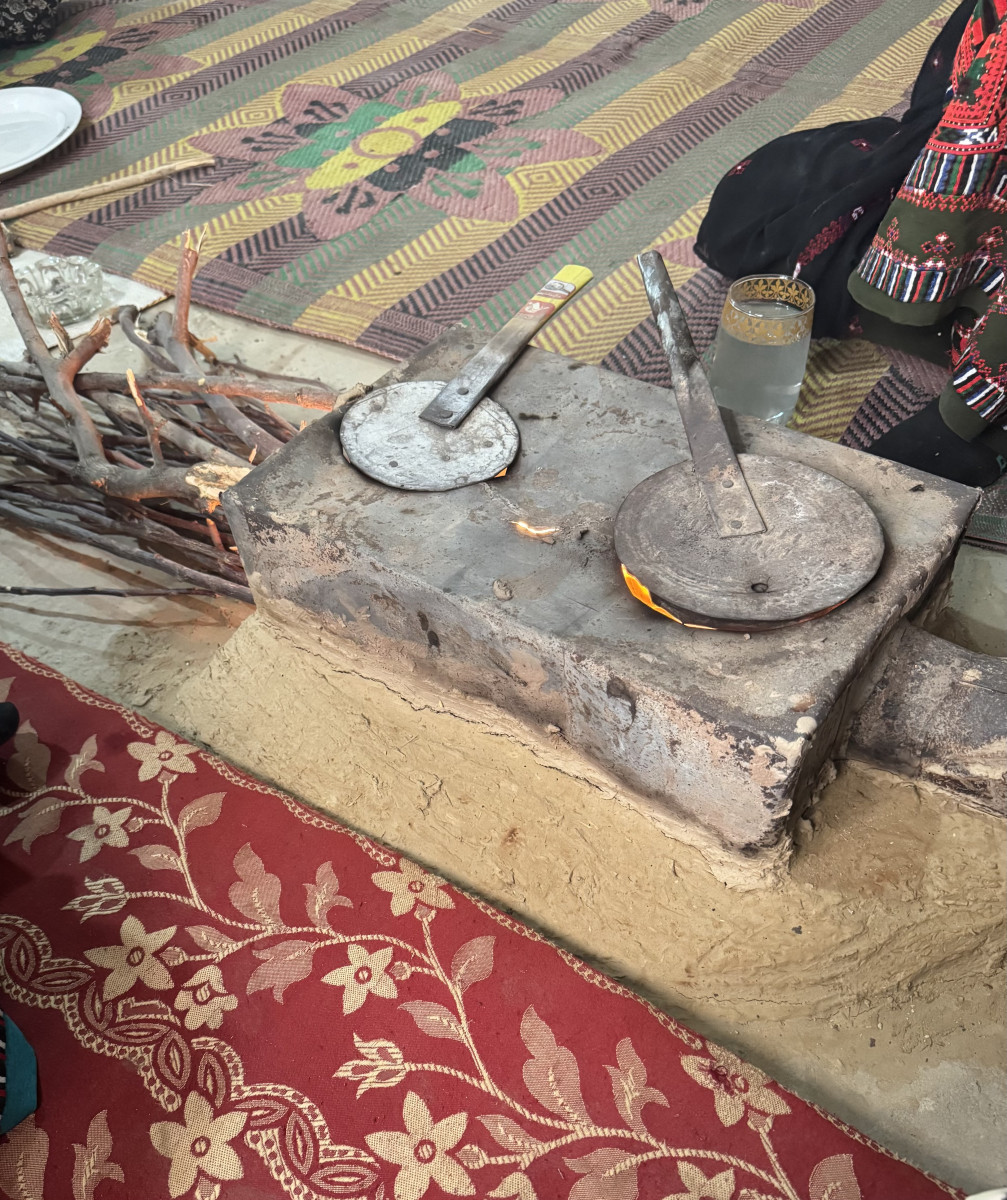
Stoves keep homes warm and cook, but colder winters are pushing Manguchar residents like Shakira and her family away for winter due to escalating firewood costs. Photo: Hazaran RahimDad.
When Rashid was enforcedly disappeared, his father had spoken to many mirs and sardars, all assuring him that Rashid would be released. Just as the family was preparing to leave for Uthal, a man associated with Mir Khalid Langov told them he had a Punjabi friend who could secure Rashid’s release for two lakh rupees. The family could not afford it at first, but with help from relatives and neighbors, the money was gathered. The man asked them to wait a week but the week never came.
With their luggage packed, the family worried: what if Rashid came while they were away? Rashid’s father told them, “You people leave. I will stay.” For a month, he remained alone in Manguchar, but Rashid never returned.
Rashid’s father said he had been asked for such money many times – some offering Rs 30,000, some Rs 15,000. He cannot even recall how much he had given to random people who claimed they could secure his son’s release.
Witnesses and guardians
Rashid’s chachi, Guwari, carries the guilt of what happened at her house – the place where Rashid was taken. She goes to almost every protest and dharna. And when Rashid’s mother is unable to attend, Guwari makes sure to go in her place.
“Rashid was at my home,” she says. “In front of my eyes, they took that innocent. It happened before my eyes. I cannot forget it. I cannot even forget that I witnessed this.”
Rashid’s father shared that whenever someone was released, Rashid’s father would ask them if they had seen him. Some would say yes – they saw him in the Quetta Cantonment. And they would describe him as having white hair or slightly crippled from the rod in his leg. He would believe them, because their description matched Rashid. But since 2016, whenever someone he knew was released, they denied ever seeing him.
“If someone commits a crime, there are courts for that,” he said. “But here, a cruel king rules, and he rules with cruelty on people.”
This article went live on December seventh, two thousand twenty five, at thirty-one minutes past six in the evening.The Wire is now on WhatsApp. Follow our channel for sharp analysis and opinions on the latest developments.


