

Trucks, Cargo Stranded at Indo-Nepal Border, Markets Empty After Arson at Customs Office


The intense violence, vandalism, and arson in Nepal last week, triggered by the Gen-Z protests, as well as the curfew and restrictions that followed, have significantly impacted the Indo-Nepal border.
A long queue of heavy vehicles could be seen along the border in the aftermath of the political upheaval in the Himalayan nation, while Indian markets adjacent to the border were eerily quiet due to restrictions on movement. Shopkeepers were seen sitting idle and both government and private vehicles were unable to find passengers.
After the formation of the interim government on Friday night (September 12), with former Chief Justice Sushila Karki assuming the role of Nepal’s Prime Minister, the situation began to normalise by Saturday, with the border completely reopening on Sunday.
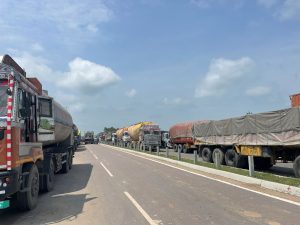
Trucks stuck on the highway. Photo: Manoj Singh.
Curfew, arson and restricted border movement
The Sonauli border, located in the Maharajganj district of Uttar Pradesh, serves as a significant checkpoint along the approximately 1700-km-long India-Nepal border, facilitating the import and export of a wide variety of goods between the two nations, as well as the daily commute of thousands of individuals.
The brutal suppression of the Gen-Z movement in Kathmandu last week, which resulted in the deaths of 19 youths and injuries to over 400 individuals on the first day, prompted widespread protests and arson on September 9.
Rioters vandalised and set fire to numerous government buildings including the Parliament, Supreme Court, Singh Durbar, and the president's residence in addition to attacking the homes of prominent leaders, political party offices, businesses, hotels and departmental stores.
Various hotels, residential complexes, and commercial establishments were also targeted in multiple regions across the country. Over 14,000 inmates escaped from more than a dozen prisons, with some setting fire to jails and district courts during their flight. So far, 51 individuals have been reported dead across the country.
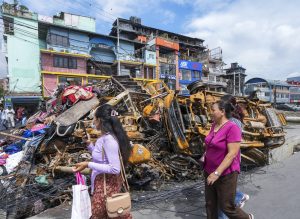
Women look at a pile of charred and damaged vehicle in the aftermath of anti-government protests and clashes, in Kathmandu. Photo: AP/PTI
On the evening of September 8, a curfew was imposed in Bhairahawa, Butwal, located in the Rupandehi district of Nepal. The Belhiya customs office, situated across the Sonauli border, was shut down and tourists attempting to enter Nepal were stopped. Cargo trucks headed for Nepal were also stopped, resulting in a lengthy queue of vehicles stretching approximately 4 km at the border.
On September 9, the Belhiya customs office and the cargo office in Bhairahawa were set ablaze. In Bhairahawa, the residences of former home minister Sarbendra Nath Shukla, mayor Ishtiaq Khan, and the hotel owned by former MP Pramod Yadav too were set on fire. Maurya Hotel and Bhat Bhetni Super Market in Bhairahawa were destroyed in the arson. Later that night, the homes of former minister and President of the Janata Pragatisheel Party Nepal, Hridayesh Tripathi, as well as MLA Santu Jaiswal, were also set on fire in a village near Thuthibari, which is the second checkpoint of Maharajganj district.
Following this, all check posts along the Nepal border in the Maharajganj and Siddharthnagar districts of Uttar Pradesh, including Sonauli-Belhiya, Thuthibari-Maheshpur, Badhni-Krishna Nagar, and Khunwan-Taulihawa, were completely shut down. At the Khunwan border, authorities apprehended 14 inmates who had escaped from the Taulihawa jail in Nepal as they attempted to enter India.
Indian tourists stranded in Nepal and Nepali citizens traveling back from India were gradually permitted to cross the border after the verification of their identity cards.
Stranded truck drivers
The movement of cargo trucks was completely halted until September 11 while trucks carrying gas, oil, and essential goods were permitted to pass the following day. However, the operations at the Belhiya and Bhairahawa customs offices remained disrupted due to arson.
The heavy vehicles stranded at the border were instructed to depart by preparing manual forms. Over 300 trucks remained stuck at the Belhiya customs office depot on Friday.
Nearly 1,000 trucks were stranded along a 7.6 km stretch from Sonauli to Nautanwa after violence began on September 8, with a lengthy queue of trucks occupying one lane of National Highway 24.
These trucks are carrying a variety of goods, including coal, cotton, oil, plastic and grains. Trucks transporting raw materials, such as potatoes and onions, unloaded their cargo at local go-downs and returned. Some trucks also opted to sell their raw materials at reduced prices in local markets to prevent spoilage.
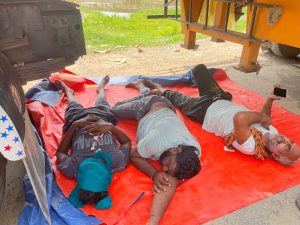
Truck drivers stuck at the border with their cargo camping near the highway. Photo: Manoj Singh.
A source from the Service and Goods Tax and Customs Office, situated in Sonauli, reported that, on average, 400-500 cargo vehicles receive clearance after fulfilling all necessary formalities, allowing them to cross into Nepal. However, this movement had come to a complete standstill.
Along the route from Nautanwa to Sonauli, 2,000 to 2,500 truck drivers and their helpers had been residing on the roadside for the past week. They were sleeping beneath the trucks and preparing their meals there. Their situation was becoming increasingly challenging as local traders and hawkers raised the prices of vegetables, water, and food items due to heightened demand. A meal that previously cost Rs 100 is now priced at Rs 250 at dhabas along the route.
Mohsin, Satpal, and Arif were en route to Nepal from Alwar in Rajasthan with sanitary supplies when they got stuck at the border. Mohsin arrived in Sonauli on September 12, while Satpal and Arif were stranded there for a week. Satnam said that he reached the border on September 6. The necessary documentation was prepared at the Belhiya customs in Nepal prior to the border closure.
“Now, even the customs office has been set ablaze and I am not sure whether my documents are still intact,” he said. All three individuals were set to travel to Kathmandu.
Mohsin stated that a businessman based in Kathmandu warned the group that if they entered Nepal, their truck might be set ablaze, advising them to remain where they were.
“Fortunately, there are no perishable goods in our truck. Those transporting raw materials are returning after unloading their cargo at Sonauli-Nautanwa,” he said.
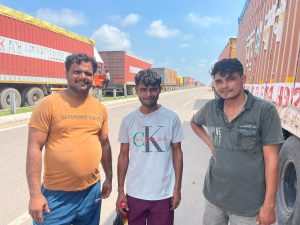
Mohsin, Satpal and Arif. Photo: Manoj Singh.
Vimal Pandey, a resident of Urwa in Gorakhpur, was en route to Bhairahawa transporting coal from Margherita, located beyond Tinsukia, but was stranded for five days between Nautanwa and Sonauli due to the border closure.
Vimal mentioned that seven to eight trucks loaded with coal were also trapped alongside him. He has been operating a truck for 15 years and purchased his own truck five years ago. Each month, he needs to pay an installment of Rs 53,000. Initially, he employed a driver, but when earnings fell short of covering the installment, he took to driving himself.
He mentioned how everything had become costly at the border. “Potatoes are being sold for Rs 80 per kg, and cabbages for Rs 210 per kg. Curd that typically costs Rs 100 is now priced at Rs 250. A platter that usually costs Rs 100 at the Dhaba is now being sold for Rs 250. The most significant issue is the scarcity of water. It is generally assumed that drivers are carefree people, but only we know of the hardships we are facing.”
'No one is coming to see our plight'
Vimal noted that company trucks and their drivers are experiencing a different set of challenges, whereas independent drivers are incurring substantial losses due to the border closure. “If we remain stuck for 15 to 20 more days, we will be ruined. It is disheartening that no one (from the government) has tried to come and see our plight.”
Harish Pal from Pilibhit arrived at the Nepal border on September 8 with Mobil oil sourced from Bhiwadi. When he went to get the customs paperwork done, he found that the border was closed. He operates a company truck and has been in the profession for 18 years.
He said, “I earn between Rs 10,000 to Rs 11,000 monthly. If I remain stuck here for a few more days, the owner will not even cover my daily food expenses. Everything is becoming expensive here. A small bucket of water now costs Rs 20 instead of Rs 10. A packet of milk, which used to cost Rs 16, now costs Rs 25.”

Drivers stranded at the highway due to border closure. Photo: Manoj Singh
Arshad, a truck driver from Pratapgarh, who was en route to Bhairahawa in Nepal with bales of cotton was also stranded due to the stir in Nepal. He expressed his frustration, saying, “It has been a week. Everything is becoming more expensive here. The owner has instructed us to remain here and not return. Everyone is facing difficulties.”
Typically, trucks arriving at the border receive clearance from the relevant authorities of India and Nepal within a span of 24 to 48 hours, allowing them to proceed to their destinations.
A customs official recalled that this marks the third time such a situation has arisen at the border.
The first instance happened during Rajiv Gandhi's term as prime minister, when vehicle movement was similarly halted following the expiration of the Nepal-India trade treaty. This type of situation also emerged multiple times during the Maoist movement, though briefly. In 2015, during the Madhesi agitation in Nepal regarding the implementation of the current constitution and the 'controlled blockade' imposed by the Indian government, resulted in a long line of trucks from Kolhui to the Sonauli border.
The market in Sonauli, which is usually bustling with activity from morning till 10 pm in the night, saw no visitors. Roadways buses operating in the area were mostly empty. Taxi drivers who were ready to transport passengers to Gorakhpur were unable to find any customers despite reducing their rates.
A shopkeeper selling cookware mentioned that he typically earns up to Rs 40,000 daily, but by 2 pm that day, he had not recorded a single sale.
Ansh Kapoor, a resident of Manali, said he had arrived at the border with his friend from Nepal, intending to visit the latter’s home in Butwal. Kapoor, who is pursuing his graduation from a college in Chandigarh, said that he was planning to return after a two-day visit.
At the border, his friend was permitted to cross after his identity card was verified, but Kapoor was informed that Indians were currently not allowed to enter Nepal. Disappointed, he bid farewell to his friend at the border and returned to Chandigarh.
This article went live on September sixteenth, two thousand twenty five, at forty-one minutes past eleven in the morning.The Wire is now on WhatsApp. Follow our channel for sharp analysis and opinions on the latest developments.


