

Aditya L1: ISRO's Mission to Study the Sun Launched Successfully


New Delhi: Aditya L1, India's first space-based observatory to study the Sun, was launched successfully at 11:50 am on Saturday, September 2. The mission to study the Sun's outermost layers represents another milestone for the Indian space programme after the Chandrayaan-3 mission successfully soft landed on the lunar surface on August 23.
The observatory was launched in the PSLV from the Satish Dhawan Space Centre in Sriharikota. The Aditya L1 mission's goal is to shed light on the dynamics of several solar phenomena by imaging and measuring particles in the sun’s upper atmosphere.
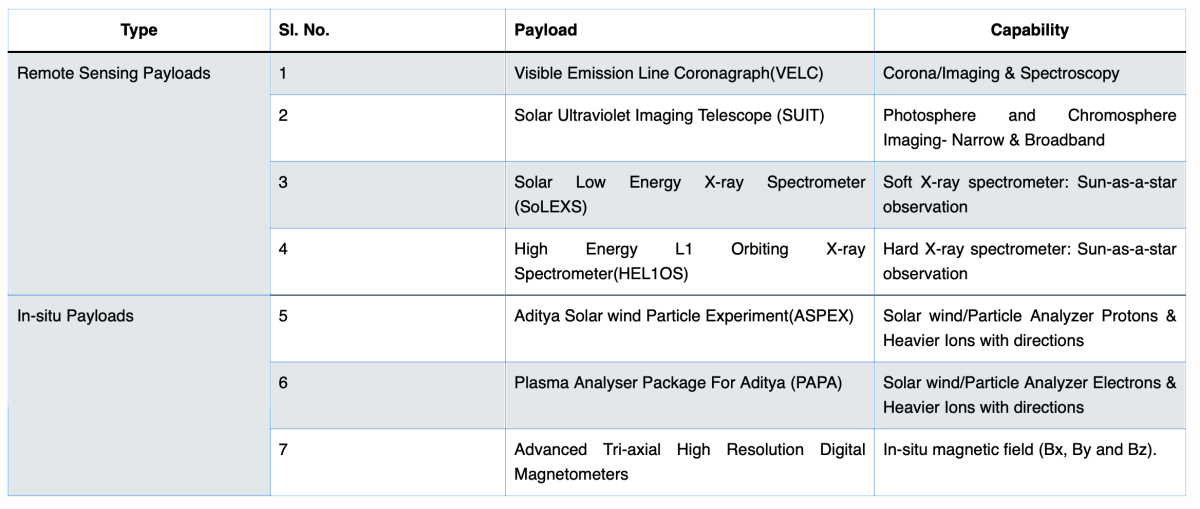
The spacecraft carries seven payloads to observe the photosphere, chromosphere and the outermost layers of the Sun, called the corona, using electromagnetic, particle and magnetic field detectors. Four payloads will directly view the Sun and the remaining three payloads will carry out in-situ studies of particles and fields, "providing important scientific studies of the propagatory effect of solar dynamics in the interplanetary medium", according to ISRO. The space agency plans to understand phenomena like the problem of coronal heating, coronal mass ejection, pre-flare and flare activities and their characteristics, and the dynamics of space weather.
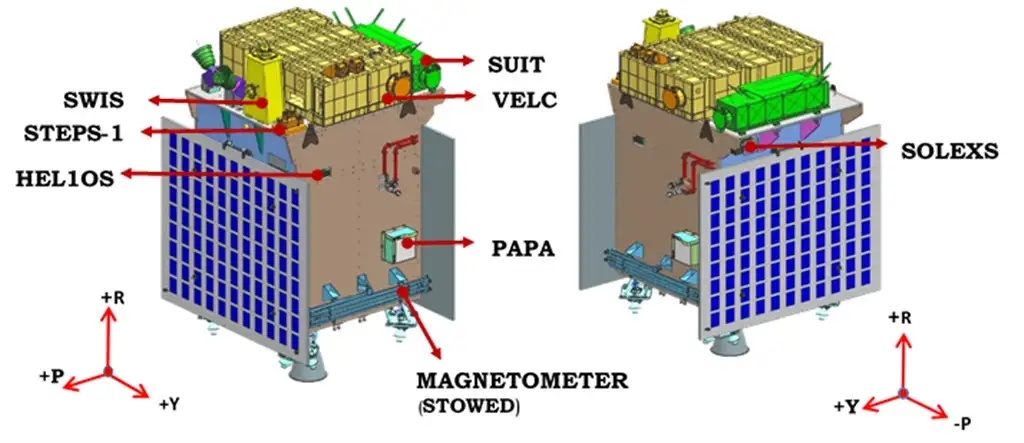
Aditya L1's scientific payload. Photo: ISRO
Initially, the spacecraft will be placed in a low earth orbit. The orbit is gradually made more elliptical, after which the spacecraft will be launched towards its destination: L1 refers or Lagrange point 1 (L1) of the Sun-Earth system, which is about 1.5 million km from the Earth.
Lagrange points are positions in space where the gravitational pull of the two large bodies equals the necessary centripetal force required for a small object to move with them – meaning a small object placed there will stay there.
The total travel time from launch to L1 would take about four months.
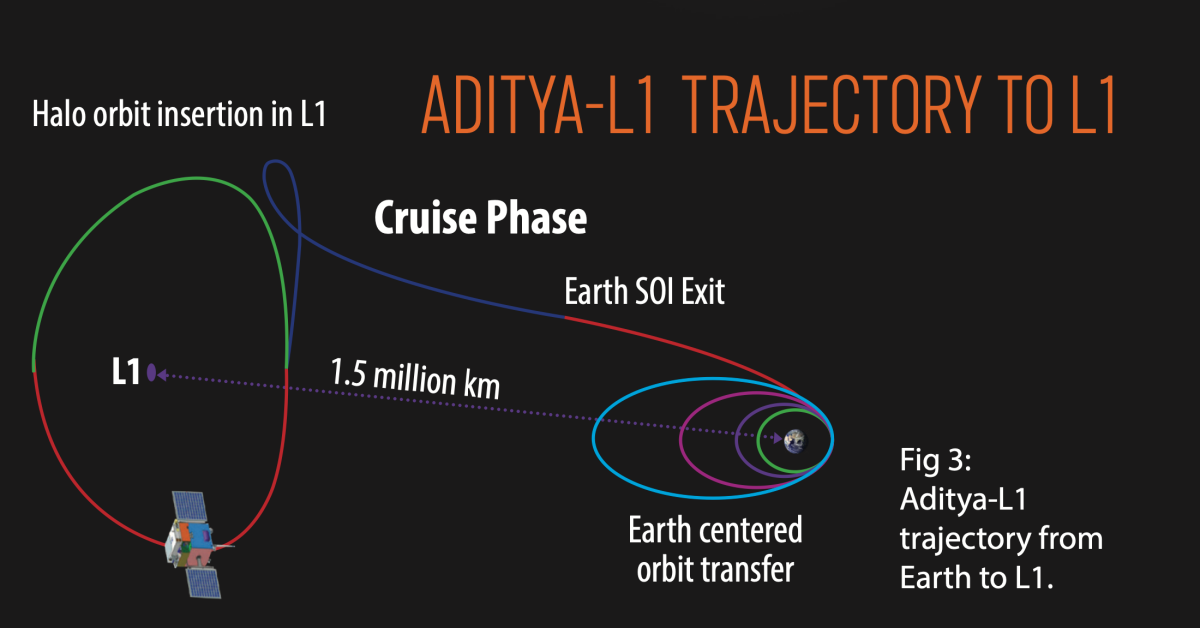
The trajectory of the Aditya-L1 mission. Photo: ISRO
While NASA and the European Space Agency have sent numerous probes to the centre of the solar system, India is the first Asian nation to place an object in solar orbit.
Scientific objectives
According to ISRO, the major science objectives of the Aditya-L1 mission are:
- Study of Solar upper atmospheric (chromosphere and corona) dynamics.
- Study of chromospheric and coronal heating, physics of the partially ionized plasma, initiation of the coronal mass ejections, and flares.
- Observe the in-situ particle and plasma environment providing data for the study of particle dynamics from the Sun.
- Physics of solar corona and its heating mechanism.
- Diagnostics of the coronal and coronal loops plasma: Temperature, velocity and density.
- Development, dynamics and origin of CMEs.
- Identify the sequence of processes that occur at multiple layers (chromosphere, base and extended corona) which eventually leads to solar eruptive events.
- Magnetic field topology and magnetic field measurements in the solar corona.
- Drivers for space weather (origin, composition and dynamics of solar wind.
The Wire is now on WhatsApp. Follow our channel for sharp analysis and opinions on the latest developments.


