

'Beyond the Report Button': Experts Contend With Redressal in the Era of Takedowns


New Delhi: As of September 22, India's online dispute resolution body for content moderation complaints, the Grievance Appellate Committee had received 63,353 appeals but disposed of only 13,375, indicating a pendency of nearly 50,000 cases. In January 2025, the same body had a pendency of just 241 cases. These were among the many astounding figures to emerge from the event organised by the Software Freedom Law Centre India at the India International Centre in New Delhi on September 28.
The event titled, 'Beyond the Report Button: Rethinking Digital Rights and Remedies' brought together a wide range of perspectives with journalists, lawyers, telecom industry representatives, platform policy experts, and former government officials for two panel discussions on cyber fraud redressal and content moderation against the current spree of content takedowns India has been witnessing.
SFLC.in also presented data from RightsLine, a digital rights helpline which has received 590 complaints from across 25 states since its launch in September 2025.
The event started with SFLC.in founder Mishi Choudhary, who underlined that between March and July this year, the Union government issued nearly 1.95 lakh blocking orders to Instagram, Facebook and YouTube, roughly one order every 68 seconds. "That is not a user grievance system," she said. "This is infrastructure."
"India now has a very vast machinery for taking down content, moderating speech, processing cyber crime complaints, and of course policing online behaviour," she said.
The Wire was a media partner for the event.
‘Scam vs System: The Race Between Fraud and Response’
The first panel, on cyber fraud redressal, was moderated by Mishi Choudhary and included Tanishka Sodhi of the news outlet The Quint, Darpan Singhi from the law firm CMS IndusLaw, Hariti Chadda of the number identifier Truecaller, Vikram Tiwathia of the Cellular Operators Association of India (COAI), Amrita Choudhary of the Cyber Cafe Association of India (CCAOI), and Srikanth of the consumer awareness collective CashlessConsumer.
The panel looked at why a person who has been scammed still struggles to get a remedy, even though India has an elaborate response system. Choudhary noted that a scam relies on infrastructure: a telecom network carries the call, a payment system moves the money, and mule accounts receive it.
Tanishka Sodhi, who has reported on digital arrests, said criminals exploit the fact that police and banks work in silos. She highlighted the concerns surrounding digital illiteracy by noting that often, victims she spoke to also included doctors and former army generals.
Sodhi also highlighted how AI is increasing the levels of scam sophistication which is making it difficult for not just elderly people but everyone else as well.
Darpan Singhi argued that India's regulatory architecture actively enables fraud by distributing responsibility without accountability. "The RBI issues guidelines to banks, banks pass obligations on to technology companies, and there is little disincentive for bad actors." He said the RBI had since introduced friction points on larger or age-linked transactions, and that draft mule-account regulations were out for comments. When the moderator cited government figures saying more than Rs 8,690 crore had been "saved" across over 24.65 lakh complaints, he said even as a lawyer he was unsure what "saved" meant.
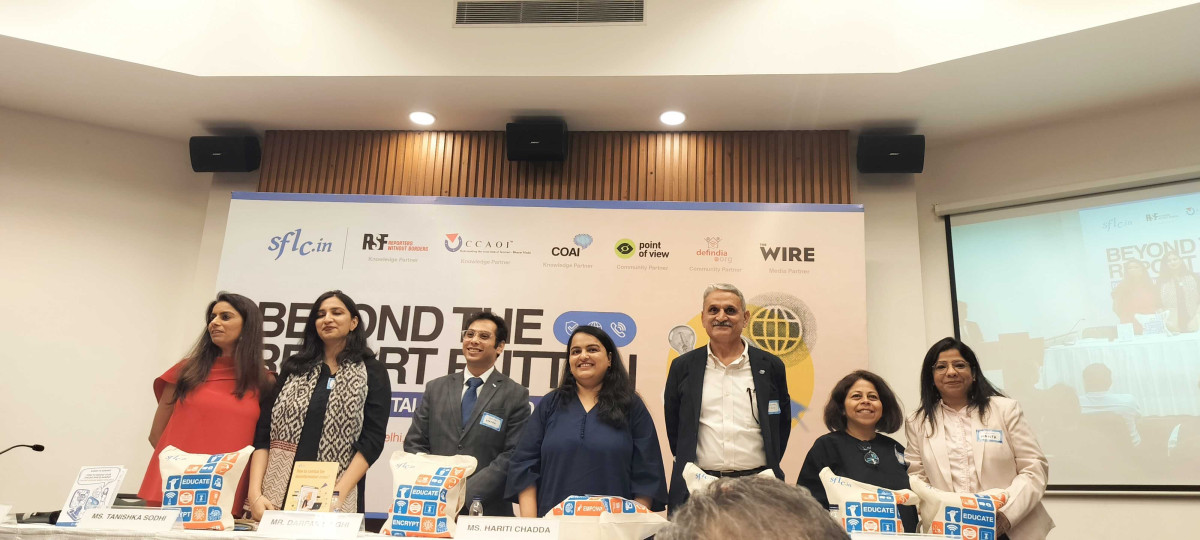
Photo: Ramsha Sartaj.
Srikanth said the "real scam" is people's assumption that regulators exist. He argued that the RBI has officially approved more than a dozen self-regulatory organisations whose incentives are completely misaligned with consumer protection. "The scam in the system is that there is a semblance of regulation when there is none," he said. He said the payment system needs friction, but that it helps only up to a point and has limitations.
CCAOI's Amrita Choudhary said victims feel shame and often do not know where to report. She also highlighted how the language barrier is also an issue because the cybercrime portal is available only in English and Hindi. There are problems with its "anonymous" option which still requires login details. Lastly, she noted that the design of the cyber portal is too difficult for users to navigate through for filing a report.
Cellular Operators Association of India’s Vikram Tiwathia said telecom operators were giving advance warnings and working with the DoT, I4C and TRAI, including through the 1600 and 1601 number series and platforms such as Chakshu. He said social engineering remains hard to counter, and that fraud is shifting to OTT platforms outside telecom regulation.
Truecaller's Hariti Chadda alleged that the fraud ecosystem is better coordinated than the prevention ecosystem. She said Truecaller relies on community reports and does not directly share information with telecom operators, and that there is hesitation in sharing government action on flagged numbers with platforms like hers.
The panel broadly agreed that tackling fraud requires closer coordination among stakeholders rather than placing responsibility on individual users. Suggestions included stronger transparency mechanisms, easier reporting, greater victim support, telemarketer registration, regulation of emerging platforms and bringing regulators together. Sodhi also urged a shift away from victim-blaming. Concluding, Choudhary said RightsLine continues to hear from people who cannot get effective redress, and that the panelists still seemed to be "talking in their own worlds". The panel's closing consensus was that too much responsibility is placed on individual users while institutional accountability remains inadequate.
Between panels
Before the second panel, Meghnad S, an independent politician and content creator who has faced repeated content takedowns described three incidents illustrating how platform and government mechanisms operate in practice – 11 copyright strikes that left his videos unavailable, removals of videos of a Karnataka political event following disputed harassment complaints, and a Meta takedown of a politically sourced video without notice or appeal. He said appealing such decisions had become routine, describing it as “playing whack-a-mole all the time.”
SFLC’s legal team said the Grievance Appellate Committee (GAC), created as a redress mechanism, was itself facing a significant backlog. While the first RightsLine case resolved through the GAC in March 2025 took three weeks, the body had around 50,000 pending cases by September 2026. The team also described difficulties with Meta’s grievance system, saying SFLC.in was eventually directed by Meta’s AI assistant to send a physical letter to its grievance officer in Gurugram. It also reported that 35 of 50 Islamophobic posts flagged for soliciting donations through violent content had been removed. SFLC.in has approached the Supreme Court challenging confidentiality provisions governing takedown orders.
‘User Rights: Between Platforms and Processes’
The second panel, moderated by Siddharth Varadarajan, founding editor of The Wire, included former MP Saket Gokhale, former MeitY senior director Rakesh Maheshwari, Ritika Jain of Reporters Without Borders, Matthew Sells of the Appeals Centre Europe joining online, lawyer Shashank Mishra of the firm Shardul Amarchand Mangaldas, and Gajendra Singh, founder of News Diggy.
Vardarajan opened the discussion of the second panel by highlighting that we are living through a time of a "takedown epidemic". “You have this high-tech system of content identification and deletion”, he said. “The whole rash of orders which is happening in virtually real time is a new form of censorship. It is far more pervasive, far more efficient and I would say far more destructive for citizens’ rights than the kind of censorship we saw earlier in India."
Saket Gokhale described two categories of takedowns: platform-initiated and government-initiated. For the latter, he said platforms have no power to restore content. He said the Sahyog portal, through which designated officers issue takedown notices, had been integrated directly with Meta's API, meaning content is now deleted automatically without Meta even reviewing the notice. "Even a police constable across states has been empowered to issue takedown notices on the Sahyog portal," he said. He described a pattern he observed during the Janta Mantar protest, where he set up a microsite for people to report takedowns. "Your content eight out of 10 times will be restored but it's 30 days after that," he said, underscoring that delayed content restoration is effectively meaningless because social media algorithms prioritise new content, making old posts unlikely to regain visibility.
They described this as an intentionally slow process where “the process is the punishment,” regardless of the legality or grounds of the takedown. He also highlighted that ‘who’ is reporting also matters because a request from an MP would be given preference over a general citizen’s complaint.
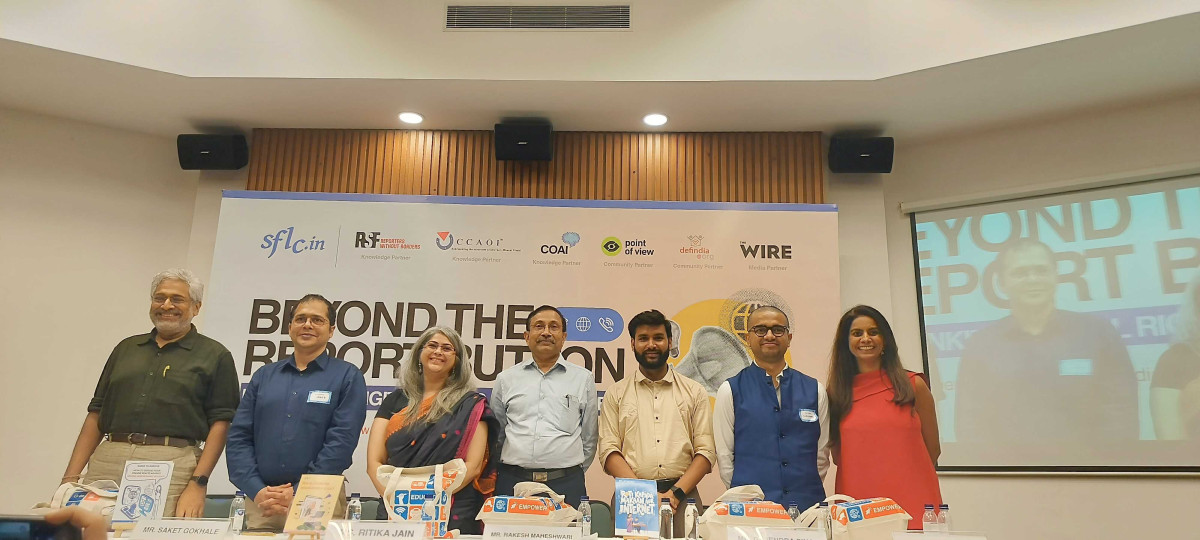
Photo: Ramsha Sartaj.
Gokhale also argued that platforms such as Meta and Google proactively remove content that might portray the government negatively, beyond what they are legally required to do, partly because of their commercial relationships with large Indian corporate entities close to the government. He described self-censorship operating at three levels: the government sets the overall tone, platforms interpret and act on it, and content creators self-censor before posting. "It's a form of inducing you to self-censor before they have to take any action," he said.
Varadarajan described The Wire's own experience with the interdepartmental committee that can hear appeals against government-initiated Section 69A takedowns. The Wire had published an excerpt from a Caravan article on custodial deaths and received a takedown notice. The only justification offered was that the excerpt was derived from an article that had been taken down. "I said well an excerpt, I could have run a two-line excerpt that, 'Rajnath Singh is the Raksha Mantri of India'. Will that be taken down because it's an excerpt? And they had no answer," he said.
Gajendra Singh of News Diggy said his Instagram account had been suspended on July 12, during his coverage of the student protest, without any notice or reason. He said four videos on his personal account were taken down. He said that his colleagues had refused to travel to cover certain issues because of the fear of account suspension. "All independent journalists are now losing their courage to content takedowns," he said. He filed an appeal on July 12 and as of Tuesday, he had received no response from either the platform or the government.
Shashank Mishra, a lawyer on the panel, said the GAC was developing the same backlog problem seen in India’s courts. He added that repeated changes to the IT Rules since 2021 have increasingly focused on removing content, while offering limited protection against wrongful takedowns.
Rakesh Maheshwari, former Ministry of Electronics and Information Technology of India official, defended the initial intent of Section 69A of IT Act, as limited to national security, public policy and issues affecting friendly foreign relations, with formal notices, a designated officer process and secretary level approval. He also acknowledged that the transparency mechanisms regarding takedowns have not always operated as intended. He said that recent 2025 and 2026 amendments had attempted to check as to who can issue notices.
Ritika Jain said she had written an article examining why no effective action appeared to have been taken against Hindutva rabble-rouser Yati Narsinghanand despite cases concerning his online statements. She said his content remained accessible and argued that repeatedly ignoring hate speech can contribute to the normalisation of violence, particularly when powerful political alignments appear to shield such speech.
The discussion also focused on the difficulty of addressing hate speech online while ensuring that legitimate speech is not wrongly removed. Panelists questioned how genuine complaints about harmful, violent or hateful content can receive effective redress when platforms are often slow or inconsistent in responding.
Matthew Sells of the Appeals Centre Europe described the EU model, a certified out-of-court body under the Digital Service Act that handles disputes with platforms free for users, with a human review guaranteed. Its decisions are non-binding, but platforms must engage in good faith. “So that in practice means, one, they have to send us the content that led to the account suspension or whatever it was. Two, they need to reconsider their decision. So we send them our decision. They should consider whether to reverse their original decision or not” he said.
He highlighted that DSA tried to resolve the issue as soon as possible, requiring decisions within 90 days, but also added that the centre generally resolves disputes in three to five weeks, which he called “not quick enough”.
The discussion came to an end with a remark by Varadarajan, who argued that platforms may choose “the path of least resistance” and proactively remove content likely to offend the government. He also raised concerns that while legitimate content can be easily taken down, material involving calls for violence, rape or genocide often remains online. Varadarajan cited a recent instance in which a complaint on X about books by Ambedkar, Jotiba Phule and others led the PMO to seek responses from central universities, which he described as creating a chilling effect on academic expression.
The event ended with Prashant Sugathan’s remarks that the report button is not the end of the problem. He called for stronger processes, clearer takedown reasons, coordination among institutions, and remedies that reach affected users.
Ramsha Sartaj is an editorial intern at The Wire.
This article went live on September thirtieth, two thousand twenty six, at seven minutes past four in the afternoon.The Wire is now on WhatsApp. Follow our channel for sharp analysis and opinions on the latest developments.


