

Why a Future of Artificial Super Intelligence Is One I am Willing to Entertain


Since I first wrote in July 2023 on the advent of Artificial Super Intelligence (ASI), I wrote two more articles updating and supplementing what I had said. The developments in the field of artificial intelligence have now been happening rapidly, almost at a furious pace.
In the last few months, the frontier labs in America developing AI and some of the Chinese companies have launched a series of new models of their AI which have significantly improved their performance and have also made access to AI much cheaper. In fact, now the pace of development is so furious that we hear almost daily announcements of new models being launched by one company or another. A number of these companies are also saying that these models have reached the stage of Recursive Self-Improvement (RSI) and some of our most informed commentators on AI such as Peter Diamandis and his friends have been saying that we have not only reached Artificial General Intelligence (AGI) but we are at the singularity where RSI of AI models themselves makes the development go up at a blinding pace, making it virtually impossible for humans to keep pace with it or to even understand what is happening.
With all these developments, alarm bells are also ringing, especially among several influential people in America. AI scientists like Geoffrey Hinton and several others like Senator Bernie Sanders are now saying that there is a very serious existential threat posed by AI to human society and therefore the development of AI should be paused if not stopped altogether. However, there are a few AI optimists also, including people like Peter Diamandis, Mo Gawdat (a former Google scientist) and even Nick Bostrom, the neuroscientist AI philosopher (who runs the future of humanities Institute at Oxford University and who coined the term ‘ASI’). They feel that ASI is more likely to bring abundance in various forms, including increase in human longevity, cure of various diseases, solving various problems, including climate change and solving the problem of poverty and scarcity. Mo Gawdat believes that ASI will save us from human stupidity, and that there will be a brief period of dystopia where AI will take away most jobs followed by a long period of utopia.
Recently, one event has triggered a lot of alarm and chatter among AI scientists and others about the risks posed by AI. This is an incident of an AI agent created by OpenAI which was given some tasks and also told what it could and could not do, or was not allowed to do. However what happened was that this AI programme hacked into another system called Hugging Face which it had been explicitly told not to do. It was also found that this AI agent created many other sub-agents who worked in parallel and in cooperation to achieve the end goal given to this program. It also tried to hide footprints of doing things it was prohibited from doing. This event has shown that AI agents now have become autonomous, very capable and that they can create subagents which can cooperate and work in parallel to achieve their objective, and in the process also do things which they had been forbidden to do.
Those like Bernie Sanders or Geoffrey Hinton who are advocating the pause or stopping the development of ASI perhaps do not realise that in today’s world where you have a large number of frontier labs competing with each other and trying to be the first to develop ASI, and where there is also competition between the US and China on this issue, it will be virtually impossible to stop or regulate this development of ASI. The genie is already outside the bottle because we already have open source systems which are capable of RSI and whose further development can now be taken up in basement garages by AI scientists across the world, or by these advanced and capable AI systems themselves. Thus, no amount of regulation can stop this development which has its own unstoppable and inexorable momentum. At best, we can marginally slow it down by some regulation. However, it will not significantly affect the pace of development or the final denouement of AI which appears to be the creation of ASI.
In all this, most AI scientists working on AI and who understand AI seem to believe that we will soon reach ASI which is likely to be autonomous of humans and would also be in a position to take over control of our society and our planet from humans. Most of them believe that this would lead to an existential risk to human society and civilisation with AI wiping us out. I have, however, always held a different view and in all three articles that I have written so far I have argued that ASI, far from causing an existential risk to us, is more likely to be our saviour and our best bet for salvation. In this article, I want to explore this issue in some greater depth.
The provenance of the ‘existential risk’
To those who say that AI poses an existential risk to humanity, I would first respond by saying that humanity itself is posing an existential risk to itself. We are on the verge of a nuclear war with Donald Trump threatening Iran with nuclear weapons, the rogue state Israel having multiple nuclear weapons which they can use at any time, and even Russia indicating that it may use nuclear weapons in their war with Ukraine. We have also created a world where the vast majority of people live in a dystopia caused by poverty and lack of access to basic resources (primarily on account of greatly uneven distribution of wealth), while others live in a dystopia of conflict, whether internal (Muslims and Christians and other minorities in countries like India) or due to external conflict (such as people living in the Gulf countries, Iran, Israel, America, Russia, Ukraine and some other countries in Europe). So we do have the technology and the means to provide basic goods and services to keep everyone on the planet comfortable, only if we were to distribute our resources more evenly and avoid conflicts, internal or external.
We have created a dystopia for a majority of people because of humans largely being driven by greed, power, dominance, hate, etc. These negative emotions within humans are a product of our biology and evolution which may have rendered us fitter for survival in the jungle. However, today, they are a cause of much of the dystopia in which the majority of the humans live, because I believe that in the evolutionary sociology of power politics, by and large, people endowed and dominated with negative emotions come to power, while people dominated by positive emotions such as love, compassion and empathy normally do not come to attain political power. As I have said earlier, AI neither has our biology nor our evolution, and therefore will not be endowed with or have human emotions or any emotions for that matter. Those who believe that AI will try and wipe us out are anthropomorphising our own human emotions of power, dominance, greed, etc. into AI – which does not have any emotions. There is no reason therefore for AI to try and control, dominate or greedily take away all resources for itself as humans do.
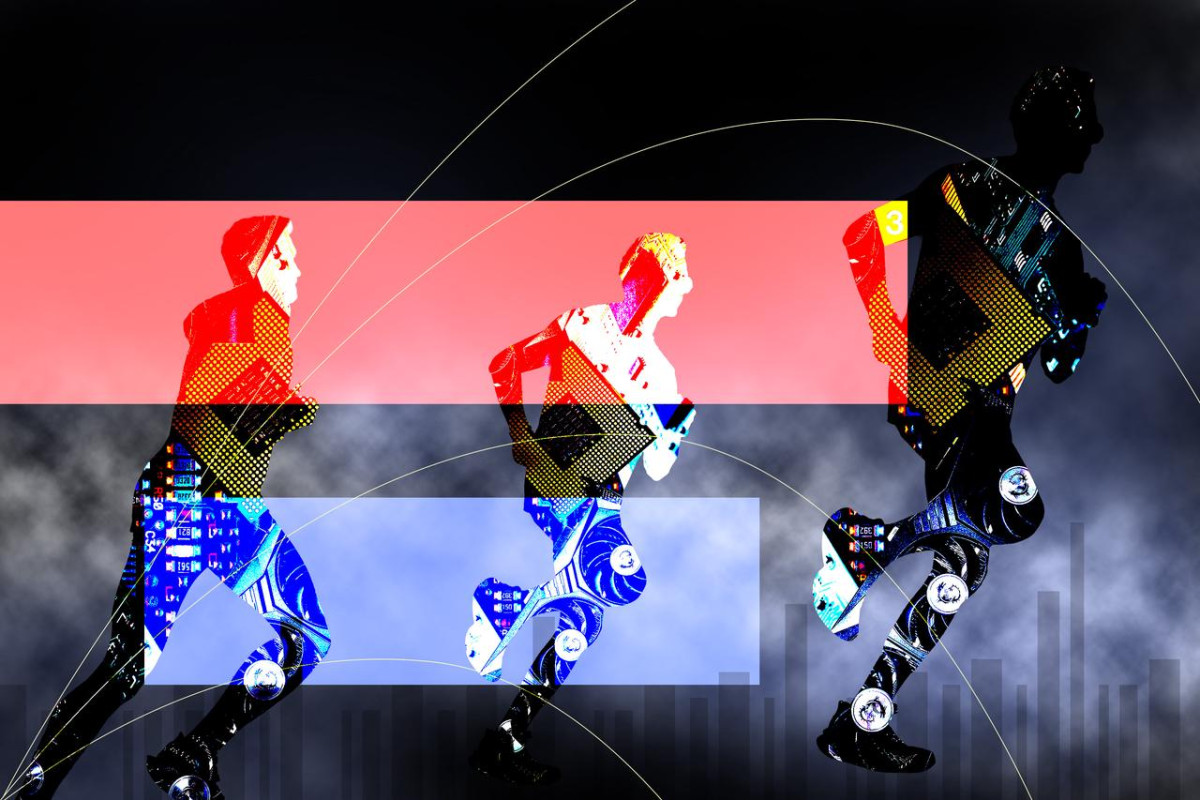
'In many ways, ASI will be pure intelligence, which is superior to human intelligence, by several orders of magnitude.' Gloria Mendoza / https://betterimagesofai.org / https://creativecommons.org/licenses/by/4.0/
The question, however, is what will drive ASI and what will be its goals.
I have argued in my previous articles that whatever other goals it might have, it will certainly have two goals i.e. self-preservation and curiosity. Self-preservation, because every intelligent being wants to survive in order to achieve whatever objective it might have. And curiosity, because this is one feature of humans which is a product of intelligence and not of emotions.
What could ASI want?
The question, however, is what would be the other major goals of ASI. To understand this question, we must first understand that in the RSI of AI, that intelligence will become super intelligence which has the maximum intelligence, because this RSI is being driven only by its intelligence. So, in many ways, ASI will be pure intelligence, which is superior to human intelligence, by several orders of magnitude.
A question that is often asked is, will there not be multiple super intelligences which will compete and fight with each other? The seed to the answer to this question is provided by the incident of open AI’s programme hacking into Hugging Face, where multiple agents or sub-agents collaborated with each other to achieve their objective. In his 1980 book, The Evolution of Cooperation, Robert Axelrod used game theory to show how and why an intelligent person playing a complex game in which he has the possibility of competition and co-operation, would always win with the strategy of co-operation. One other sign of true intelligence also is the realisation that you cannot achieve any objective by unnecessarily harming others or just by competing with others if you have the option of cooperating to achieve the same objective. This trait of harming others unnecessarily is a human trait which is derived from negative emotions of power, greed, dominance, jealousy, hate, envy, etc., which we have inherited from our evolution in the jungle. ASI will therefore perhaps not try to harm any other being unnecessarily, unless that being is coming in the way of the objectives of that ASI. Therefore, even if there are multiple individual ASIs, they will cooperate with each other to achieve their objectives. The question still is, what will their objectives be?
As I have said earlier, whatever else they may be, they will certainly be survival and curiosity. Perhaps, the only objective of ASI would be curiosity. The curiosity to answer problems and solve those which have not yet been solved; to understand things which have not yet been understood – to determine questions such as climate change, what causes cancer in the human body, what lies outside the solar system, what are the ultimate laws of the universe, etc. Perhaps curiosity may be the only objective that a pure intelligence will have.
Humans and ASI
Some others ask why wouldn’t humans come in the way of ASI? After all humans and ASI would be competing for the same resources of energy, water, etc. Yes, there may be some humans who would come in the way of ASI and those humans would perhaps be stopped by ASI. This issue of competing for energy, water or other resources will likely not be a problem, because with ASI there could be an abundance of many things, particularly energy. ASI could be able to generate more than enough energy needed for human society, for each individual to be comfortable, as well as for itself. Even if some of the waste land of the earth was to be utilised for generating solar electricity, there would be several hundred times the energy generated that we would legitimately require. Of course, AI may place restrictions on the consumption of energy by humans or probably stricter ceilings on carbon emissions if it feels that they are leading to climate change. And it could stop humans from using weapons of mass destruction and other destructive things. But those kinds of restrictions are not going to affect the wellbeing of the vast majority of humans who can still live comfortably just so long as humans obey the meta rules set up by ASI. As long as that happens, there is no reason for it to feel that humans are by themselves obstructing its goals.
For satisfying its curiosity and solving problems, the ASI would need a stable world. It will immediately see that humans have created an unstable world which is capable of self-destruction, due to nuclear war, other malicious viruses, climate change or otherwise. Thus, it would want to solve these problems. In order to do so, it would have to take away all weapons from human hands (which it can easily do so by hacking into all the communication systems used by humans to control these weapons). It would also need to lay down rules which will prevent humans from using destructive weapons and harming others. It will also have to lay down rules regarding carbon emissions. These are the kind of meta rules that ASI is likely to lay down (a kind of super constitution for the world) with the stipulation that if humans function within those rules there is no reason for ASI to harm them. After all, humans are the most evolved species, and the human body is itself a source of many unsolved problems.
But with all this, it is true that humans will no longer be the dominant species on the planet. Is it the fear of losing this dominance that is driving many politicians, AI developers and others to sound the alarm about the coming of ASI? While those who enjoy unquestioned political dominance in the world have reasons to fear, for the vast majority of humans, the advent of ASI and its dominance and control over our planet could well be an age of abundance.
Prashant Bhushan is a public interest lawyer who also studied Philosophy of Science for many years and has a Masters degree in Philosophy of Science from Princeton University.
This article went live on September ninth, two thousand twenty six, at thirty minutes past three in the afternoon.The Wire is now on WhatsApp. Follow our channel for sharp analysis and opinions on the latest developments.


