

In Patna’s Bihar Museum, a Biennale to Sync With G20 and to Showcase Local Cultures


Along with the heads of government meeting in Delhi on the occasion of the G20 summit, the decade-old Bihar Museum was hosting an art biennale, with artists from all those countries participating.
It is an ambitious undertaking, because when it was conceived – it was a brainchild of chief minister Nitish Kumar – the team, headed by director general Anjali Kumar Singh, was faced with several hurdles.
Kumar had given it a carte blanche, and the museum came up by demolishing five ministerial bungalows, a move that was firmly resisted. An open call was made to invite international architects.
Moreover, the team had to learn things from scratch, such as putting a governance process in place and exhibitions that matched global standards.
It now has 2,500 visitors a day and the team insists that care has been taken to not alienate the average-everyday visitor. Nothing is overtly intellectualised, and the use of costly and difficult-to-maintain technology has been limited to only enhance the experience of viewers and for interactive interventions.
The G20 exhibition had an immersive quality to it, and this immersive nature extended to both the temporary exhibitions organised for the biennale and the permanent museum displays.
The fundamental aim of the biennale is to interrogate the two sides. Dr. Alka Pande, artistic producer and chief curator of the Bihar Museum biennale, believes that museums are becoming increasingly important cultural spaces where we learn about our very own culture and civilisation.
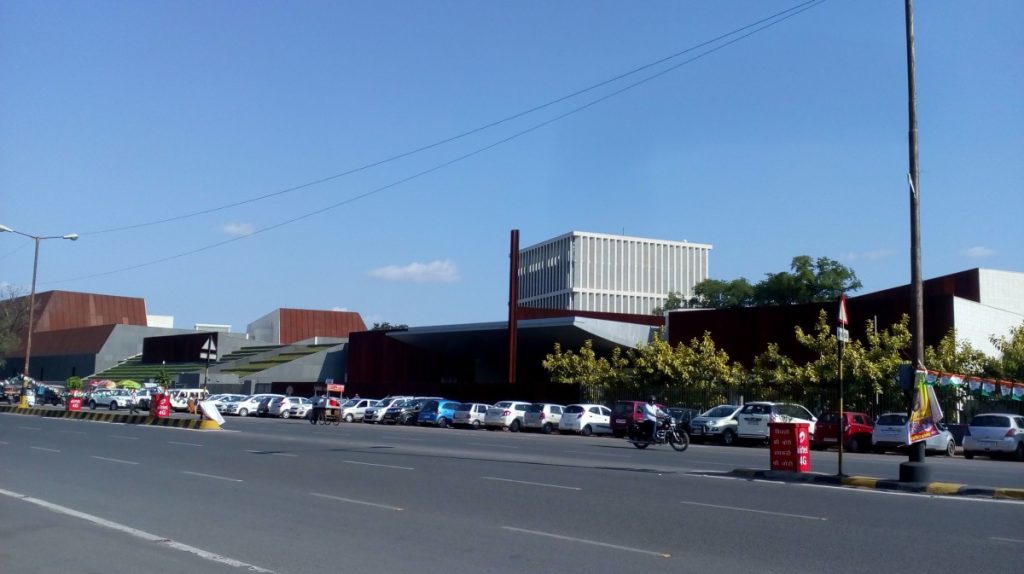
Exterior of the Bihar Museum in Patna. Photo: Shivam Setu/Wikimedia Commons. CC BY-SA 4.0.
The “History of Civilization” exhibit on the ground floor of the museum is not a mere display of antiquities, but it evokes a sense of memory, exploring ideas of identity and roots. It includes representation of the state’s rich history through artefacts in terracotta, bronze, stones and manuscripts.
Patna lends itself to be the most appropriate location for the event. Pataliputra, the old name of Patna, was a place where art and cultural glory thrived, and the region was the centre of education.
The exhibit underscores what the history of the region stood for – a seat of power that reflects the pluralistic nature of India where all religions existed side by side; Buddhism, Jainism, Sikhism, Hinduism and Islam. The museum reflects that inclusiveness and speaks of the plurality of India.
The temporary exhibits uniquely keep a non-Eurocentric approach through the selection of countries like Nepal, Costa Rica, Panama, Israel, Thailand and Russia. The title of the G20 exhibit – “Together We Art” – became an expression of various exhibitions within the biennale, a sort of meta-narrative of the curatorial framework of the number of exhibitions taking place through the four months of the biennale.
There is no singular theme that binds the entire biennale, rather, the main focus in this edition seemed to be to immerse, engage and enlighten all art enthusiasts as well as the general public. The programming is comprehensive to include a wide array of shows that shed light on the profound significance of various cultures and art forms.
Adriana Bustos, a multidisciplinary artist who currently resides and works in Buenos Aires, Argentina, presented the work titled “Bestiario de Indias” (Bestiary of Indias). A large-scale painting, it depicts a landscape populated by an array of fantastical beings, some of which possess a hybrid nature, combining human and animal characteristics.
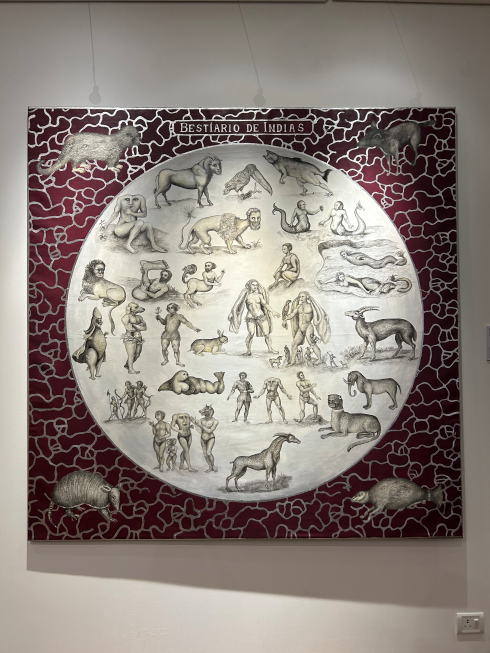
Photo provided by author.
The narrative is derived from the images and stories documented by the first chroniclers who arrived in the territories that later came to be known as the Americas. These representations and descriptions depict the chroniclers immersed in a hallucinatory world of dreams where men and women, plants and flowers, stones and landscapes intertwine to form enigmatic creatures that conceal and reveal the desires, fantasies and fears of humanity.
In her artistic practice, through cutting, joining and designing images, she aims to create artworks that challenge traditional notions of historical representation and invite viewers to engage with history in new and transformative ways.
In contrast, Kolkata-based Sanatan Dinda’s sculptural-installation titled “Bodhi Tree” examines the issue of e-waste and its impact on our environment and society. It draws attention to the Pandora's box-like nature of this progress, where advancements in global communication and entertainment come at the cost of non-recyclable toxic materials that harm our planet.
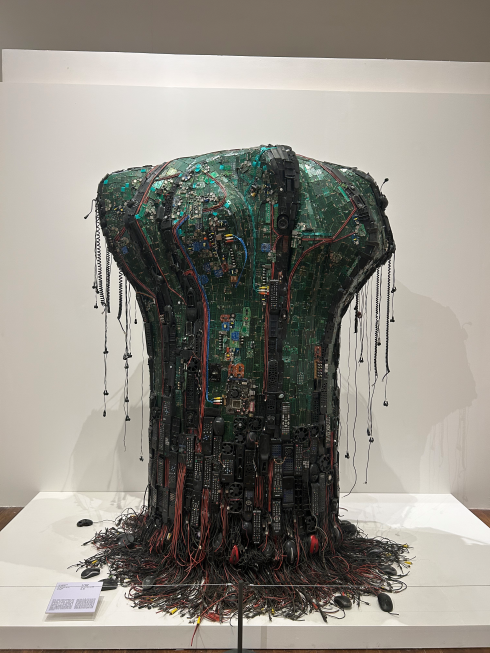
Photo provided by author.
It portrays the transformation of discarded electronic waste into the form of a tree, symbolising the consequences of our relentless pursuit of progress and consumerism. Through “Bodhi Tree”, Dinda draws attention to the community’s unsustainable practices and the irreversible damage caused by our ignorance. The artwork questions the progression of science and technology, accompanied by the forces of capitalism, which often endangers our ecosystem.
Isaac Chong Wai from Hong Kong, on the other hand, explores the conceptual, political and performative qualities incorporated by an interdisciplinary approach, processing the exigencies of societal shifts and global phenomena.
At the Bihar Museum’s G20 exhibit, Chong Wai has developed a two-channel video referencing Käthe Kollwitz's woodcut “Die Mütter” (1922-23). The performers move in a circle and sing lines from songs, including dirges and lullabies in various languages. The video is directed by musician Dagmar Aigner, who has been working with mourners for over ten years in Munich.
Revolving around the ideas of death, birth and motherhood, the work, named after Kollwitz’s woodcut, responds to the rhythm of histories marked by wartime experiences and places grief into a trans-national discourse.
It is intriguing to see folk and tribal cultures sitting juxtaposed with contemporary experiences and expressions created with the use of futuristic technology. This stems out of a key vision of the Bihar Museum itself – no divisions between antiquities, traditional or folk artefacts and crafts, and contemporary arts. They all sit side-by-side in the building designed by the Pritzker Prize-winning architect Fumihiko Maki.
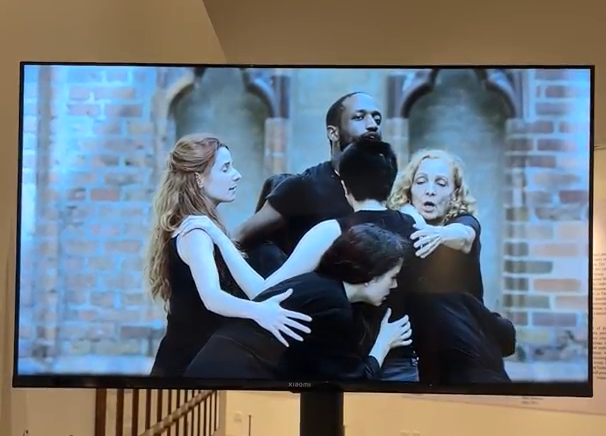
A photo of Chong Wai's video playing at the museum. Photo provided by author.
The event has initiated cross-collaborations to broaden the scope of the programming. The Chhatrapati Shivaji Maharaj Vastu Sangrahalaya (CSMVS) in Mumbai is showcasing a rich tapestry of Tanjore art paintings in an exhibition titled “Three Dimensions of Divinity - Thanjavur Art Revealed”, that pays tribute to the unique layering technique of the art form.
With over a dozen works displayed, the significant intervention included a wall that showcased the various stages of making a traditional Thanjavur painting.
Another display titled “Modern Indian Painting” by the Salar Jung Museum of Hyderabad showcases the culture of Telangana through an artistic lens. It comprises a selection of works by contemporary artists responding to the idea of Telengana’s people and culture.
The Nepal Art Council has brought the exhibition “Nepal: Where The Gods Reside” to the biennale. Through over 70 artworks, the display aims to impress upon visitors the vastness of the country’s syncretic spiritual atmosphere, as the abode of deities. The most striking display is the 108 interpretations of Lord Buddha, made in traditional miniature style.
From Russia comes “Mystic Universe” – a show offering a journey that fuses ancient mysticism with state-of-the-art technology. Artists like Julius Horstuis, Luminokaya and Igor Baranko created a distinct 360° immersive experience in a dome, with technologies like virtual reality weaving Vedic philosophies.
In all this, a cohesive theme to bind the various shows was missing. Many of the exhibits were mere documentary in nature, like the presentations on “Making of the Bihar Museum”, “Patna, the City of Museums”, and “Maritime Museum at Lothal”. Salar Jung's presentation was underwhelming in the choice of contemporary artists to represent the culture of the state.
The Kiran Nadar Museum of Art, Delhi, is the knowledge partner, which has created an outreach plan that aims to enhance the scope of public accessibility to art and museum culture through the tool of engagement and interaction. At the main entrance lobby, they are also exhibiting two installations, “Taj Mahal” by Sudarshan Shetty and “Cheap Rice” by Subodh Gupta.
Rahul Kumar is a Fulbright Scholar. He is a curator, artist and an art journalist, and writes on global contemporary visual arts.
This article went live on September eleventh, two thousand twenty three, at thirty minutes past five in the evening.The Wire is now on WhatsApp. Follow our channel for sharp analysis and opinions on the latest developments.


