

Indian Art From the 16th and 20th Centuries Hits London Headlines


Two events in London last week illustrate Indian art’s growing importance, both for moneyed collectors and for galleries and museums. Just as previews were starting on October 28 at the Royal Academy of Arts in Piccadilly for a much-heralded exhibition of works by renowned sculptor Mrinalini Mukherjee and her fellow artists, one of the most striking auctions for years was hitting record prices a few hundred yards away at Christie’s.
Bids were flowing for 95 classical Indian and Islamic works from the personal collection of Prince and Princess Sadruddin Aga Khan, part of the family of the Ismaili Muslim sect’s spiritual leader. Records were broken with sales totalling £45.76m.
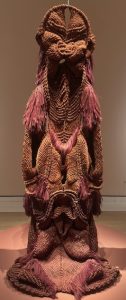
Mrinalini Mukherjee’s 7ft high “Pakshi”.
At the Royal Academy (RA), the most striking work on show was Pakshi, Mukherjee’s iconic seven-feet high suspended sculpture (left) of voluminous golden-brown to pinkish red knotted hemp resembling both a deity and a human figure.
At Christie’s, headlines were grabbed for a 12in x 7in painting on cloth of a “family of cheetahs in a rocky landscape”, attributed between 1575 and 1580 to Basawan, a famous Indian Mughal artist who was said to have been a favourite of Emperor Akbar.
This established a record for a classical Indian or Islamic painting with a hammer price of £8.5m ($11.16m), an astonishing 12 times the low estimate, and £10.25m including fees.
The works were mostly acquired by Sadruddin and his wife between the 1960s and 1980s, and the sale attracted buyers who have been setting new records this year for 20th and 21st century modern Indian art as well as museums and other collectors from the Middle East and elsewhere. The £45.76m ($60m) total beat the top South Asian art auction record of $40.2m achieved at a Mumbai-based Saffronart sale of modern works on September 27.
“This was a once in a lifetime opportunity to acquire very famous paintings from a highly illustrious collection,” says Hugo Weihe, an independent Indian art advisor. The prices achieved for the many relatively small paintings showed “that it is not always about size, but artistic merit and appreciating the full scope of cultural heritage.”
The overall sale was Christie’s second significant coup within a few months. It lagged behind other auction houses during the South Asia summer sales, but in March it achieved the highest auction price ever for an Indian painting – M.F. Husain’s 1954 Gram Yatra, which sold for $13.75m.
Mukherjee’s RA show, which continues till next February, is significant both for the artist and for Indian modern art at a time when international attention is growing with the high auction prices and increasing institutional interest in staging exhibitions.
This is the first exhibition of Indian modern art at the Royal Academy since the 1982 Festival of India in the UK that was driven by the then prime ministers Margaret Thatcher and Indira Gandhi. Benefitting from the political focus, it involved works by 45 artists in the main large galleries (currently occupied by a stunningly dramatic and colourful exhibition of the American artist Kerry James Marshall). With works by seven artists, the Mukherjee exhibition is located on one of the academy’s upper floors.
Also read: Indian Art Boom Generates $96 Million in Two Weeks’ Auctions
Mukherjee’s last UK show was some 30 years ago in Oxford, though she had an acclaimed exhibition titled Phenomenal Nature at New York’s Met Breuer gallery in 2019. Pakshi was among her “deities” shown at the 2022 Venice Biennale.
With almost 100 works spanning a century, the RA exhibition flows on from a modern art show at London’s Barbican last year, which had a tighter-focussed 1975-98 time span with over 150 works by 30 artists, including Mukherjee and several others who are at the RA.

Christie’s 16th century record breaking family of cheetah in a rock landscape.
Sadly, there are on show only a few of Mukherjee’s spellbinding large textile figures like Pakshi for which she is most famous. This is partly because of financial constraints and partly because of what the RA describes as conservation issues with transporting older hemp works (though more have appeared at other exhibitions).
Mukherjee’s other bronze and ceramic sculptures along with water colours are also on show, accompanied by works by her mother Leela and five other artists who were friends and who influenced each other’s styles. A very high proportion of the works have not been shown abroad before, including those by her mother.
The friends include husband and wife Gulammohammed (GM) and Nilima Sheikh. GM Sheikh had a memorable retrospective in Delhi early this year and both were included in the Barbican exhibition. Nilima has a softly colourful installation of hanging vertical scrolls not previously seen outside India, Titled Songspace, it uses milk-based casein protein to bind the paint pigments. Other notable works include paintings by Jagdish Swaminathan and K.G. Subramanian.
The RA says that the main aim has been to show the close relationships and shared learning and support between the artists. This formed a “vibrant creative and intellectual network that influenced the development of modern and contemporary art in South Asia”.
As one of the oldest art schools in Europe, the RA highlights India’s notable art institutions—the Kala Bhavana (Institute of Fine Arts) in Santiniketan, founded in 1919 by the Nobel laureate Rabindranath Tagore, and the Faculty of Fine Arts at Maharaja Sayajirao University in Baroda, which are both noted for their artistic learning and styles. They comprise two of the sections of the exhibition, the third being Delhi.
Notably not included, because they are not relevant to the Mukherjee story, are the Mumbai-based Progressives such as M.F. Husain and F.N. Souza who date from the 1940s and dominate the top end of the auction market.
Mukherjee’s most memorable exhibition, Transfigurations, opened in Delhi’s National Gallery of Modern Art just a week before she died in 2015, aged 65. The gallery’s vast spaces were filled with her large and striking textile sculptures as well as metal and other works. I walked through that exhibition with the curator, Peter Nagy of Delhi’s Nature Morte Gallery, and wish I had written about it then.
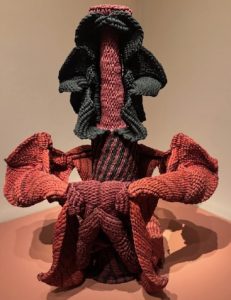
Mrinalini Mukherjee’s “Adi Pushp II” described as “a potent emblem of generative energy and affirming nature as a vital erotic life force”.
Tarini Malik, now the Royal Academy’s chief curator for modern art, was also there and met Mukherjee before the artist died. That gave her the ambition to stage what is now on view at the RA, while acknowledging that the show should have been done years ago.
The RA covers the theme of Mukherjee and friends well, with neat division into the three Santiniketan, Baroda and Delhi parts. For many, it is a welcome opportunity to see so many works by respected names that have been loaned from normally hidden private collections. But unfortunately this is neither an exceptional display of a century of Indian modern art, nor an adequate display of Mukherjee’s drama.
Reviews in the UK media so far have been partly critical, reflecting the absence of enough of Mukherjee’s big textile work and the remoteness of the basic theme. The FT tactfully ends a generously positive full page-spread with “the contextual lacunas make this seem more a show, perhaps, for the initiated connoisseur”.
The Guardian is most belligerently negative. After saying Mukherjee’s “surreal spins on Indian folk and sacred art are powerfully fascinating”, it asks why the RA has tried “to suffocate her exhilarating works in an incoherent show that surrounds them with mediocre stuff by much less interesting artists”.
The Times reviewer says, “In many ways, it’s a beautiful show, aided by soft lighting and pale-pink walls. But I can’t help but wonder whether it would have been better off as a family affair.”
This is not the end of the story. Tarini Malik will be curating a follow-on exhibition next May at the Hepworth Gallery in Wakefield that describes Mukherjee as “one of the world’s most significant modernist sculptors”. The gallery website says this will be a major Mukherjee retrospective, but it seems that it will also include her mother Leela along with sculptures by other female artists. The critics hope that the focus will be clearer than many see it at the RA.
This article first appeared on the writer’s blog Riding the Elephant.
The Wire is now on WhatsApp. Follow our channel for sharp analysis and opinions on the latest developments.


