

Seamus Murphy and The Discipline of Distance


Seamus Murphy opens the show with a line from James Joyce on the wall, “Every life is in many days, day after day, we walk through ourselves meeting robbers, ghosts, giants, old men, young men, wives, widows, brothers in love, but always meeting ourselves,” and for Murphy a photograph holds what a life looked like passing through a place, his own included.
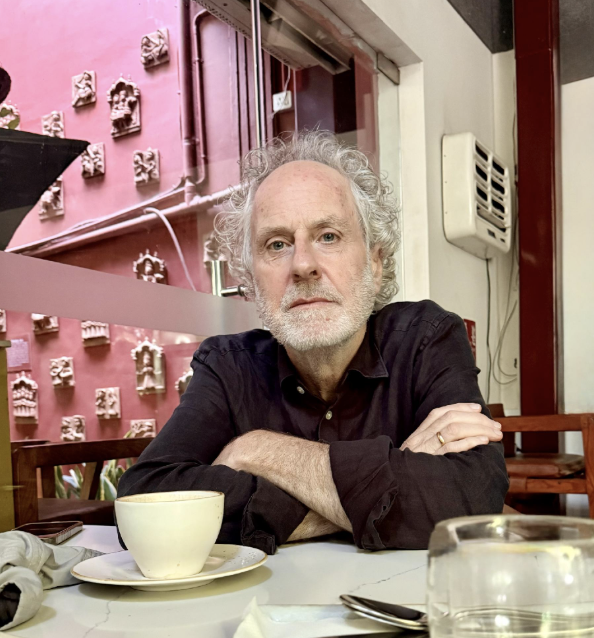
Seamus Murphy. Photo courtesy: Samar Jodha.
'Life is in Many Days', showing at Museo Camera in Gurugram, with Zelda Cheatle as curator, brings together work made across more than 30 years, and across Afghanistan, Ireland, America, Russia, and Kolkata – where he has spent a part of each year for some time now, closer to a second home than an assignment. The photographs themselves carry the same conviction throughout, that a photograph doesn't need explaining, that meaning arrives through atmosphere rather than argument, through an ordinary moment rather than an extraordinary one. Murphy has seven World Press Photo awards to his name. That's plainly not where his own interest sits.
Seamus Murphy first went to Kabul in November 1994, a city under blockade, in a civil war the Red Cross then judged the deadliest place on earth, and in the Shor Bazaar district of the old city he photographed the Ba Deli family, the father and his four sons together, Farhuddin among them, who had lost a leg in a rocket attack on the street the year before, and Murphy has returned to Afghanistan 20 times since, through years he could not get a visa back in, through decades of war that never really got anywhere, and he does not speak of them as subjects now, he speaks of people he will not walk away from.
One picture from that Afghanistan work sits apart from the rest of it, a coal miner, mid shift, among his sacks, head thrown back, laughing, and Afghanistan usually reaches people through one register only, the gaze fixed on disaster, on pain, on suffering photographed the way suffering is supposed to look, and this isn't that. A man simply living, more than what the world has decided it wants to see out of that country.
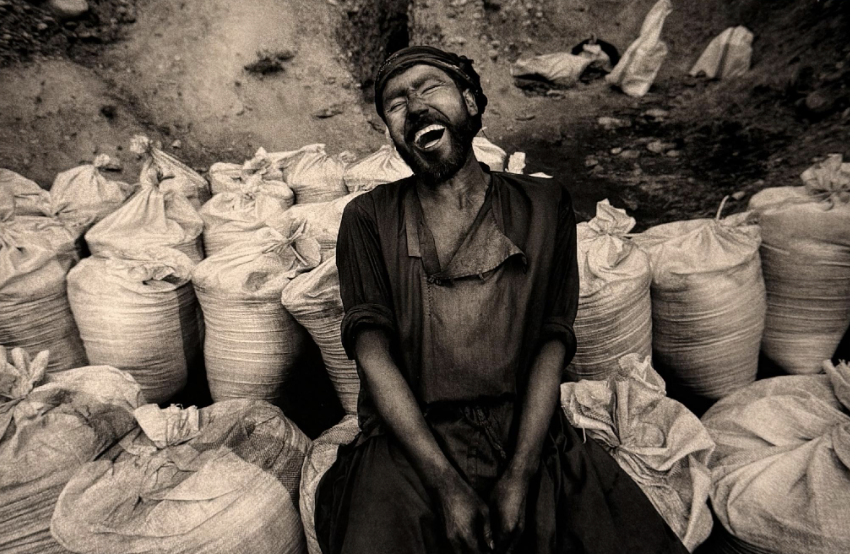
Gazastan, Takhar Province, Afghanistan, 2004. Photo: Seamus Murphy. Photo courtesy: Samar Jodha.
Ask Murphy what makes a photograph and the answer splits into two kinds of choice, some are his, the lens, the distance, the decision to turn down one lane instead of another, and some are not, whatever happens to be waiting at the end of the lane he chose. He doesn't call this staging – 'the man was simply asleep' – he calls it serendipity as much as instinct. When the conversation turns to artificial intelligence, the distinction he reaches for is not technical, it is moral. The camera itself doesn't lie, he says, you don't rely on the camera for evidence. The intention behind whoever is holding it is where the truth is honoured or not.
That same instinct decides how he moves through the world once the camera is down, and he has said he needs to remain something of an outsider even among people he loves, that he switches photography on and off rather than living inside it permanently, because staying in that mode constantly around people who are not his subject would be an imposition on them, not coldness so much as the condition that makes it possible to stay this close to one family for this long without the closeness turning into performance, or the seeing into intrusion.
None of that came free either, plenty of photography gets called conflict work from inside an itinerary someone else arranged, a fixer, a driver, an embed, home again within a fortnight carrying the frame a commissioning editor had already decided on, but Murphy kept going back to a country where the risk stayed real the whole time, where a name on a bullet was nobody else's problem to worry about, and probably a great deal of what he actually brought back over those years never really made it into print, not because it wasn't true, but because it didn't serve whatever line a newsroom elsewhere had already settled on. His commitment was always about what he did with the years that followed the visa stamp.
Against that discipline, he measures what photography has largely become, more followers, more extreme pictures, more desperate stories, and now, openly and unapologetically, invention, images with no remaining claim on what was actually in front of a lens, an Instagramisation of the image is what I'd call it, where a picture's worth is set by how fast a stranger can understand it. Murphy's own answer to that is a refusal rather than a better technique, going against the flow rather than swimming inside it, because the flow, as he put it, is endless, and staying in it too long means going under. Plain enough to say to anyone starting out now, if you want to be part of the crowd, you will never have a voice.
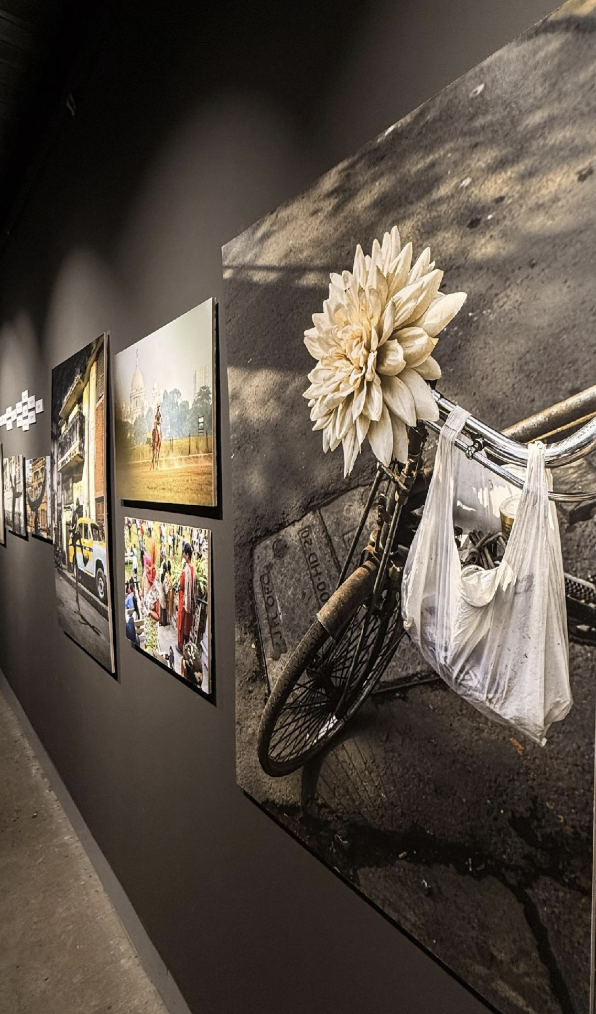
Photo: Seamus Murphy. Photo courtesy: Samar Jodha.
There is a photograph of Murphy's of a Kolkata bicycle, the kind a working man rides, plastic shopping bags looped over the handlebars, and tucked in among them, a single white dahlia, put there by someone with no reason to expect a photographer walking past. Murphy did not arrange it, he only turned down that street instead of another one, flower, bags, wet grey road, exactly as he found it. Described, not explained, exactly as he'd want it.
Life is in Many Days is on view at Museo Camera, Gurugram till October 25, 2026, part of the venue's programme marking 200 years of photography, 1827 to 2026.
Samar Jodha is a transdisciplinary artist, photographer, and TED speaker, working across South Asia, West Asia, and East Africa.
This article went live on October fourth, two thousand twenty six, at twenty-five minutes past one in the afternoon.The Wire is now on WhatsApp. Follow our channel for sharp analysis and opinions on the latest developments.


