

Secular Fabric: A Mumbai Designer Is Ensuring Flowers of Faith Are Reborn in Cloth


Italian designers Dolce & Gabbana are known for their Catholic opulence – sequined sacred hearts and crosses in gold-thread embroidery. Pop star Madonna has simulated stigmata, the hand wounds mirroring Christ, to a mock crucifixion in her music videos and live shows. Indian couture designers, from Gaurav Gupta to Rahul Mishra, have relied heavily on temple art, goddesses and ornamentation in their latest couture shows, weaving religious and cosmic iconography in intricate zardozi, resham and laser cuts.
But this is perhaps the first time that a textile designer is not just referencing religious and cultural iconography but has decided to use religious offerings and ornamentations to create natural dyes for fabrics. Adiv Pure Nature’s Temple Blessings Project, started by Rupa Trivedi, is charged with plurality and multiculturalism. It splashes natural cottons and silks with organic dyes extracted from the tonnes of flower waste from the two most iconic religious sites in Mumbai – the 200-year-old Siddhivinayak Ganesha temple in Prabhadevi, and Haji Ali Dargah, the famous Sufi shrine on an islet off the coast in Worli.
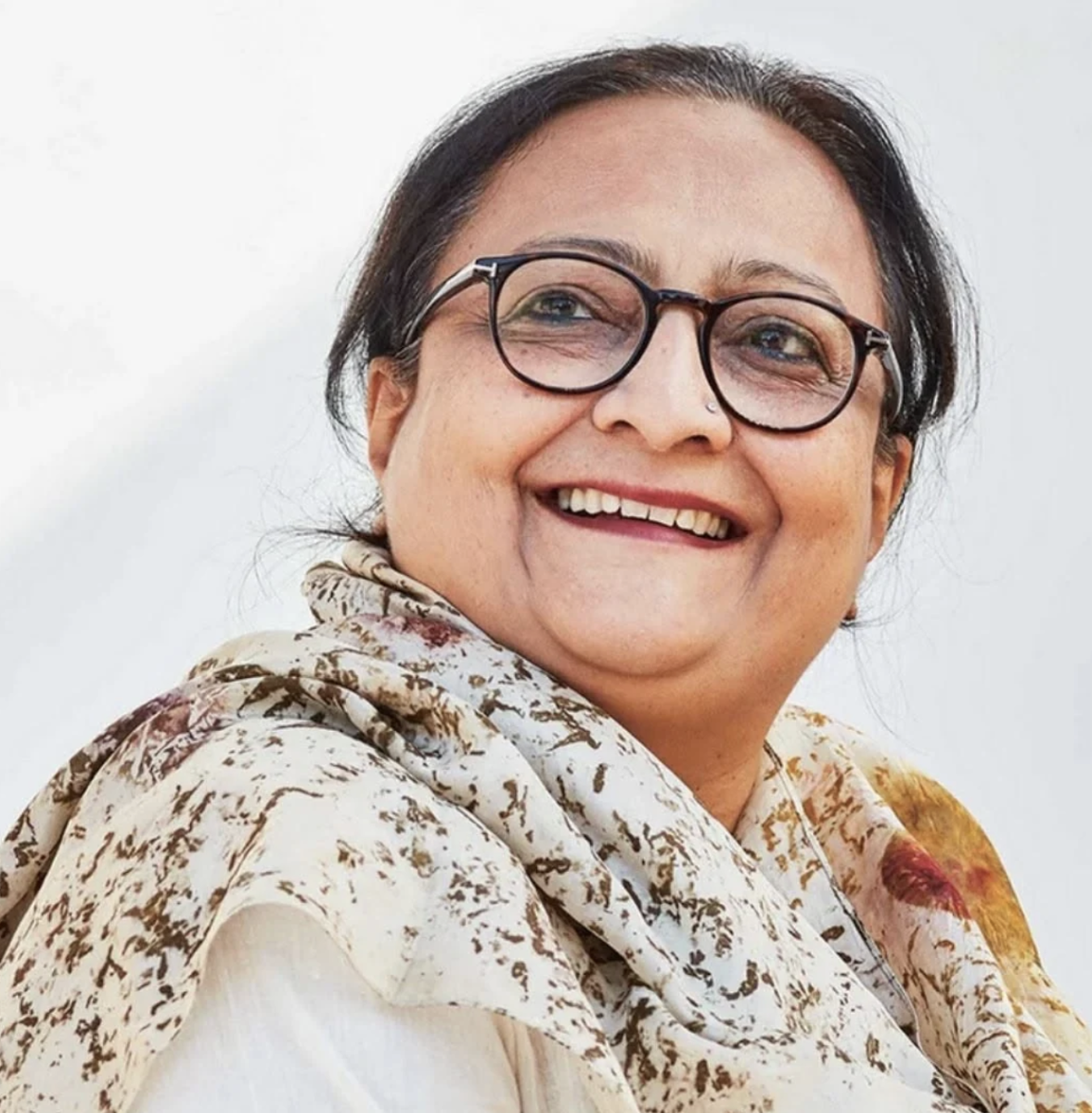
Rupa Trivedi. Photo: adivpurenature.com.
The Mumbai-based artisan’s studio in an industrial estate in Andheri East, a suburb in Mumbai, has created an innovative template of natural dyes and materials for textured prints designed for scarves, tableware, pin-tuck dresses and other garments, for the domestic market as well as global brands like Anthropologie and Eileen Fisher, along with folk art markets in Santa Fe and Madrid. The colour dyes from the floral offerings are vibrant – from the sunburst marigolds that symbolise purity, auspiciousness and the divine to the red hibiscus flower petals used for worshipping Ganesha and Kali; from leftover coconut fibre from offerings, which yields a soft, old-rose pink colour to the fragrant desi Indian roses, mostly red with frequent flushes of pink and white, that are offered as flower chadars to cover the tomb inside the dargah of Haji Ali.
While it’s been more than a decade since Trivedi started the Temple project, it’s Adiv’s secular process of entwining flowers and fusing their colours and dyes in apparel and furnishings from the temple and mosque today that makes the enterprise unique.
It did not begin so much as a religious or spiritual venture but was more of an environmental enterprise. Trivedi launched it in an effort to save the sea and its fragile shores.
“For years, after the Ganesha immersion during the festival, which happened recently too, the Mumbai sea and shores were awash with broken clay statues and rotting flowers. It was a giant mess, and it really broke my heart. I had just finished studying the art of extracting natural dye from marigold, and I thought, why not get the flowers from the temples which are dumped in the water routinely, as a way to save the sea? Of course, it was going to be only a drop in the ocean, but I decided to get in touch with places of worship in the city and get their offerings to make natural dyes," Trivedi says.
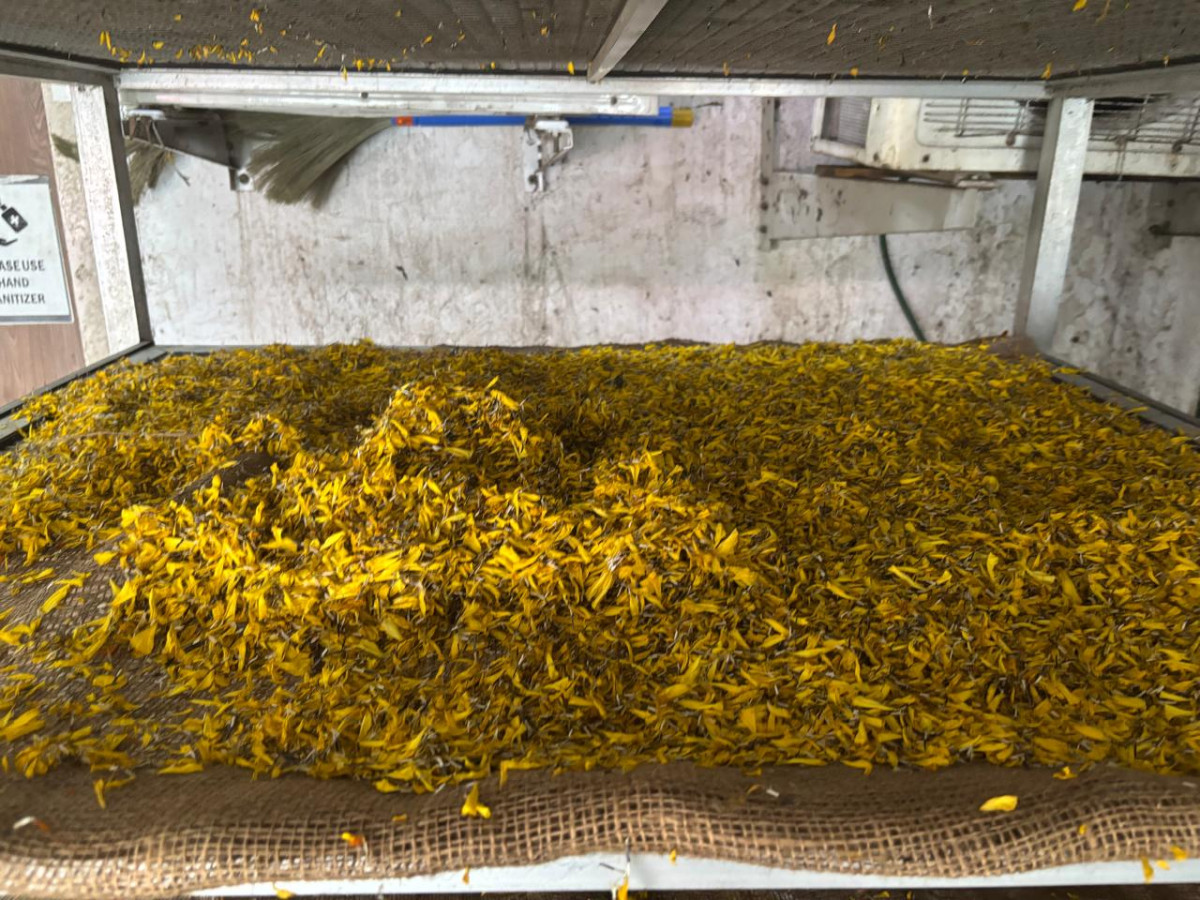
Flowers gathered at Adiv's studio, to be processed. Photo: By arrangement.
It was not an easy task in the beginning, as temple administrations were disagreeable to giving Trivedi the floral offerings after the rituals were over. “There was all this business of who could touch the flowers and who cannot,” says Trivedi. “But after visits to several temples, I decided to simply walk into the Siddhivinayak temple management trust – and while it is the biggest temple, it is not an easy one – and ask them for their flowers. Perhaps it was the alignment of some universal forces but the chairman agreed in minutes after I told him what I intended to do. Not only did he agree to give me the tonnes of flowers but also the facilities to segregate the good from mulched ones, a place for storage, and an employee to be in charge, who would be paid by us. The sorter has been with us ever since," she says.
The roses and tuberose plaited together to create the thousands of latticed chadars offered in Haji Ali are segregated and collected by yet another paid worker in the dargah, and transported to Adiv’s studio to be dried and processed to extract their natural colours. The flowers from the temple come three times a week to the workshop, while the roses from the dargah come twice; the weekly count is about 1,000-2,000 kg from both shrines, and doubles during festivals.
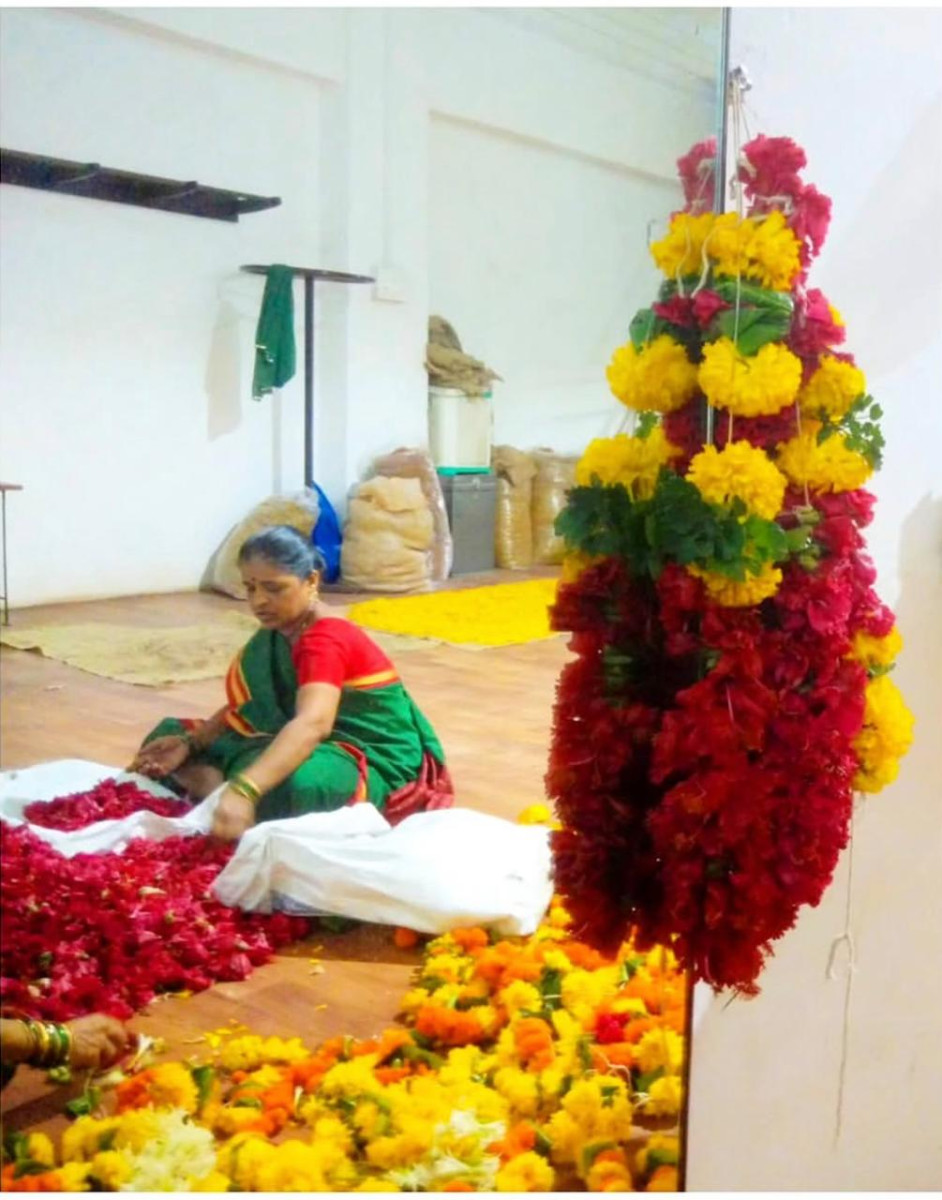
A woman sorts flowers before they are processed. Photo: By arrangement.
“It’s all that we can take,” says Trivedi. “Workers in the studio, I call them urban artisans, don’t just do the dyes but we also pulverise excess dyes into powder to be stored for later; compost floral leftovers, recycle used dye water and use other non-toxic ecological practices. The sustainability concept extends to the workers too; they come from nearby slums, both women and men; we have trained together and are invested in it together.”
Adiv uses other natural ingredients like food waste too – from pomegranate and onion peels from neighbourhood eateries, and pigments like natural madder and indigo. The workshop does patterns and textures, tie-dye and block printing, shibori, petals for imprints, boiling and steaming. “We’ve used an idli steamer to experiment with flower patterns and colours and created the eco-print Idli steam dye,” says Trivedi, adding, “I am not a designer of garments. We create fabrics that are styled by various designers – so far we’ve collaborated with a foundation in Spain to do a collection of sacred wraps; Ateev Anand of Re-Ceremonial and Teev, Arjun Saluja, Narendra Kumar Ahmed and others. My focus is on dyes and we have to keep updating with the times.”
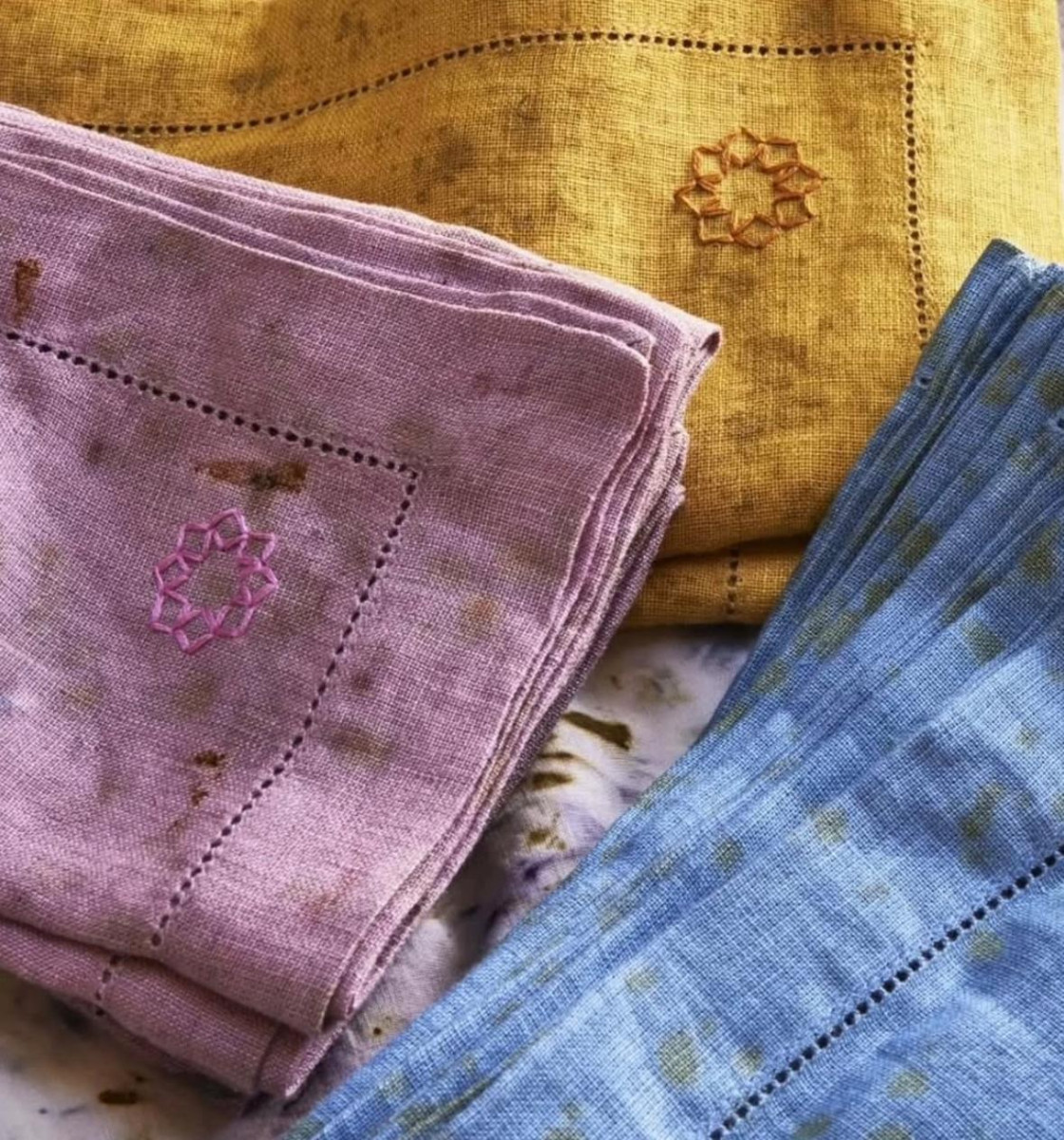
Fabric coloured with the dyes extracted from flowers. Photo: By arrangement.
Pomegranate peels give shades of silver, grey and black. Coconuts give an old-rose pink; their husk gives a nude beige. Roses a vibrant red; marigold a bright yellow, mixed with indigo, gives an emerald green; marigold and onion peels give olive green; pink onion peels with a mordant give gold; and, of course, marigolds and rose petals are imprinted as bundle dye on scarves. These prints are called mandir-masjid. They also exist in other combinations.
Has Adiv made secularism a fashion brand? “Yes, it is a brand, but unintentionally though,” says Trivedi. “And this fusion of flowers and dyes is a style that can attract the fashion industry to come towards us in a palatable way, even as we continue to be very close to the craft we’ve evolved and created for the fashion industry. Ours is an enterprise for product development, sustainability of human dignity and environment, and promoting natural beauty. There’s always room for more.”
This article went live on September twenty-second, two thousand twenty six, at twenty-four minutes past four in the afternoon.The Wire is now on WhatsApp. Follow our channel for sharp analysis and opinions on the latest developments.


