

Ebrahim Alkazi: The Early Stirrings of a Renaissance Man


The following is an extract from Ranjit Hoskote's curatorial essay for Opening Lines: Ebrahim Alkazi, Works 1948-1971 (Art Heritage, New Delhi, 2019).
Bombay’s cosmopolitanism, especially between the 1930s and the 1960s, has often been misunderstood as merely a byproduct of Westernisation. Bombay had an Art Deco quarter before Miami did; it featured on the international jazz circuit. And yet, its young intellectuals were not indifferent to sources of political ferment and cultural energy outside their charmed metropolitan circle. Nor were they all wrapped up in an easy Anglophone assurance; they reached out to languages other than English to develop a comprehensive sense of cultural discussions across India.
A more attentive look at the cultural circles in which Ebrahim Alkazi was socialised, on moving from Poona to Bombay at 17 and starting life as a student at St Xavier’s College, would reveal a richer, more complex texture to Bombay’s openness to diversity. Alkazi was drafted into the Debating Society and soon came into contact with Sultan ‘Bobby’ Padamsee, who had returned from Oxford during World War II and presided over the St Xavier’s Shakespeare Society. Crucially, Bobby’s gift for overflowing with ideas was combined with a pragmatic ability to realise them. Inspired by Wagner’s idea and Diaghilev’s practice of the Gesamtkunstwerk – theatre conceived as a synthesis of all the arts – Bobby opened expansive intellectual and artistic horizons for Alkazi and other colleagues. With Alkazi, Jehangir ‘Jean’ Bhownagary, Derek Jefferies, and Hamid Sayani, Bobby founded the Theatre Group.
Looking to Santiniketan, Bobby set himself to bridging the gulf between European and Indian aesthetic philosophies, and embarked on a production of Rabindranath Tagore’s one-act play Chitra, casting Alkazi in it. This involved, for the young Arab-Indian, a rigorous regimen of training in Kathakali under Guru Mampuzha Madhava Panicker, who had revived this classical form. Bobby’s untimely death in early 1946 was a shock to his circle of friends, who, however, rallied bravely around his ideals and committed themselves to taking them forward. Having already fallen in love with Bobby’s sister, Roshen, Alkazi married her later that year. The marriage would involve a lifelong collaboration, with Roshen researching and making the costumes for the actors in Alkazi’s plays.
To train himself formally as a theatre-maker and to engage at first hand with advanced cultural production, Alkazi decided he must go to Britain. Astutely, he realised that British art and theatre tended to be more conservative than their French counterparts, but the ease of language and familiarity pointed him towards London. He sailed out in 1948, and would spend the next three years in London; he enrolled at the Royal Academy of Dramatic Art (RADA) and also spent a productive summer at Dartington Hall in Devon, an artists’ retreat and educational centre modelled on Santiniketan. At various points, Alkazi would be joined by Roshen; by his close friend, the poet Nissim Ezekiel; and by the artist F N Souza and his wife Maria.
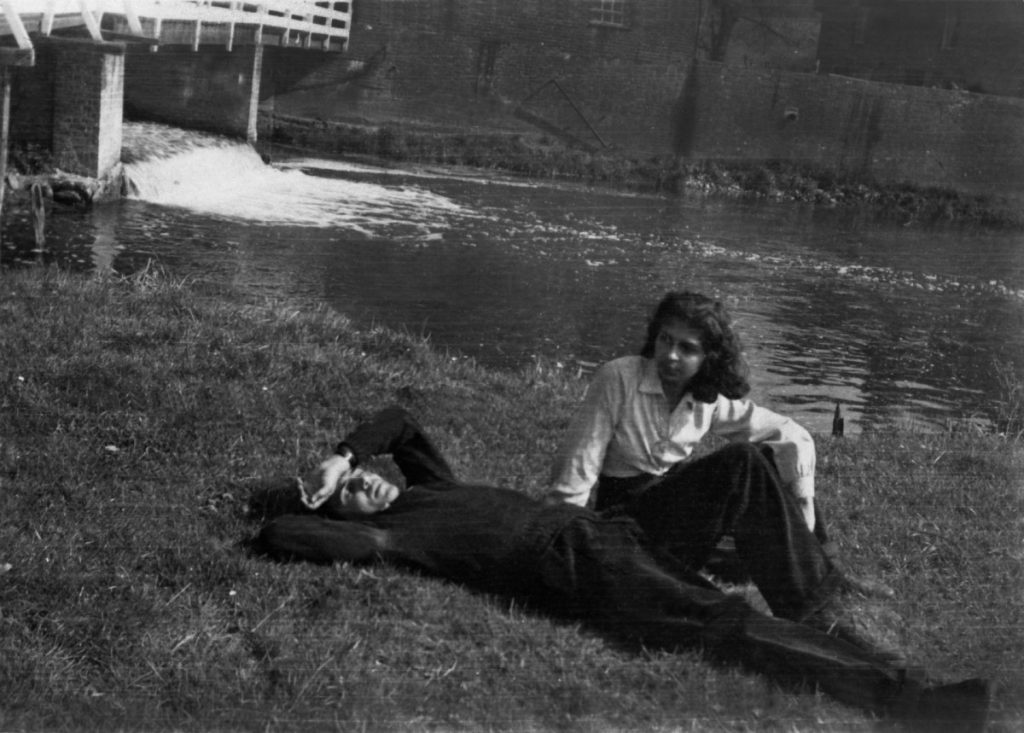
Ebrahim Alkazi and Roshen Alkazi in the UK in 1949. Photo: Courtesy of the Alkazi
Foundation
Alkazi and his circle read widely and deeply in those years of intense preparation for their future journeys. They read the art critic Herbert Read, who, as co-founder of the vibrant new Institute of Contemporary Arts (ICA, established 1947), was a magisterial presence on the multi-disciplinary, avant-garde London scene. Roger Fry, a key member of the Bloomsbury Group, had been dead 14 years by the time Alkazi arrived in London – but his thought and practice continued to shape debates about art, creativity, and cultural institutions. He had been an artist, a critic, an editor, a curator, and the founder of the Omega Workshops, an art and design collective. The erudite art historian, museum professional and indefatigable populariser of art, Kenneth Clark, was busy doing a series of public lectures on art during those years. From across the Channel, André Malraux’s ideas would have made themselves felt. Not coincidentally, perhaps, all these figures had multiple practices: as artists, critics, organisers of exhibitions, institution-builders, and popularisers of the arts.
Also Read: Remembering Ebrahim Alkazi, the Master Who Helped Shape Modern Indian Theatre
Once Alkazi was ready to show his own work, he was invited to hold an exhibition at the gallery of the Asian Institute, which had been founded in London in 1950 by D P Chaudhuri. The Institute was socialist and globalist in its allegiances, from the evidence of its cycle of exhibitions and a short-lived periodical that it published, Asian Horizon. Alkazi’s first solo was formally opened on the evening of 18 September 1950 by his friend, the poet, art critic and cultural organiser Nissim Ezekiel (1924-2004). The close friendship between the two young men – one belonging to an Arab émigré family, the other descended from Jews settled in western India for two millennia – was a mutually energising one. Ezekiel, who would become a foundational figure in the lineage of Anglophone poetry in India, joined Alkazi in London, where they shared the “basement flat” mentioned in some of Ezekiel’s poems. The poet stayed on there after Roshen came out to London to join her husband, and they moved to an upper floor. Ezekiel’s first collection of poems, A Time to Change (1952), was dedicated to them: ‘To Elk and Roshen’. Alkazi’s erotically charged London series, ‘Lovers II’, is based on a poem by Ezekiel, included in the exhibition catalogue.
Ranjit Hoskote is a poet, essayist and curator based in Mumbai. In 2019, he curated Ebrahim Alkazi: Works 1948-1971, and is working on a book on Alkazi's career as a visual artist.
The Wire is now on WhatsApp. Follow our channel for sharp analysis and opinions on the latest developments.


