

Delhi’s Stolen Villages: How Constitutional Betrayal Built an Illegal City in Plain Sight


New Delhi: Thirty years ago, Delhi’s villages stood at the threshold of history. The 73rd constitutional amendment of 1994 promised them self-governance, dignity and control over their future through panchayati raj institutions. Instead, that promise was buried in silence. And in that silence, Delhi’s villages were looted.
The Union ministry of home affairs has refused to release 30-year-old files on this betrayal. When asked under the RTI Act in March 2025, officials denied access under the absurd excuse of a “fiduciary relationship”.
The truth is simple: disclosure would expose decades of fraud.
It will expose how lands were swallowed by unauthorised colonies; how “commons” were destroyed and how Delhi’s youth were branded as criminals in a city built illegally on their ancestral soil.
This was not an oversight. It was fraud – a constitutional crime executed in plain sight and a strategic manner.
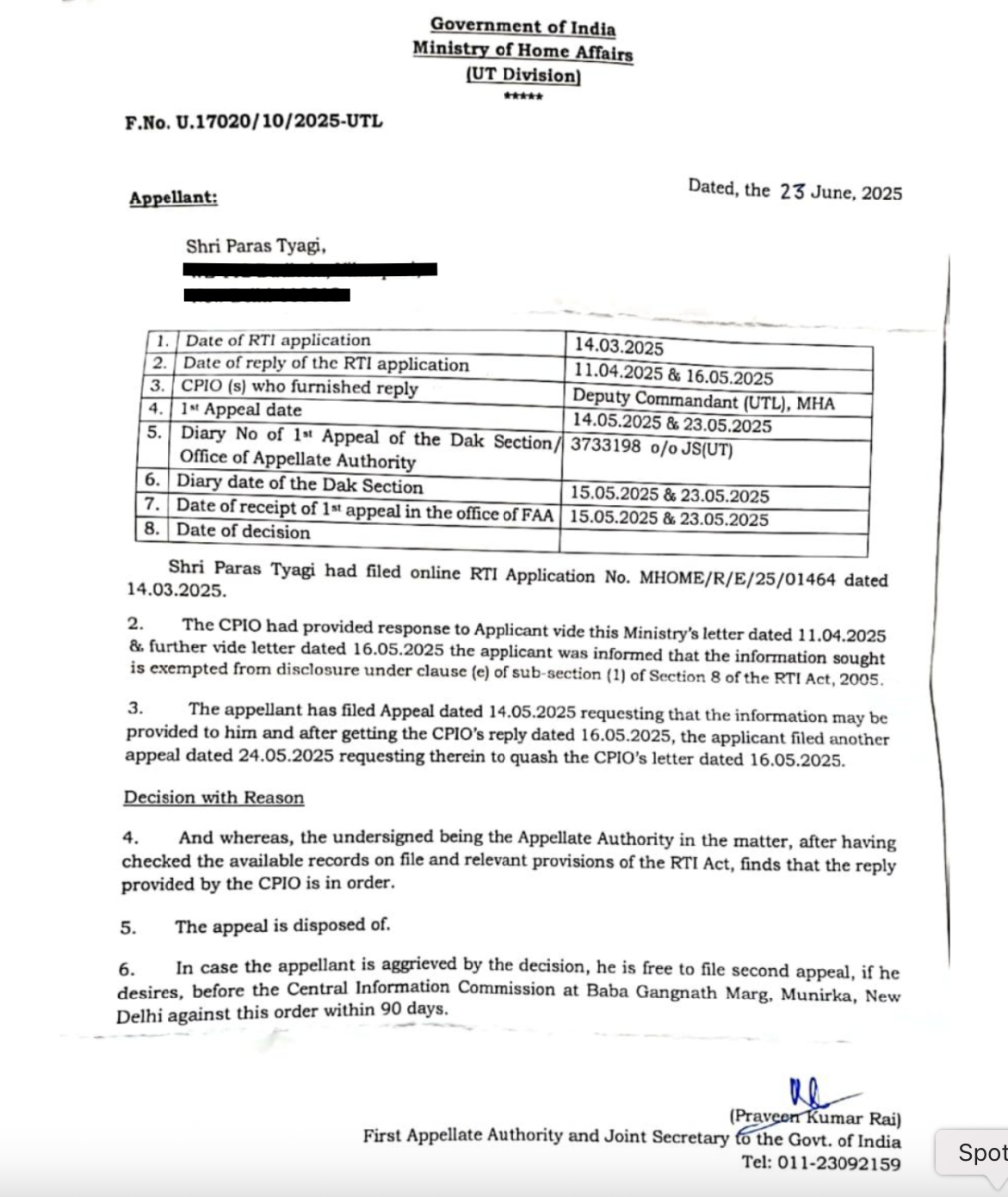
The MHA's response to an RTI application filed by Paras Tyagi.
The constitutional crime nobody talks about
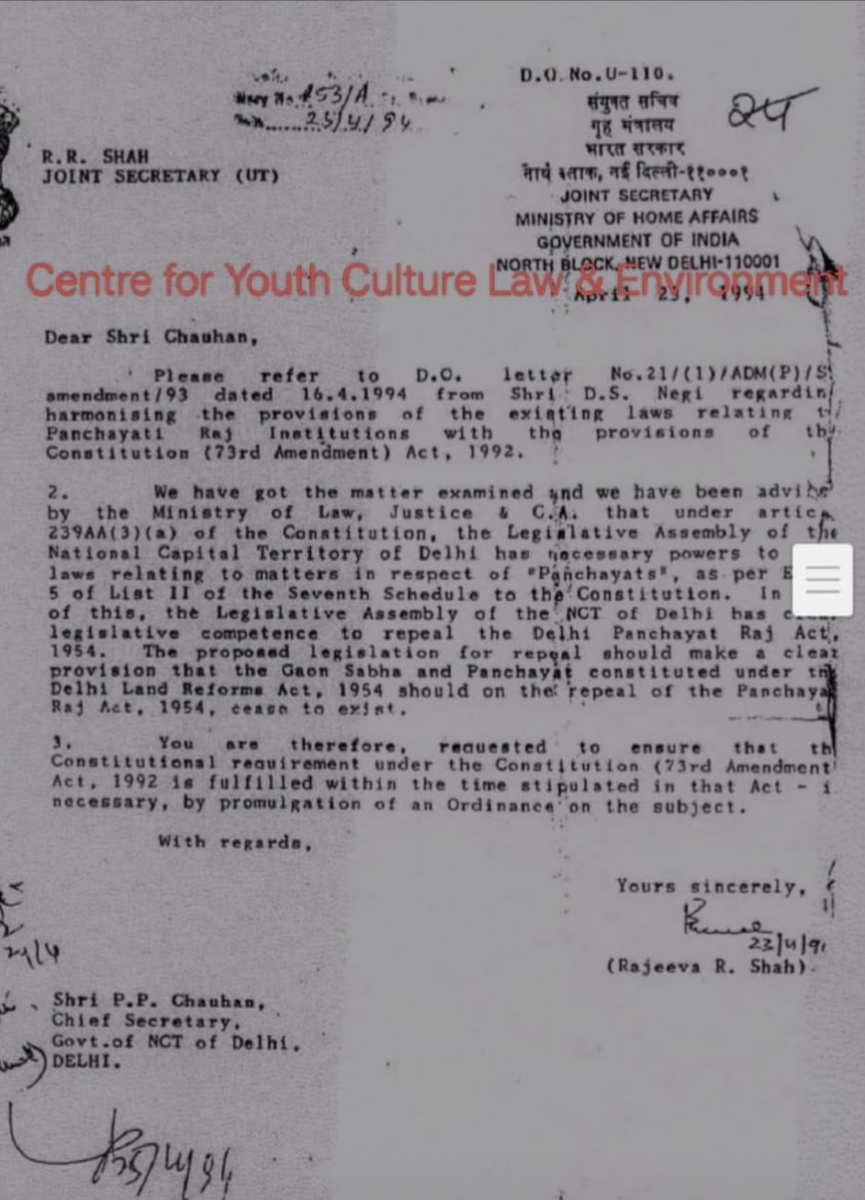
The constitution mandated that every village in India should be governed by its own panchayat. Delhi was no exception. The MHA, which directly controls Delhi’s governance framework, had the duty to align the Delhi Land Reforms Act, 1954, and Delhi Panchayati Raj Act, 1954, with the 73rd Amendment.
Files were created, communications exchanged. But the process was quietly killed. No amendments. No notifications. No empowerment.
Instead, the vacuum became Delhi’s governance model. Land mafias, corrupt intermediaries and unauthorised colony developers filled the gap, while elected governments feigned helplessness.
The capital city was built not by law but by countless public policy frauds that now continue on a daily basis.
Rise of unauthorised Delhi
After not holding panchayat elections from 1983 to 1990, the lieutenant governor of Delhi ordered that "the term of the pradhans had ended and now the duties of the panchayats would be discharged by the deputy commissioner”.
The Delhi National Capital Territory Government Act was born, and it put an end to the governance of rural Delhi forever. What happened then is now used as a model in many other states where village panchayats are being weakened to sell the dreams of corporation and development that city will bring at their doorsteps.
What emerged from this betrayal is the Delhi we live in today:
- 1,700+ unauthorised colonies mushrooming on village lands: agriculture lands that were either acquired or privately turned into illegal buildings and gram sabha land of the village that was either vested in the Union government or put under maintenance of the Delhi administration.
- More than 50% of Delhi’s population live in unplanned, illegal settlements. A fact that, if analysed through satellite imagery today, will show more such constructions in process in different parts of the city.
- Crumbling infrastructure: roads, drains, power, water stretched far beyond capacity to serve needs of unauthorised/unplanned and illegal human settlements.
Had panchayats been empowered in 1994, these villages could have been watchdogs against illegal conversions.
They could have mapped community needs, planned growth and checked the land mafia. Instead, they were silenced – and in their silence, Delhi’s urban chaos was manufactured.
Branded ‘criminals’
The cruelest irony is that the very communities that were robbed of their lands are now painted as the problem. The natives of Delhi’s 200+ villages are the ones criminalised:
- Farmers, whose fields were eaten up by unauthorised colonies, are now called “encroachers.” Except for a few farmers lured by the market forces, the majority of Delhi's infamous colonies are the end result of a deep nexus of corrupt officials and elected representatives of different eras who built this method of securing votebanks for their political gains.
- Youth, denied jobs and opportunities, are stereotyped as “gangsters” or “mafia” so sharply that the fact about complete absence of education facilities provided to them and the manner in which higher education possibilities were snatched from them in the very first years of nation building.
- Villagers, dispossessed of their commons, are blamed for lawlessness that the State itself engineered. All Gram Sabha land of Delhi villages has been looted either by the state departments.
This is not just injustice. It is betrayal turned into stigma.
Social and economic fallout
The price of this fraud is staggering:
- Lost opportunities: The villagers migrated to Gurugram, Noida and beyond, in search of livelihoods their own capital denied them.
- Broken communities: Cultural roots weakened as the villages hollowed out.
- Criminalisation of survival: In the governance vacuum, some youth fell prey to illegal trades and shadow economies.
- Judicial paralysis: Courts remain choked with endless land and property disputes born of this deliberate legal limbo.
Destroyed ecology, looted commons
Delhi’s villages once held lakes, ponds, grazing lands and woodlands. With no empowered local institutions to defend them and plan their future, these commons were systematically destroyed. As a result:
- Groundwater depleted.
- Flood risks multiplied.
- Lakes vanished under concrete.
- Air grew toxic.
Ecological collapse was not inevitable, it was allowed because silence served those who profited.
Politics of loot and vote banks
Instead of empowering villages, Delhi’s politics fed off their dispossession. Successive governments discovered that unauthorised colonies were fertile vote banks. Politicians promised regularisation, free utilities and post-facto amnesty, turning fraud into electoral currency.
The panchayati raj promise would have created accountability. Its denial created a politics of freebies, doles and patron-client patronage – and democracy hollowed into deception.
The cost of silence
For 200+ villages, the silence of the State froze them in a cruel limbo:
- Not rural enough for panchayats.
- Not urban enough for municipal protections.
This silence was not neutral. It was a policy designed to keep villages defenceless while their lands were consumed.
A national warning
Delhi’s betrayal is not an isolated story. The same model of silence and dispossession is now creeping into its neighbouring Gurugram and Faridabad, as well as Dehradun, Guwahati and countless other urbanising regions.
Villages across India risk being pushed into the same trap – stripped of rights, their lands devoured, their youth branded criminals. If Delhi’s constitutional betrayal is not called out, it will be repeated everywhere.
The betrayal in one line
This is not just bad policy. It is a constitutional crime.
- A crime against the 73rd Amendment.
- A crime against participatory democracy.
- A crime against the people of Delhi’s villages.
The path forward
Delhi’s villagers do not need regularisation. They do not need doles. They need:
- Constitutional recognition of their right to local self-governance.
- Restoration of village commons and protection of ecological assets.
- Transparency: full disclosure of every suppressed file and communication since 1994.
- Accountability: fixing responsibility for decades of constitutional fraud.
The preparation of “village development plans” will set precedent for the future urbanisation of the whole nation that shouldn’t promote bogus cities to prosper at the expense of native communities of the village lands.
Break the silence
Delhi’s story is not all of progress, but of betrayal disguised as development for the native villagers. Its villages were denied their voice; their lands were stolen and their identities criminalised while the city grew illegally on their backs.
The silence must end. The fraud must be exposed. And justice must be delivered – not just for Delhi’s villages but for the future of India’s democracy.
Because if constitutional crimes can go unpunished in the nation’s capital, what hope remains for the rest of the republic?
Paras Tyagi is president of Centre for Youth Culture Law and Environment (CYCLE), a Delhi based non-profit organisation.
The Wire is now on WhatsApp. Follow our channel for sharp analysis and opinions on the latest developments.


