

NATO and Russia to Meet, but Grievances Remain


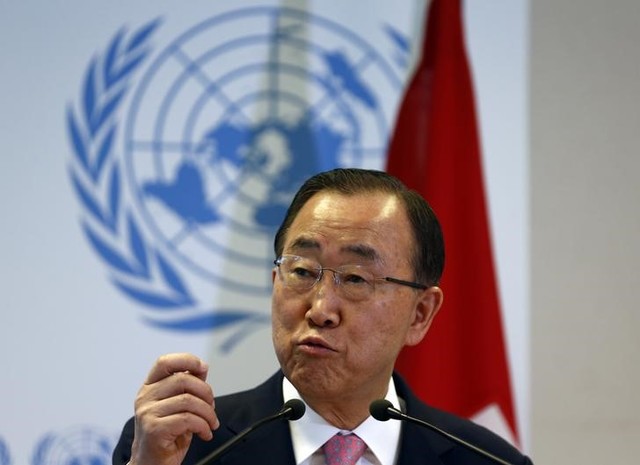
UN Secretary-General Ban Ki-moon gestures during a news conference at the Conference on the Prevention of Violent Extremism at the United Nations in Geneva, Switzerland, April 8, 2016. Credit: Reuters/Denis Balibouse
Brussels: Russian and NATO envoys are unlikely to ease the worst tensions since the Cold War very much when they meet on Wednesday in their highest-level talks on security in almost two years.
Already bridling at NATO's expansion eastwards into its old Soviet sphere of influence, the Kremlin sees the US-led alliance's new deterrents as a threat. NATO believes Moscow's annexation of Crimea puts Europe's stability at risk and is modernising to defend itself against an assertive Russia.
The NATO-Russia Council, which was broken off in June 2014 after the Crimea crisis, will meet in Brussels to discuss Ukraine, Afghanistan and how to avoid military accidents that might lead to war.
"We are not afraid of dialogue," said NATO Secretary-General Jens Stoltenberg, who will chair the talks with the alliance's 28 ambassadors and Moscow's envoy to NATO, Alexander Grushko.
While the West and Russia remain at odds over eastern Ukraine, where more than 9,000 people have been killed in separatist fighting that NATO accuses Moscow of backing, the meeting is a sign of willingness to improve relations.
Agreeing on the meeting was a breakthrough in itself after many disagreements over the agenda, NATO diplomats said.
However, the simulated attack passes of Russian warplanes near a US guided missile destroyer in the Baltic Sea last week, followed by the interception of an US air force plane by a Russian fighter two days later, have again strained the mood.
Stoltenberg called the Russian manoeuvres "unprofessional and unsafe behaviour" on Tuesday, saying they highlighted the need for dialogue. NATO allies worry that Russian pilots are ignoring safety precautions agreed during the Cold War.
Grushko said it was the alliance, not Moscow, that was increasing the risks of conflict in Europe. He cited NATO's biggest modernisation since the Cold War, possible plans for a bigger NATO presence in eastern Europe, and a US missile defence shield as reasons to be worried.
"Today we are facing a NATO military build-up which is completely unjustified," Grushko told reporters. "I don't see any possibility for a qualitative improvement of our relations if NATO continues on its path of deterrence and relevant military planning."
No improvement in European security
Washington says the US missile defence shield in Europe is not directed at Russia and is designed to shoot down any ballistic missiles that might be launched by Iran.
The United States is developing sites in Romania and in Poland, two former Soviet alllies, and may eventually hand over command and control to NATO.
Poland and the Baltic states worry about an increase in the Russian military presence in Kaliningrad, where Russia is positioning longer-range surface-to-air missiles.
NATO'S response is likely to be a small multinational force in Poland and the Baltics. It says it will respect a 1997 agreement with Russia not to station large numbers of permanent combat forces in eastern Europe.
Russia is likely to say that NATO's insistence on a "persistent", not permanent, presence is simply twisting words. "We don't see any difference between a continuous, persistent rotation and a permanent presence," Grushko said. "The military build-up in centre of Europe will not improve European security."
(Reuters)
This article went live on April twentieth, two thousand sixteen, at fifty-five minutes past twelve at noon.The Wire is now on WhatsApp. Follow our channel for sharp analysis and opinions on the latest developments.


