

At Party Meet, Xi Jinping Stresses China's 'Right to Use Force' on Taiwan


New Delhi: China's President Xi Jinping said China will never renounce the right to use force against Taiwan but will strive for a peaceful resolution.
During a speech at the start of a congress where he is widely expected to win a third leadership term that cements his place as the country's most powerful ruler since Mao Zedong, Xi said, "We insist on striving for the prospect of peaceful reunification with the greatest sincerity and best efforts, but we will never promise to give up the use of force and reserve the option to take all necessary measures."
Continuing, he said, "We have resolutely waged a major struggle against separatism and interference, demonstrating our strong determination and ability to safeguard state sovereignty and territorial integrity and oppose Taiwan independence."
The delegates, wearing blue face masks, responded with loud applause.
The twice-a-decade gathering of roughly 2,300 delegates from around the country began in the vast Great Hall of the People on the west side of Tiananmen Square amid tight security and under blue skies after several smoggy days in the Chinese capital.
President Xi also touted the ruling Communist Party's fight against COVID-19 while reiterating support for the private sector and allowing markets to play a key role even as China fine-tunes a "socialist economic system".
Xi said the party of 96 million members "has won the largest battle against poverty in human history".
"We must build a high-level socialist market economic system... unswervingly consolidate and develop the public ownership system, unswervingly encourage and support the development of the private economy, give full play to the decisive role of the market in the allocation of resources, and give better play to the role of the government," he said.
"The fight against corruption has won an overwhelming victory and has been comprehensively consolidated, eliminating serious latent dangers within the party, the state and the military," Xi told CCP delegates referencing a campaign critics have said has been used to curb dissent within the party.
On Covid, Xi said China had won international praise.
In recent days, Beijing has repeatedly emphasised its commitment to Xi's zero-Covid strategy, dashing hopes among countless Chinese citizens as well as investors that Beijing might begin exiting anytime soon a policy that has caused widespread frustration and economic damage.
On Hong Kong
While lauding the party's control of the situation in Hong Kong, which was rocked by anti-government protests in 2019, he said China must ensure Hong Kong is ruled by patriots and China will support Hong Kong in integrating with the mainland.
"One country, two systems" is the best system for Hong Kong and must be adhered to, in the long run, Xi said.
On environment
He said China will give priority to environmental protection and promoting green lifestyles, and that the conservation of nature was an essential part of building a modern socialist country.
"Ecological and environmental protection has undergone a historical, transformational and comprehensive change – our motherland's skies are bluer, the mountains are greener and the water is clearer," Xi told more than 2,300 delegates. He added that China had made progress in tackling environmental problems over the last 10 years and vowed to "basically eliminate" heavy air and water pollution while bringing soil contamination under control.
Xi vowed last year China – the world's biggest source of climate-warming greenhouse gases – would achieve carbon neutrality by 2060 after bringing emissions to a peak by the end of this decade.
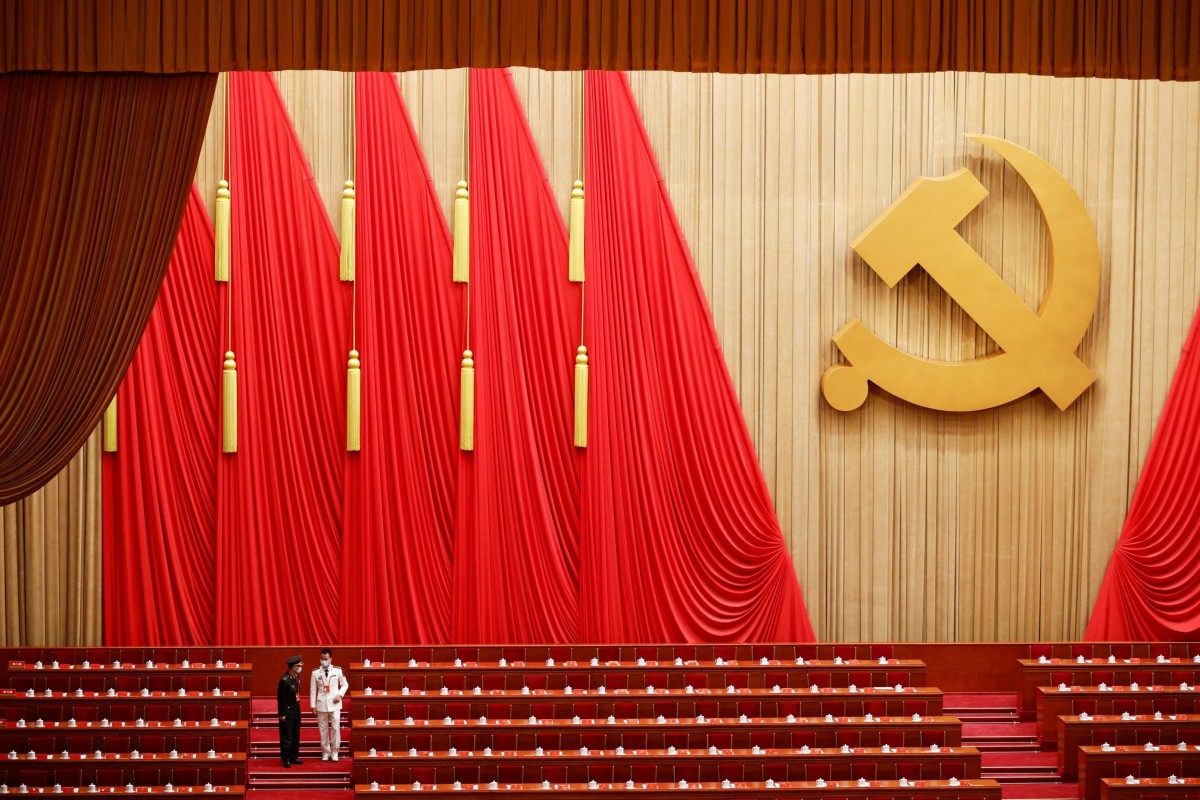
Military delegates arrive before the opening ceremony of the 20th National Congress of the Communist Party of China, at the Great Hall of the People in Beijing, China October 16, 2022. REUTERS/Thomas Peter.
He told delegates China's carbon peak and neutrality targets would be implemented steadily and in accordance with the country's energy resources.
China will support low-carbon industries, pursue an "energy revolution" and build a new energy system while continuing to promote the "clean and efficient use of coal", Xi said.
Reversing the damage done by decades of breakneck economic growth has been one of China's major policy objectives during Xi's decade in power. He warned in 2018 any failure to tackle pollution could be used as an "excuse" for hostile forces to undermine Communist Party rule.
On military and defence
China will accelerate the building of a world-class military and strengthen its ability to build a strategic deterrent capability, Xi said in a speech that mentioned "safety" or "security" 73 times.
He called for strengthening the ability to maintain national security, ensuring food and energy supplies, securing supply chains, improving the ability to deal with disasters and protecting personal information.
Continuity expected
In his decade in power, Xi (69) has set China on an increasingly authoritarian path that has prioritised security, state control of the economy in the name of "common prosperity", a more assertive diplomacy, a stronger military and intensifying pressure to seize democratically governed Taiwan.
Analysts generally do not expect any significant change in policy direction.
Xi's power appears undiminished by the tumult of a year that has seen China's economy slow dramatically, dragged down by the COVID policy's frequent lockdowns, a crisis in the property sector and the impact of his 2021 crackdown on the once-freewheeling "platform economy", as well as global headwinds.
Also read: Xi Jinping’s Quest for Complete Control Over China Is a Crown of Thorns
China's relations with the West have deteriorated sharply, worsened by Xi's support of Russia's Vladimir Putin.
"China... resolutely opposes all forms of hegemony and power politics, opposes the Cold War mentality, opposes interfering in other countries' domestic politics, opposes double standards," Xi said.
Party power
The son of a Communist Party revolutionary, Xi has reinvigorated a party that had grown deeply corrupt and increasingly irrelevant, expanding its presence across all aspects of China, with Xi officially its "core".
Xi did away with presidential term limits in 2018, clearing the way for him to break with the precedent of recent decades and rule for a third five-year term, or longer.
"We have comprehensively strengthened the party's leadership ... and ensured that the party plays the role of leadership core in overseeing the overall situation," he said.
"Through continuous struggle, we have realised the thousand-year-old dream of a Chinese nation of moderate prosperity."
The congress is expected to reconfirm Xi as party general secretary, China's most powerful post, as well as chairman of the Central Military Commission. Xi's presidency is up for renewal in March at the annual session of China's parliament.
In the run-up to the congress, the Chinese capital stepped up security and COVID curbs, while steel mills in nearby Hebei province were instructed to cut back on operations to improve air quality, an industry source said.
The day after the congress ends on Saturday, Xi is expected to introduce his new Politburo Standing Committee, a seven-person leadership team. It will include the person who will replace Li Keqiang as premier when Li steps down from that post in March after serving the maximum two terms.
(With inputs from Reuters)
This article went live on October sixteenth, two thousand twenty two, at fifteen minutes past twelve at noon.The Wire is now on WhatsApp. Follow our channel for sharp analysis and opinions on the latest developments.


