
Somali Mothers Face Agonising Choice: Which Child to Feed


Real journalism holds power accountable
Since 2015, The Wire has done just that.
But we can continue only with your support.
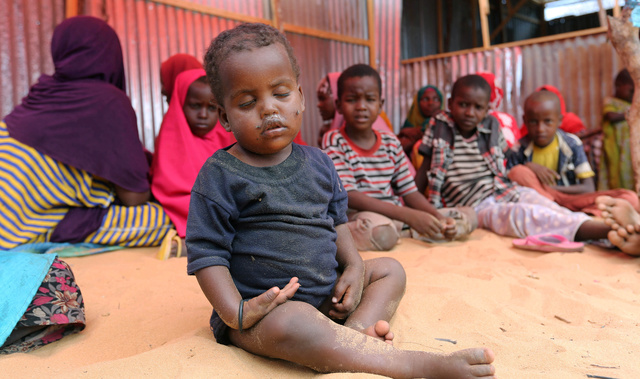
Internally displaced Somali children sit inside their general shelter at the Al-cadaala camp in Mogadishu. Credit: Reuters
Mogadishu/Baidoa: Somali mothers are facing an agonising choice over how to divide their shrinking food supply among hungry children as a devastating drought kills off livestock and leaves the Horn of Africa nation facing the possibility of famine.
"If there's a very small amount of food, we give it to those who need it the most, the youngest," said Fatuma Abdille, who arrived in the capital of Mogadishu two weeks ago with her seven children after the family's herd of goats perished from hunger.
The drought has shrivelled grass and dried up water holes. In Bay, a key agricultural region, the UN says the harvest has dropped by more than 40%.
Now the UN is warning that the country risks a repeat of the 2011 famine that killed around 260,000 people. Aid workers are asking for $825 million to provide aid to 6.2 million Somalis, about half the country's population.
The appeal comes after US President Donald Trump signed a revised executive order suspending travel to the US from six mainly Muslim nations, including Somalia. Trump has justified that measure on national security grounds. He has also said he will slash budgets for US aid and diplomacy.
That could reduce the support for the new UN-backed government, which is fighting to overcome an Islamist insurgency. Somalia had been plagued by civil war for more than a quarter of a century.
Internally displaced Somali women sit with their children inside their general shelter at the Al-cadaala camp in Somalia's capital Mogadishu, March 8, 2017.Credit: Reuters
Insecurity prevents aid workers from accessing parts of the country, so in many parts of Somalia, families from rural areas are flooding into cities in search of food.
As water sources evaporate, many families are forced to drink water infected with deadly cholera bacteria. The outbreak has affected nearly 8,000 people and has killed more than 180 so far.
Mohamed Ali, 50, came to the central city of Baidoa with his seven children. He said he and his wife were getting weaker as they gave the children their share of food.
"We let the children eat first and then we follow but most of the time there's nothing left because the food is not enough," he told Reuters in a makeshift camp where families had stretched material over sticks and wire.
Abdille, the mother in the capital, said she watched her 9-year-old son give his younger siblings his portion of food with mixed feelings of sadness and pride.
"He is making a sacrifice," she said, gesturing to the solemn boy beside her. "I feel proud."
(Reuters)
This article went live on March ninth, two thousand seventeen, at thirty-two minutes past twelve at noon.The Wire is now on WhatsApp. Follow our channel for sharp analysis and opinions on the latest developments.