

Theresa May Says Her Response to Grenfell Fire Was 'Not Good Enough'


London: British Prime Minister Theresa May said on Monday that her initial response to the Grenfell Tower fire, which killed 71 people in London a year ago, was not good enough because it had given the wrong impression that she did not care.
The 24-storey social housing block in west London, home to a close-knit, ethnically diverse community, was engulfed by flames in the middle of the night of June 14, 2017, in Britain's deadliest fire on domestic premises since World War II.
The tragedy, which unfolded within one of London's richest boroughs, immediately prompted a wave of soul-searching about social inequalities, neglect of immigrant communities and poor safety standards in social housing.
The day after the disaster, May briefly visited the site, thanked firefighters for their work and held a short meeting with the team in charge of the response.
But her failure to meet any of the traumatised survivors or desperate relatives searching for missing loved ones angered the local community and came to symbolise what many people felt was a history of contempt from the authorities.
"It has long been clear that the initial response was not good enough. I include myself in that,"May wrote in a column in the Evening Standard, a London newspaper, days before the first anniversary of the tragedy.
"The residents of Grenfell Tower needed to know that those in power recognised and understood their despair. And I will always regret that by not meeting them that day, it seemed as though I didn't care. That was never the case."
May did not say why she had not ventured outside the police cordon around the blackened ruin of Grenfell Tower to meet any of the people who were being cared for at a nearby church and in the homes of local residents.
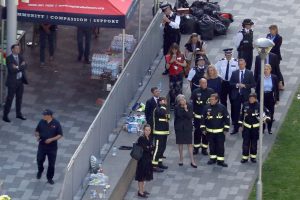
Britain's Prime Minister, Theresa May, speaks to police officers as she visits the scene of a tower block which was destroyed in a fire disaster, in north Kensington, West London, Britain June 15, 2017. Credit: Reuters/Peter Nicholls
Still in hotels
At the time, almost palpable grief and anger were coursing through the neighbourhood. While some people were pasting up improvised missing person notices and creating makeshift memorials, others were giving media interviews in which they blamed local and national government for the disaster.
The head of the local authority of Kensington and Chelsea borough, which owned Grenfell Tower, was forced to resign days later as it became clear the body was failing to provide adequate emergency housing and other services to the survivors.
Housing minister James Brokenshire told parliament on Monday that out of 203 households in need of a new home, 198 had now either moved into one or had accepted an offer of permanent or temporary accommodation. However, he said he was concerned about 43 households who were still living in hotels.
"This is not where any of us wanted to be a year on from the fire," Brokenshire said, adding that his ministry was trying to understand what was causing the delays. "While there has been progress in recent weeks, overall the pace has been too slow."
The causes of the fire are now the subject of a police investigation that could result in criminal charges and of an independent public inquiry ordered by May.
The inquiry has established that Grenfell Tower had been enveloped in a combustible cladding during a recent refurbishment, and that this was a major factor in the rapid spread of the fire.
Brokenshire told parliament that the government intended to ban the use of combustible materials on the external walls of high-rise buildings, subject to consultation which would be published next week.
He also said public sector landlords had started removing such materials from buildings and that private sector landlords should be doing the same.
(Reuters)
This article went live on June twelfth, two thousand eighteen, at zero minutes past seven in the morning.The Wire is now on WhatsApp. Follow our channel for sharp analysis and opinions on the latest developments.


