

Trump Can’t Prevail and Iran Won’t Capitulate, So Hormuz Stalemate is Set to Continue


The American war on Iran grinds on. On Saturday, the US struck three Iranian oil tankers in what it said was a retaliation for attempts by Iran to attack two American warships. In the past week, the two sides have been engaged in the most intense fighting since the campaign was paused a month ago. Iran has targeted ships in the Strait and US forces in the region. The US has retaliated with strikes inside Iran, killing military personnel and civilians.
For weeks, mediators, among them Field Marshal Asim Munir of Pakistan, have been trying to get the two sides back to the joint memorandum of understanding. But it now appears that, heartened by its ability to squeeze the Iranian economy, Washington is abandoning the MoU in favour of a harder line, one that seeks to deal not only with the question of Hormuz but also with Iran’s nuclear programme.

Illustration: Pariplab Chakraborty.
Yet, according to the New York Times, US intelligence assessments suggest that Iran has become more confident in its ability to attack American and allied targets across West Asia and remains determined to continue the conflict.
For its part, Washington believes that time is no longer on Iran’s side when it comes to the blockade. The US says it is managing to move about 40 per cent of the oil that passed through the Strait during peacetime. At the same time, it claims to have effectively halted Iranian oil exports.
The American optimism rests on the proposition that if Washington can keep enough oil flowing to prevent a global energy crisis while using a naval blockade to choke Iran’s trade, it can force Tehran to capitulate. But whether that strategy will work remains an open question. There are limits to the ability of the US to sustain a blockade, while Iran still has considerable capacity to escalate the conflict.
Under Operation Economic Outcast, Washington is seeking to cut off Iran’s remaining financial lifelines and revenue sources. Alongside the naval blockade, the campaign threatens secondary sanctions and trade penalties against international companies, financial institutions and countries that continue to do business with Tehran. The measures target Iran’s access to digital assets, shipping, aviation, technology and gold.
This is where India’s predicament becomes more complicated. US Secretary of State Marco Rubio recently denied, on the Brian Kilmeade Show, that India and Iran were negotiating a trade deal. But his warning was unmistakable: “No country should be out there helping them create mechanisms by which they can generate revenue”. Countries that did so, he said, would face the possibility of US sanctions.
The warning came days after Prime Minister Narendra Modi met Iranian President Masoud Pezeshkian on the sidelines of the SCO summit in Bishkek. The meeting reiterated India’s commitment to its relationship with Iran while seeking to expand and diversify bilateral trade. Modi told Pezeshkian that regional problems had to be resolved through “dialogue and diplomacy”. Incidentally, New Delhi signed up to the Bishkek declaration’s condemnation of military attacks on Iran. The declaration did so without mentioning the US or Israel.
India had already stopped importing Iranian oil following the 2019 US decision to end the sanctions waiver that had allowed such purchases. It subsequently conducted much of its trade with Iran through Dubai, but that avenue has now narrowed sharply with the UAE suspending trade with Iran as part of its own commitments under Operation Economic Outcast. India has also been forced into a more cautious position over Chabahar port after Washington ended the sanctions waiver covering Indian companies operating there.
But the bigger problem for Washington is China. Beijing retains the ability to provide Iran with an economic lifeline through overland trade and alternative financial channels. China has formally condemned what it calls illegal unilateral sanctions, while putting domestic rules in place to resist the extraterritorial enforcement of US sanctions. It has also expanded its alternative payment infrastructure, including the Cross-Border Interbank Payment System, or CIPS, allowing transactions to be conducted outside the dollar-based financial system.
A number of smaller Chinese and Hong Kong companies have already faced US sanctions. But Washington has so far avoided directly targeting China’s largest state-owned banks. That restraint is significant and the US is simultaneously suggesting that China is willing to “play ball” diplomatically to prevent further escalation ahead of the Trump-Xi summit expected later this month.
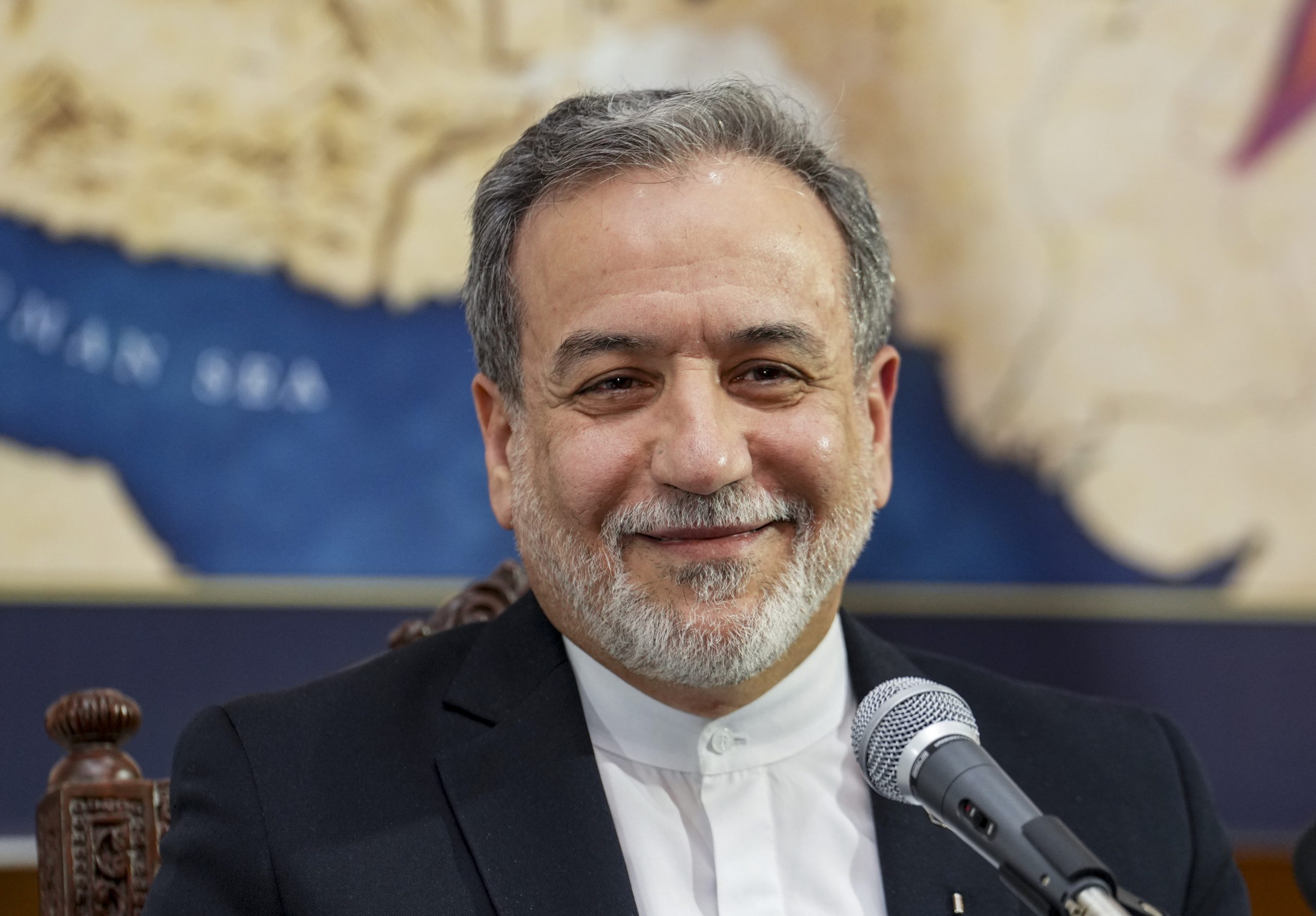
Iranian Foreign Minister Abbas Araghchi addresses a press conference during his visit to India, in New Delhi, Friday, May 15, 2026. Photo: PTI/Kamal Kishore.
When Treasury Secretary Scott Bessent was asked whether Operation Economic Outcast would be used against Beijing, he demurred. Without naming China, he said: “No one is above the reach of US sanctions.” At the same time, the Treasury has been making clear that its actions are intended to protect the stability of the global financial system.
The problem for Washington is that the harder it squeezes Iran, the more directly it runs into China. With the Trump-Xi meeting approaching, the administration has limited room to open another economic front against Beijing. The pressure on Iran may therefore be easier to sustain than the pressure on the countries that can help Iran survive it.
China also has an ace in the hole: the ability to retaliate through counter-sanctions and restrictions on critical materials. Last year, Beijing demonstrated its leverage over rare earths. The US has been working to develop alternative sources of rare-earth magnets, but reducing its dependence on Chinese processing and manufacturing will take time.
And rare earths are only part of the problem. China also dominates or has significant leverage over supplies and processing of gallium, germanium, graphite, antimony, tungsten and molybdenum, as well as a range of processed materials and industrial products.
Washington therefore faces a dilemma. Squeezing Iran harder may increase the chances of forcing Tehran to negotiate, but it also increases the pressure on China to keep Iran afloat. And retaliating against China could threaten American supply chains and financial stability at a moment when the administration is trying to avoid a broader confrontation with Beijing.
The US will consequently hope that its blockade of Iranian ports and continuing military pressure will be enough. It is betting that Iran’s economic pain will eventually become unbearable. But Iran has considerable experience in absorbing economic pressure, and its political system has survived years of sanctions.
For now, Iran appears capable of bearing more pain. Supermarket shelves remain stocked, although inflation continues to rise, particularly for food, while the country is also experiencing shortages of petroleum products. There is little indication that Tehran is ready to capitulate. If anything, it is signalling that it intends to continue fighting over Hormuz, its most important source of leverage in what the current regime sees as an existential struggle.
There is another problem for Washington: the economic costs of the conflict are no longer confined to Iran. President Trump’s claims about keeping oil flowing through Hormuz have not prevented energy prices from rising. Brent crude is trading in the low-to-mid $90s and remains under upward pressure. A sustained move above $100 would become increasingly likely if the conflict widens. US diesel prices, meanwhile, have already reached a record $5.85 a gallon, surpassing the previous peak set in June 2022.
This has become a war of attrition in which neither side has yet found a way out. Trump is still betting that economic strangulation and military pressure will eventually force Tehran to capitulate. Iran, meanwhile, has only a narrow window for compromise and little reason to believe that surrendering its leverage over Hormuz will bring an end to American pressure.
The result is a prolonged stalemate. Washington seems to believe that any negotiated end to the war would be tantamount to defeat. On its part, Tehran, given its experience, is wary of getting locked in any negotiated settlement with the Trump team. For now, as the US mid-terms approach, Iran is likely to turn up the heat rather than give in.
Manoj Joshi is a Distinguished Fellow, Observer Research Foundation, New Delhi.
The Wire is now on WhatsApp. Follow our channel for sharp analysis and opinions on the latest developments.


