

UN Attempts to Bring Transparency to the Secretary General Race


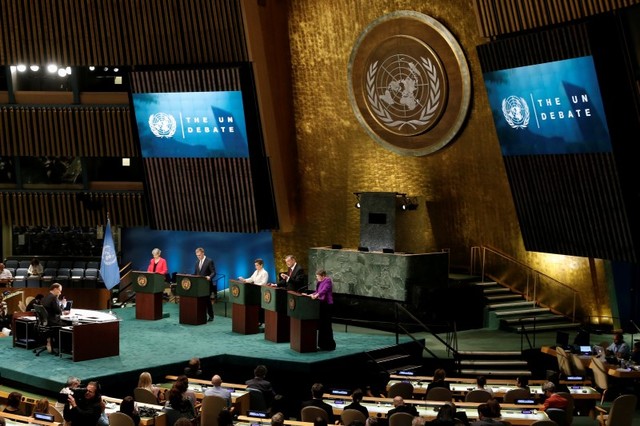
Candidates vying to be the next UN Secretary General debate in the UN General Assembly at UN headquarters in Manhattan, New York, US, July 12, 2016. Credit: Reuters/Mike Segar
United Nations: Ten of the 12 candidates vying to be the next UN Secretary-General took part in live televised debates on Tuesday, a first for the world body, but attempts to bring unprecedented transparency to the race will not extend to the Security Council selection process.
The 193-member UN General Assembly has sought to lift a veil of secrecy that has surrounded the election of the UN chief for the past 70 years by requiring public nominations and holding campaign-style town hall events with each candidate.
That transparency extended to two debates – with five candidates in each group – in the General Assembly on Tuesday, which was broadcast live around the world on the Al Jazeera television network and on the UN website.
Candidates were pressed by the Al Jazeera hosts and took questions from the audience, on issues such as leadership style, climate change, the International Criminal Court, the civil war in Syria and the recent eruption of fighting in South Sudan, where UN peacekeepers are struggling to protect civilians.
However, when the 15-member Security Council starts holding informal secret ballots next week to choose a candidate to recommend to the General Assembly for election later this year, the results of those closed-door polls will not be made public.
Council members will be given a ballot for each candidate with the options of encourage, discourage and no opinion.
The council will tally the ballots and inform the nominating states of the results for their candidate, but the overall results will not be made known to the public.
Ultimately, the five nations that hold a veto on the security council – the US, Britain, France, Russia and China – have to agree on a candidate and there is no requirement for them to pay attention to the popularity of candidates with the General Assembly. The council hopes to agree on a candidate by October, diplomats say.
Since the power to authorize military force or sanctions lies with the Security Council, the UN chief has little more than a bully pulpit. Many diplomats say the veto powers prefer a "secretary" rather than a "general".
Strength wanted
Yet Britain's UN ambassador Matthew Rycroft said on Tuesday that the more transparent process, particularly the individual candidate town halls with the General Assembly, had shown most member states wanted a strong secretary-general.
"That's an emerging consensus which wouldn't have been obvious without these changes in the [selection] process. I think it makes it harder for someone who isn't that strong to be chosen," Rycroft said.
The search for a successor to Secretary-General Ban Ki-moon – a former South Korean foreign minister who steps down at the end of 2016 after two five-year terms – has sparked a push by more than a quarter of the 193 UN states for the world body's first female leader.
Discussion on the possibility of a female secretary-general and the role of women in the world body received enthusiastic applause during Tuesday's debates.
Half the candidates so far are women: UN cultural organization UNESCO Director-General Irina Bokova of Bulgaria; former Croatian foreign minister Vesna Pusic; Moldova's former foreign minister Natalia Gherman; former New Zealand prime minister Helen Clark, who heads the UN Development Programme; Argentinian foreign minister Susana Malcorra; and former UN climate chief Christiana Figueres of Costa Rica.
Also in the race are Montenegro foreign minister Igor Luksic; former Slovenian president Danilo Turk; former UN High Commissioner for Refugees Antonio Guterres, who is also a former Portuguese prime minister; former Serbian foreign minister Vuk Jeremic; former Macedonian foreign minister Srgjan Kerim; and Slovak foreign minister Miroslav Lajcak.
Kerim and Lajcak did not take part in Tuesday's debates.
(Reuters)
This article went live on July thirteenth, two thousand sixteen, at thirty-four minutes past two in the afternoon.The Wire is now on WhatsApp. Follow our channel for sharp analysis and opinions on the latest developments.


