

As Brand Israel Grows Toxic in the US, Tel Aviv Loses a Diplomatic Tool It Has Often Used to Coerce the Rest of the World


As the positions taken by many candidates in the primaries ahead of the US midterm elections make clear, Israel’s standing in the United States has deteriorated sharply. After the war with Iran, amid the shocking brutality and extremism of the Netanyahu–Ben-Gvir government and Israel’s crimes in Lebanon, the Gaza Strip and the West Bank, Israel has become a toxic brand that many would rather avoid – particularly within the Democratic Party and increasingly even in parts of the Republican Party.
As its brand in the United States has become toxic, Israel may lose not only the American financial assistance it relies on to purchase military equipment, but also one of its key tools for persuading regimes around the world to establish and maintain relations with it.
Security and diplomatic assistance
For decades, Israel offered regimes around the world a “package” in exchange for their willingness to take domestic and international risks by strengthening ties with Israel – particularly by making those ties public. The package consisted of two components: security assistance in the form of equipment, training and expertise, and diplomatic assistance in Washington.
Declassified Foreign Ministry cables in the Israel State Archives reveal how this tool worked. The diplomatic assistance in Washington included arranging meetings with administration officials, elected officials, journalists and wealthy individuals, as well as campaigns to improve the regimes’ public image among the US public, the administration, Congress and the Senate.
According to the cables, Israel continued using this tool even though its representatives knew that they were fuelling antisemitic perceptions around the world – that Israel and some American Jews were not merely influential in Washington, but actually controlled the US. Yet when researchers, human rights activists and politicians condemned Israel for its ties with dictators and for providing them with lobbying services, Israeli representatives and some of Israel’s supporters around the world denounced the critics as antisemites.
The Chile example
In Chile, for example, although the United States had helped General Augusto Pinochet seize power, efforts were underway in Congress to impose an arms embargo and economic sanctions following the violent coup, disappearances, killings, mass arrests and torture.
In response, the Israeli Embassy in Santiago wrote to the Foreign Ministry in Jerusalem that, in order to advance relations with General Pinochet’s regime, Israel should take advantage of “the prevailing belief within the regime regarding our political weight in the United States.” According to the cables, Israel indeed helped the junta improve its image in the United States and secure financial assistance and credit from Washington, among other things to enable it to pay for Israeli weapons purchases.
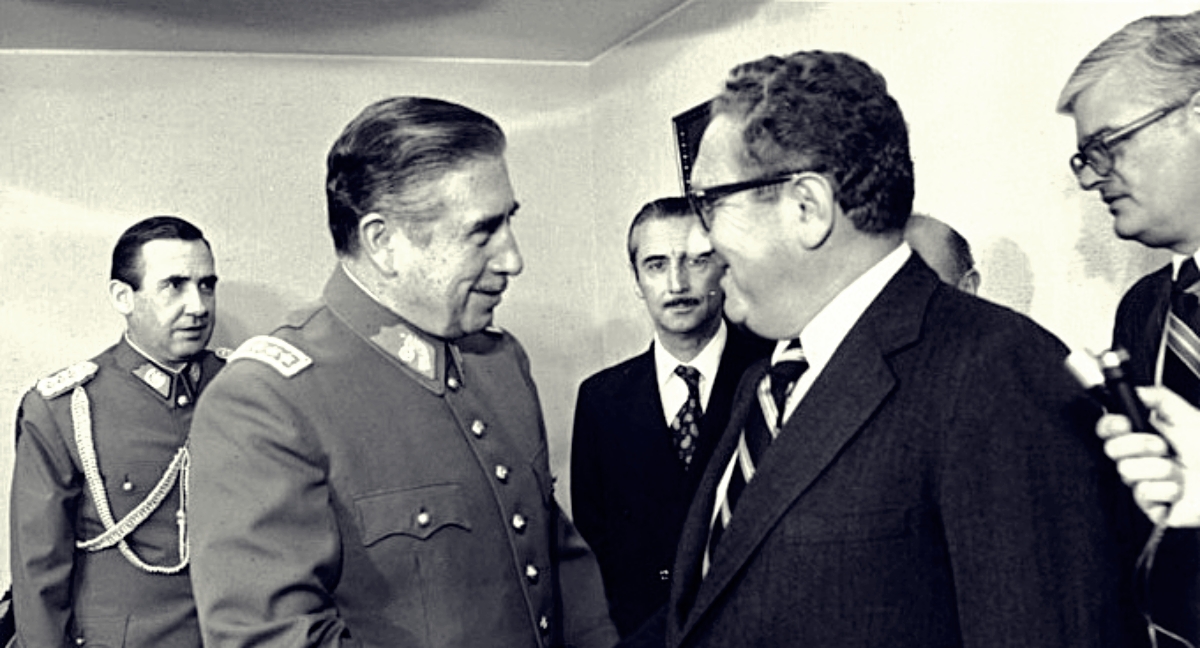
Augusto Pinochet and Henry Kissinger. Photo: Ministerio de Relaciones Exteriores de Chile/Wikimedia Commons, CC BY 2.0 CL
Following meetings in December 1974 and January 1975 between Israeli Ambassador Moshe Tov and General Pinochet and representatives of the junta, Tov requested that Israel help the junta improve its image and continue receiving U.S. aid, including assistance for junta representatives traveling to Washington “to meet with senators connected to us and to American Jewry to explain the damage being caused to them as a result of their anti-Chilean policy in the US Senate.”
In a series of cables, Israeli officials reported that Israel had indeed helped the junta “correct the mistaken impression about Chile in the United States,” while the embassy in Washington reported that the junta’s air force commander “expressed his satisfaction with the efforts we have invested on our part in the US Congress.” When Ambassador Tov completed his post in Santiago, General Pinochet said that he valued him “as a person and as an ambassador.”
The Congo example
In Congo, then known as Zaire, the relationship between the two countries rested not only on military interests but also on General Mobutu Sese Seko’s antisemitic belief that Israel and the Jews had complete control over the United States, as well as on his desperate desire to secure American financial assistance. Senior Israeli officials who met with Mobutu exploited and reinforced these beliefs, while falsely portraying relations with Israel as the only factor that could help secure American financial assistance.
When the two countries began talks to renew relations, a Foreign Ministry document prepared ahead of a March 1980 visit to Congo by the ministry’s director general stated that “one can gently hint that through our special connections with both Congress and the administration we can assist Zaire-US relations.” In his report on a meeting with Mobutu, Director General David Kimche wrote, “I noted that especially in the United States this [renewal of relations] would have a most positive effect and that there is no doubt that American Jewry would see in this first president to renew relations with Israel a hero whom they should support.”
On November 3, 1981, Deputy Director General of the Foreign Ministry Elisha Ben-Horin met with Mobutu in Paris. In a report he sent to the Foreign Ministry in Jerusalem, he wrote: “As you may recall, a central issue for Mobutu with us is that we bring him greater American assistance. I said that for many months we have been talking with the highest levels of the administration and also with members of Congress... I explained that members of Congress with whom we are speaking on his behalf ask us what Mobutu is doing for Israel.”
On April 25, 1982, Ben-Horin wrote in a cable that it was important for Zaire’s ambassador in Washington to “know that only our intervention and only the Jewish activity that wants to help those who promise to move closer to Israel is what secured him American assistance.”
Against the backdrop of Mobutu’s public announcement that he would renew relations with Israel, Israeli chargé d’affaires in Washington Yaakov Nechushtan reported in a May 21, 1982, cable that the Israeli Embassy had approached numerous members of Congress and asked them to publicly support Zaire’s decision. As a result, many sent Mobutu messages congratulating and praising him for the move, including then-Congressman Chuck Schumer.
On June 14, 1982, the head of Zaire’s security services arrived in Israel and presented Prime Minister Menachem Begin with a 26-page memorandum containing requests for security and diplomatic assistance from Mobutu. Among other things, it stated: “We know that the Jewish people and the State of Israel can serve as intermediaries with certain governments and among international financial institutions, both public and private, which sometimes benefit from relatively important Jewish participation.” Even Deputy Director General Ben-Horin acknowledged that some of the language in the memorandum presented to Begin was antisemitic.
The only Foreign Ministry official to explicitly warn of the danger of reinforcing Mobutu’s antisemitic beliefs was Israel’s ambassador to Kinshasa, Michael Michael. In a cable he sent to the Foreign Ministry in Jerusalem on July 15, 1982, Ambassador Michael wrote that he was “convinced that the real and principal reason that brought Mobutu to decide to renew his relations with us lies in his desire to obtain from the United States investments, aid, loans and, above all, legitimacy for his regime. The Protocols of the Elders of Zion in its positive version led him to believe that he could achieve this by using Israel. It seems that all the other calculations (and there are, of course, many) are secondary or even merely excuses before others and perhaps before himself.”
Ambassador Michael added that, because Mobutu’s expectations were unrealistic, “it is reasonable to assume that within a few months he will become convinced that his calculation was mistaken. It is clear that he will be angry not with me but with us, and his anger will be deep. Given the height of his expectations, his personality and character traits could easily lead him to hasty and far-reaching decisions.”
On January 3, 1983, Foreign Ministry legal adviser Elyakim Rubinstein reported to the ministry’s director general that, at a meeting with the chairman of the Congressional Black Caucus, the latter had told him that “in their opinion our embassy’s efforts in Washington on behalf of Zaire were a serious mistake. The regime in Zaire is perceived as extremely corrupt and as exploiting and oppressing. A congressional delegation that had recently stayed in Kinshasa saw with its own eyes how Mobutu’s men beat opposition members after the latter had met with the American visitors. Our support and pressure on behalf of Zaire serve as a weapon in the hands of our enemies in the United States.”
The warnings from legal adviser Rubinstein and Israel’s ambassador in Kinshasa went unheeded. Ahead of Mobutu’s visit to the White House in July 1983, he approached the Israeli Embassy in Kinshasa and asked Israel to help ensure the success of his visit, including by arranging meetings with elected officials, media events, placing articles in newspapers and the like. Israel agreed to help with the visit and lobbying campaign, and the Foreign Ministry decided that Israel’s then-deputy ambassador in Washington, Benjamin Netanyahu, would coordinate the embassy’s efforts in Washington.
Predictably, when reality dashed Mobutu’s expectations and the American financial assistance he had expected failed to materialize, he concluded that there was a Jewish conspiracy against him, and that Jews were not helping him because of malicious intent and hostility on the part of the Israeli government.
When Mobutu met on September 24, 1984, with the chairman of the Conference of Presidents of Major American Jewish Organizations and with Abe Foxman of the Anti-Defamation League, Mobutu said: “You have influence on the Hill and in the administration, in the media and in the banks, maybe you could try to persuade Wolpe [Congressman Howard Wolpe, then chairman of the House Africa Subcommittee] to change his approach toward Zaire?” A document prepared by the Foreign Ministry in May 1985 noted that Mobutu was furious and “claims that despite our promises we failed to improve his situation on Capitol Hill, even though all his opponents there are Jews who are staunch friends of Israel.”
Gabon, Liberia, Romania and more
The same was true in Gabon. As part of efforts to renew relations, when the dictator Omar Bongo visited Washington in July 1987, Israel decided to help him arrange meetings with senators and members of Congress.
In Liberia, according to a Foreign Ministry review dated June 4, 1987, military dictator Samuel Doe viewed “security assistance [as] always remain[ing] the main foundation of our relations. The second most important issue is Israeli assistance to his country in the United States in the political, public-relations and economic spheres. In his view, Israel is capable of influencing his opponents in Congress, overcoming skeptical public opinion and bringing about increased American economic assistance.”
In Romania, the regime of dictator Nicolae Ceaușescu believed that Israel and Jewish financiers controlled the world and the United States. It sought to use their perceived influence to persuade Washington to exempt Romania from the economic restrictions it imposed on relations with communist countries.
In a cable sent by the Israeli Embassy in Washington on April 5, 1967, it was written that “the Romanians have created for themselves an image of Israel’s commercial capability as the international center of the Elders of Zion. Specifically, they hope to enlist our help in their exports to the United States. Because of the customs barrier, the American market is closed to them.”
Israeli Foreign Ministry representatives did not attempt to dispel this antisemitic perception and instead cooperated with the Romanians. A cable from the Israeli Embassy in Bucharest dated October 9, 1967, stated: “The Romanians are extremely interested in increasing their exports to the U.S., ... They place their hopes in our assistance in this area. I understand that we promised them to make efforts in this direction and that we have even made certain attempts – so far without much result.” A February 15, 1968, cable noted that, during a conversation with a Romanian representative, he said that Israel could secure financing for these efforts from “a number of Jewish Rothschilds in the United States.”
In a June 1976 review prepared by Israel’s ambassador to Romania, Yohanan Cohen, it was written that one of Romania’s central motivations for its relations with Israel was “a belief in the power and influence of world Jewry, especially in the United States.” But he explained that despite the antisemitic perceptions reinforced by Israel’s promises to assist Romania in Washington, Israel continued the relationship because “the existence of normal and multifaceted relations between Romania and Israel is considered by us, and rightly so, a political asset. At a time when relations with dozens of countries are severed and Israel’s international standing is precarious.”
Similarly, when the communist dictatorship in Poland renewed its direct ties with Israel in October 1986, the expectation that Israel would help improve relations with Washington was a major motivating factor. Reviews prepared by the Foreign Ministry stated that a central motivation of the communist regime was to “strengthen trade ties with the United States.” They explained that “when the morale of the Polish people is at its lowest and the economic situation is deteriorating, the communist rulers assessed the situation and concluded, among other things, that one of the reasons for their poor situation was their attitude toward the Jews and Israel. They believed that the Western economy and the Western media were controlled by the Jews.”
In 2026, Prime Minister Netanyahu – who in 1983 was chosen to coordinate Mobutu’s visit to Washington and his lobbying campaign – has brought Israel to a low point where even Mobutu, were he alive today, might hesitate to ask for its help in advancing his interests in the United States.
Eitay Mack is an Israeli lawyer and human rights activist.
The Wire is now on WhatsApp. Follow our channel for sharp analysis and opinions on the latest developments.


