

Will the SC Rule in Trump's Favour to Keep His Presidential Ambitions Alive?


Last month, The Economist carried a stark warning for its readers on its cover: "Donald Trump poses the biggest danger to the world in 2024". A second Trump presidency would be an existential threat not only to America but the whole world. Trump has made it clear about what he intends to do if he regains power. He would order the Department of Justice (DOJ) to drop all the criminal cases against him and use the DOJ to persecute his political opponents, media, and anti-government protestors. While this would mean a totalitarian fracturing of American democracy, the potential consequences for the rest of the world are even more grave.
Trump intends to stop war aid for Ukraine and will probably pull out of NATO, giving Russia a free hand to annex Ukraine. He is also unlikely to oppose China’s plan to invade Taiwan. This would mean the end of the post-Second World War liberal order which put an end to major wars of territorial conquest, ending the endemic political instability that characterised world empires till the 19th century. But the greatest threat comes from Trump’s climate change denialism which could cripple global efforts to save humanity from the climate crisis. Canadian President Justin Trudeau on Friday said that if Trump becomes president his climate change policies would be "a menace not just to Canada but the whole world".
The stakes couldn't be higher, especially since incumbent Joe Biden is trailing Trump in every swing state by as much as 2 to 5 percentage points, according to polls. And in what is probably the most consequential case to come before any court, the US Supreme Court is expected in January to decide if Trump should be barred from running for president. The Supreme Court would essentially have to decide two things.
Political, legal, and institutional complexities
Firstly, whether Trump participated in the January 6 insurrection on Capitol Hill. And if he did so, whether he is barred from holding public office under the 14th Amendment to the US constitution. The 14th Amendment disbars any public official involved in an insurrection against the United States, from holding public office for life. Last week, an appeals court in the state of Colorado, ruled in the affirmative to both these questions. This ruling effectively bars Trump from the ballot in Colorado. Maine followed by taking Trump off the ballot. Trump has appealed the Colarado ruling in the SC . Unlike the Colorado judgement, the SC’s decision will apply to all states and if it upholds the lower court’s judgement, Trump will effectively not be able to run for President. What the five men and four women of the SC decide could potentially change history, and the fates of millions of people around the globe.
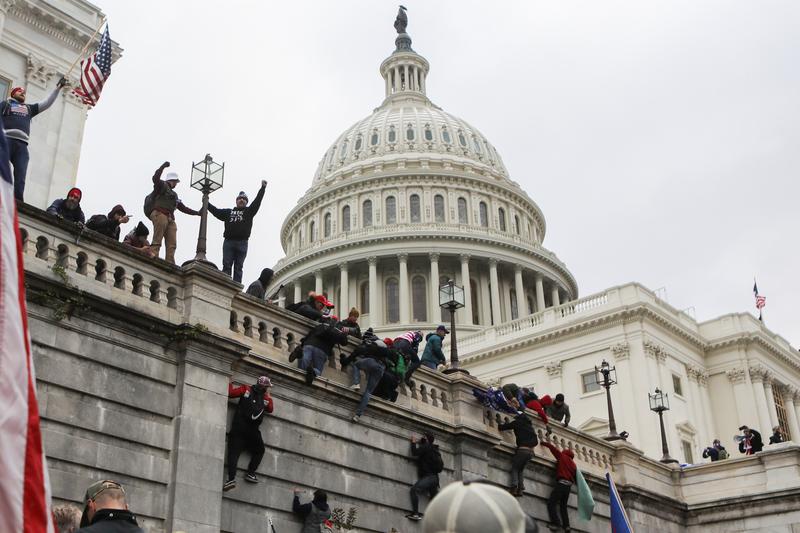
Trump supporters marching on the US Capitol on 6 January 2021. Photo: Wikimedia Commons.
To try and predict the outcome of a US Supreme Court decision is a lot like reading tea leaves, especially with a court as heavily politicised as the present one. The current court is the most conservative in US history, with six conservative judges to three liberal judges. Three of the judges were appointed by Donald Trump and have been instrumental in driving an extremist conservative agenda, overturning the right to abortion, restricting the government’s ability to make environmental regulations, and striking down the Biden administration’s plan to forgive $400 billion in student debt.
Given the majority’s egregious political bias, there is a fair expectation that Supreme Court would rule in favour of Trump, who looks certain to win the Republican presidential nomination by a landslide. Even discounting political bias, there are other reasons that would give both the conservative and liberal justices pause. Trump has conducted his campaign around shrill propaganda that the Democrats stole the previous election from him and all the criminal cases against him are political persecutions intended to keep him from winning the next election. A judgement that prevents Trump from running for office is sure to result in massive demonstrations from millions of his supporters and probably violence.
Nonetheless, there are political, legal, and institutional reasons that make a ruling against Trump possible. Politically, it is not clear if the loyalty of the conservative judges is to the insurgent Trump MAGA faction of the Republican party or to the traditional Republican establishment. While Trump has been steadily taking over the Republican party based on the almost religious support of the Republican base, the Republican establishment as well as the traditional corporate interests that back it, have made it clear in private that Trump is a problem that they would like to be rid of, so as to return the Republican party to a traditional conservative party rather than the right wing extremist party Trump is fashioning it into. Many of the conservative judges, especially those appointed by Trump’s Republican predecessor George W. Bush might be sympathetic to this view and might not be averse to accomplishing by judicial fiat what the Republican party cannot accomplish politically.
There are institutional reasons too. The SC has been plagued by scandals, especially that concerning financial impropriety by Justice Clarence Thomas, whose wife also came under the scanner for links to the larger January 6 insurrection. Public confidence in the SC is at its lowest point in decades. The chief justice John Robert is keen to protect the court’s reputation and this gives the SC incentive not to be seen favouring Trump and to judge the case on its merits. As far as far as the substantive legal issues are concerned, the SC need only to apply the law to kick Trump off the ballot. The fourteenth amendment only requires that someone participates in an insurrection. They need not be charged of any crime, let alone convicted. Having delivered a televised address to his followers to march on Capitol Hill, it is hard to argue that Trump did not participate in the insurrection.
Trump lawyers argued in the Colorado court that even if he had participated in an insurrection, the fourteenth amendment provision should not be applied, because it would rob the voters of the right to chose who they want for President. The Colorado court, which had 7 liberal judges appointed by Democrat presidents, was split on the decision 4-3. But ironically, the conservative judges on the SC would find it far more difficult to question the majority opinion disbarring Trump if they follow their own conservative legal philosophy. For decades, the judicial right has adopted a narrowly defined criterion called intentionalism which says the meaning of a law is what its framers intended it to be. Such a view of jurisprudence would in this case mean that the law disbarring an insurrectionist from public office should be applied in its letter, and other considerations which found weight with the dissenting liberal judges of the Colorado court, should have no bearing on the decision.
Will the US Supreme Court do its job and apply the law to Trump? Given that Trump has been recently accused of echoing Hitler in his attacks on immigrants, it is a curious coincidence that exactly 100 years ago, a court in Germany heard a case of insurrection against the government by a man named Adolf Hitler. The court had enough evidence to lock Hitler up for life and throw away the key. Instead it chose to sympathise with Hitler politically and sentenced him to five years in prison with parole in six months. Hitler eventually served only nine months and would go on to complete his aim of overthrowing German democracy. The three judges who had sworn an oath to uphold the law, could have prevented the greatest catastrophe in human history if they had only done their job. The Supreme Court would do well to look to the court of history.
Govind Krishnan V is a long-form journalist based in Bangalore. He won the 2014 Red Ink Award for Human Rights reporting. He is a published poet and is deeply interested in Western philosophy.
This article went live on January fifth, two thousand twenty four, at zero minutes past twelve at noon.The Wire is now on WhatsApp. Follow our channel for sharp analysis and opinions on the latest developments.


