
How Saeed Naqvi Became the 'Wrong' Kind of Journalist
https://m.thewire.in/article/books/how-saeed-naqvi-became-the-wrong-kind-of-journalist
President of India Zail Singh with the King of Bhutan Jigme Singye Wangchuck. Credit: President's Secretariat, GODL-India, via Wikimedia Commons.
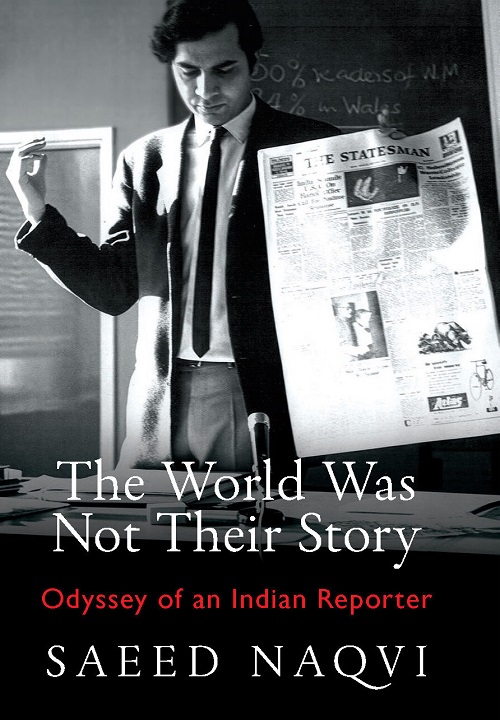
The World Was Not Their Story: Odyssey of an Indian Reporter (Speaking Tiger Books, 2026) is veteran journalist Saeed Naqvi's memoir of a life spent reporting from India and around the world. The book offers an insider’s account of journalism, politics and foreign affairs, including Naqvi’s encounters with political leaders and his years reporting for the Statesman and the Indian Express.
In this extract, Naqvi recounts how his reporting on India-Bhutan relations – and a rare interview with Bhutan’s King Jigme Singye Wangchuck – shook New Delhi’s establishment and how being an international correspondent made him the subject of suspicion and controversy.
§
What shook the establishment even more were my stories on Indo-Bhutan relations. Thus far, New Delhi had taken a very dim view of Bhutan opening a mission in the capital and stepping further onto centre stage, as it were. Bhutan was a story wrapped in cotton wool and put away on a sanitised shelf. No one could discuss Bhutan because of ‘certain sensitivities’ with China. These sensitivities were bruised when the headline appeared on Page 1 of the Express: ‘Bhutan Mission May Be Raised to Embassy’.
There was a furore in the corridors of South Block and an uproar in Parliament. A few days later came a double whammy: ‘Bhutan Upgrades its Mission to Embassy’. This was a fait accompli. The deed was done. The possibility of a mission being opened was met by noisy protest intended to impede the process. Bhutan had clearly ignored the message of the Indian government and taken its own decisions.
The climax of the story was enacted 10,000 miles away in Havana, capital of Cuba, at the 1979 summit of the Non-Aligned Movement (NAM), where Shyam Nandan Mishra, in his capacity as the external affairs minister, proceeded to put his foot in his mouth in the presence of His Majesty Jigme Singye Wangchuck of Bhutan.
India had from the very beginning treated Bhutan as a vassal, but this treatment was cloaked in good manners. Ambassadors posted to Thimphu were specifically briefed to be deferential, polite, and low-key with His Majesty. That was the only way a relationship with a country that had a long border with China could be managed. Mishra inelegantly ruffled royal feathers in Havana.
Bhutan’s relations with British India were determined by the treaties of 1865 and 1910. After India’s independence, the Government of India signed the Treaty of Perpetual Peace and Friendship with Bhutan in 1949. This treaty has guided all relations between the two countries ever since.
Of particular interest to strategists in India was Article 2 of the treaty, which made it incumbent upon Bhutan to seek India’s advice in the conduct of its foreign affairs. While India considered the treaty sacrosanct, Bhutan had indicated a degree of restiveness with this article and wanted it reinterpreted. Apparently, in a packed hall, Mishra rubbed this point in.
Until the early 1970s, there were no differences in the interpretation of Article 2, and in 1971, Bhutan entered the United Nations as a full-fledged sovereign state largely with India’s assistance. Since then, Bhutan had steadily expanded its diplomatic ties, reducing its dependence on India in foreign affairs.
Over the years, there was a perceptible increase in the United Nations Development Programme (UNDP) aid to the mountain kingdom, along with assistance from friendly countries like Japan, Australia, and various European nations. With this, Bhutan’s desire for greater autonomy in its foreign policy grew. It gradually became transparent that Bhutan was keen to diversify international partnerships without disrupting strong ties with India.
It was in 1979 that I received a call from the Bhutanese ambassador.
‘May I come to see you?’ This was most unusual.
Within an hour, he was at my Gulmohar Park residence.
‘There is very little time. Can you fly to Bombay immediately?’
‘Why?’ I said.
‘This is to do an interview.’
That is how an interview with His Majesty, the King, was arranged in Bombay’s fanciest hotel, the Taj Mahal. The King was returning from Havana, breaking his journey in Bombay before proceeding to Thimphu.
He turned out to be a most charming man and took me into confidence on all manner of issues between India and Bhutan. In a rare ninety-minute interview with me, the King touched on a host of sensitive issues, ranging from the Tibetans in Bhutan ‘forming a state within a state’ to the need for revising the Treaty of 1949, particularly Article 2. This was a straitjacket that Bhutan had been trying to get out of.
He dismissed as ‘utter nonsense’ suggestions that Bhutan was aspiring to have close relations with China at the expense of its traditional ties with India. He reiterated Bhutan’s stand that it would have no trade or diplomatic relations directly with Beijing. This policy, pursued by the Bhutanese over the years, had recently been ratified by the National Assembly of his country, he said.
Also read: India's Real Problem Lies in its Bhutan Policy, Not the Border
The King was careful in his choice of words. He thought a ‘close understanding’ preferable to ‘close consultations’ – consultations somehow implied that ‘we are seeking India’s permission, which is not the case’.
What, then, was the relevance of the Treaty of Friendship between India and Bhutan? He said much had happened since 1949. Thimphu did not consider India’s advice in the conduct of Bhutan’s foreign affairs as binding on the kingdom.
To a direct question about whether the two countries had serious difficulties or differences in the interpretation of Article 2, he said: ‘If you want my candid reply and not a diplomatic one—the treaty can certainly be brought up to date… Why should we retain a treaty which can lend itself to loose interpretations?’
The basic understanding would be that Bhutan would do nothing that would harm India’s vital interests. He said it was wrong to say that Bhutan had taken a position at Havana on the question of Kampuchean representation that was at variance with India. If Bhutan had not asked for Pol Pot’s representatives to be seated at Havana, it would have been tantamount to endorsing Vietnamese armed intervention in Kampuchea.
‘India took no position at all. Can you blame us if we took one, and can our stand be described as being in opposition to India’s?’
He said the Non-Aligned Movement was in real danger of splitting into two camps—moderates (Bhutan considered itself a moderate state) and radicals, led by Cuba. He said there was little doubt that Cuba was attempting to tilt the movement towards the Soviet bloc.
If Bhutan was not bound by India’s advice in foreign affairs and was a sovereign, independent nation, what inhibited it from having normal diplomatic relations with China, I asked him.
‘The communist ideology practised in Beijing is incompatible with Buddhism,’ he replied.
Never had a king of Bhutan given an interview to a journalist. This was the first. Secondly, never had the Treaty of 1949 been the subject of an article in a major Indian newspaper. The Ministry of External Affairs was divided. Some friends became cautious with me; others invited me to their rooms and handed over a large and significant story that needed to be broken.
At the time, there was no culture in India of journalists covering foreign affairs. Our meetings with foreign leaders immediately caused motives to be imputed. For instance, an interview with Libyan leader and revolutionary Muammar Gaddafi in Tripoli after his palace was bombed by American warplanes would in ideal circumstances be applauded. But in the whispering gallery, the talk was that I had interviewed someone who was a pariah in the international system.
Yes, the Israeli lobby and the West do take a dim view of Gaddafi, for the simple reason that he was the most vociferous supporter of the Palestinians. Given India’s support for the Palestinian cause, my decision to interview him might have made sense to the Indian reader, but for my colleagues in South Block, the foreign policy elite, I had interviewed the wrong man.
Gaddafi had given me the interview because I was a Muslim, it was implied. Later, when I interviewed, for the first time, Hashemi Rafsanjani, president of Iran, the whispering gallery pointed to the ‘Shia axis’. I was determined to poke these protectors of the national interest in the eye. So, I proceeded to interview every prime minister of Israel – Yitzhak Shamir, Yitzhak Rabin, Shimon Peres, Benjamin Netanyahu. None of these were applauded as world scoops. I suspect the whispers must have been about Saeed Naqvi being a double agent.
The point of this digression is that the appearance of my interview with the King of Bhutan created a storm. Why had I been chosen? I must be on the payroll of the Bhutanese. Some journalists, whom I always thought were friends, were part of the conspiracy to spread these rumours.
Only Salman Haider, as Foreign Secretary, had the grace to invite me and clarify the position.
‘Saeed, why did the King select you for the interview?’
If you look at the newspaper files from those days, I was the most active in South Block. I had done all the stories on Bhutan, and I had violated the taboo: don’t touch sensitive stories. That is why I was selected.
Salman understood the point. It is difficult to imagine the impact at this distance in time, but when the Bhutan story was splashed on the front page of IE, it shook the establishment. I had been hired to be on the right side of the Janata Party government. RNG and his friend Nanaji Deshmukh had invested in Indira Gandhi’s downfall and Janata success. Alas, I found myself unable to shed the adversarial role so thoroughly instilled in me during my years in The Statesman.
Excerpted with permission from The World Was Not Their Story: Odyssey of an Indian Reporter, by Saeed Naqvi, Speaking Tiger Books, 2026.
The Wire is now on WhatsApp. Follow our channel for sharp analysis and opinions on the latest developments.