

Before Gandhi in Noakhali, There Were Vasant-Rajab in Ahmedabad


Excerpted from an introductory booklet first published in Gujarati in 2006 by the Parichay Trust, Mumbai, and translated into English by the Movement for Secular Democracy in 2025.
It was the second day of the Hindu month of Ashaadh, the day of the festival of Rath Yatra. It was a people's celebration in Ahmedabad. And on this occasion, rain is also expected. Some showers are always welcome.
In 1946, the 1st of July, Ahmedabad did witness rain. But rather than cooling down by rain, when Independence was only one year away, the land of Gujarat became so hot that showers seemed to be the tears of Bharat Mata. On that evening, Vasant Rao Hegishte, 40, and Rajab Ali, 27, laid down their lives in their attempt to stop communal riots. Heaven was crying.
Bhanubhai Shukla, a friend of Rajab, recollected that day: “Mobs were looting, burning and killing on all sides. I was walking near the Khadiya crossroads and I ran into Rajab Ali and Vasant Dada.
“A washing-company shop was being looted near Bala Hanuman. Rajab and Dada immediately rushed there. They tried to talk sense into rioters, urging them not to indulge in violence and also not to provoke the other community. They were already very agitated and said, ‘Go and see what is happening at other places. If any Muslim comes here, we will not spare him.’ Rajab came forward and said, ‘I am a Muslim, kill me.’ The mob felt ashamed. They could stop one mob.
“The second incident took place on Richie Road [now Gandhi Road]. A mob had surrounded a Muslim driver. Rajab reached there and persuaded the mob to let the driver go.”
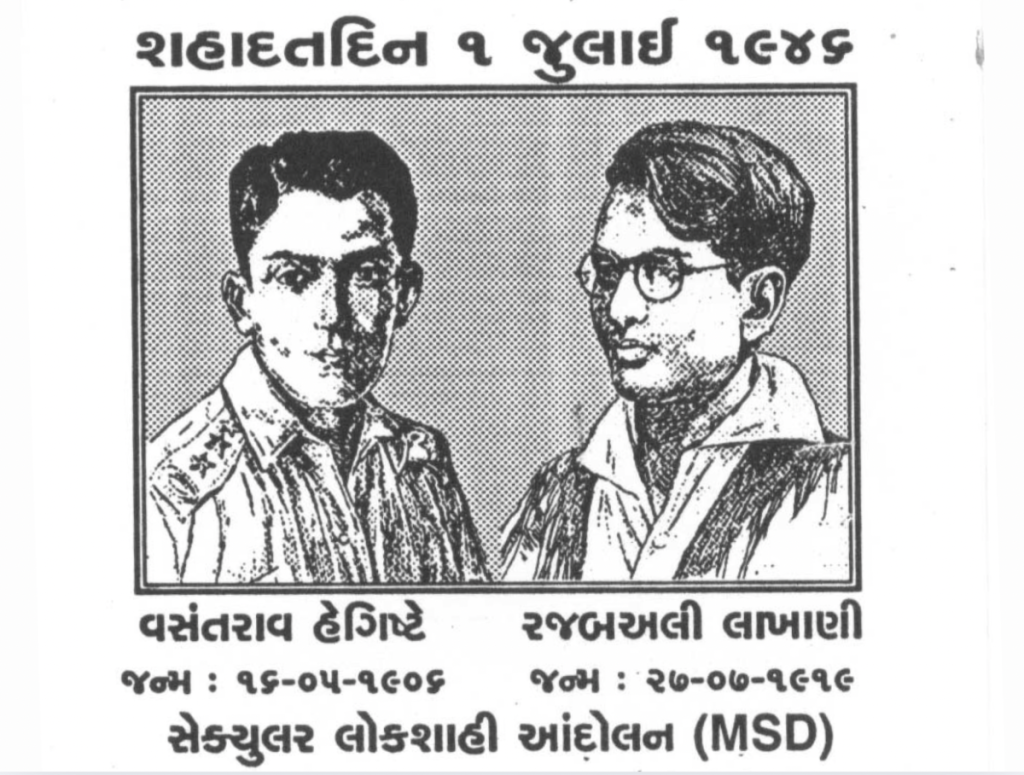
The Gujarati booklet from which the portion is excerpted.
In the evening, volunteers and activists met at the Congress House (now Sardar Congress Bhavan, at Bhadra). Suddenly the news came of the burning of Dudhabhai’s house and adjacent houses in Dugalpura, near Khand-ni Sheri in Jamalpur in the walled city. Dudhabhai was a nationalist activist and a member of the 11-member committee of Harijan Sevak Sangh proposed by Anasuya Sarabhai. These concrete houses, which were built due to the efforts of Majoor Mahajan Sangh, became the target of communal frenzy.
Vasant and Rajab prepared to go there. Ghulam Rasool Qureshi, Lalakaka and others dissuaded them and advised them to proceed after a vehicle or a team was arranged. But they could not remain quiet. It was as if they could see localities on fire, murderous knives and people getting killed in front of their eyes; as if they could hear the cry of the suffering humanity. They said, “We are going. Let others come after making arrangements.”
They left, accompanied by two volunteers of Seva Dal: Popatlal Soni and Dwarkadas Patel. The four encountered a violent mob near Kachhiya Sheri. What happened there is related in this account by Dwarkadas Patel:
“A mob of 100 to 150 people in a frenzy was coming towards us. They were armed with weapons like knives, sickles and pipes. We raised our hands and indicated to them that we had no weapons. We tried to pacify them. The mob stopped at a distance of 20 to 25 feet from us. Some of them even said, ‘Ok, you can go’ and allowed us to go further. Vasant as well as all of us were trying to pacify them and moved forward. Some fundamentalists among them shouted, ‘We will not allow you to go. We will kill you.’ Vasant replied in a loud voice, ‘We have come for peace. If by killing us, your purpose is served we are ready to be killed. You kill us. We will not try to save ourselves'."
“Saying this, Vasant and Rajab lied down on the road. Popatlal and I were still trying to persuade the mob. On seeing Vasant and Rajab lie down on the road, Popatlal also lied down beside them. At that time somebody attacked me from behind. My clothes got torn and I got injured also. But when I looked back, I saw my comrades lying on the road in the open. There was blood on their bodies. Seeing them, I also lied down next to them. We were in the high spirit of sacrifice, so we never thought of attempting to save ourselves when we were attacked. All four of us were lying down and calmly waiting for martyrdom. We all became unconscious due to injuries.
“It started raining then, as we came to know later. The mob had left, thinking we had died. After half an hour, a police van came there. It was followed by a truck which had collected the bodies of the victims from nearby areas. Thinking that we too were dead, they put us in the truck and sent us to the hospital…”
When he came to senses, he realised what had happened. Dwarkadas adds, “Out of the four of us, two comrades became immortal by laying down their lives.”
And then he repents like a true freedom fighter: “Alas! We remained just a little distance away from martyrdom.”
When Vasant’s sister, Hemlata Hegishte, saw his body in the hospital, she found “there was no pain or mutilation. The eyes were open and the face smiling. As if in the last moment he smiled at death too… Brother thought that Rajab Ali must be there because he would never leave him alone. On searching, we found his body also. He remained with him in death too. His eyes were open, though his spectacles were missing. The mouth was open and smiling. No pain or mutilation on face, as if there was the smile of victory in the face of death.”
The next day, during their funeral, the heart of Hemlataben – and of many others – was pained to see the two bodies separated in their last journey from the Congress House, when even death had failed to separate them. “At that time, I was not in a state of mind to do something about it. But now, thinking over it, I feel it should have been arranged somehow to keep them together,” she said later.
Compared to Vasant’s popularity in Ahmedabad, Rajab was nearly unknown in the city. His funeral procession started with a few people. But then more people joined. When his body was taken to Char Toda Qabristan in Gomtipur, the words of the priest, who was telling everybody to have a look at Rajab for the last time, reverberated in the air: “Yeh shahid ka janaza hai, bhai! Aisi kismat har kisi ko nahin milati (It is the funeral of a martyr; not everybody can be so fortunate).” Revolutionary Jain priest Santbalji also reached there in time for the last rites.
Jhaverchand Meghani, the poet-journalist who edited the Vasant-Rajab memorial volume, wrote in a letter to a friend: “My heart gets torn apart when I read about these two martyrs.” Meghani’s response was more nuanced a month later in his column in the Urmi Ane Navrachana magazine:
“Mahatma Gandhiji looks at these riots in his own way. He has not tried out the resistance which he prescribes. The name of Ganesh Shankar Vidyarthi can only be a mere token example. But if Mahatmaji had gone from Pune to Ahmedabad instead of Panchgani and entered Jamalpur with 500 volunteers, the world would have learned a new lesson.”
How Gandhiji would have been looking within and without during this time can be understood from his note in the journal ‘Harijan Bandhu’ of August 4, 1946:
“…Under these circumstances, I should act myself whether others join me or not. It will be disgraceful on my part to sit at home and tell others to go and lay down their lives. Such a thing cannot be an indication of non-violence. I have never had the chance to test my non-violence in the face of communal riots. It might be argued that it was my cowardice which prevented me from seeking such a chance to test my non-violence.”
And then in nearly prophetic words, he adds:
“Be that as it may, God willing, the chance will still come to me, and by throwing me in the fire, He will purify me and make the path of non-violence clear. No one should take it to mean that sacrifice of my life will arrest all violence. Several lives like mine will have to be given if the terrible violence that spread all over is to stop and non-violence is to reign supreme in its place.”
Those who understand the true meaning of Gandhiji’s assassination will surely be able to hear the voice of truth in these remarks.
There is no doubt that it is the responsibility of the police, the judiciary and the government to maintain law and order and they must function properly. But real solutions will come only when the people will act on their part.
How much work still remains to be done as citizens, as common people and as society can be gauged from an anonymous letter Meghani received that said:
“We felt so much pain to know that you have accepted the task of editing the Vasant-Rajab memorial volume. Vasant Rao Hegishte should have been punished. He had Hindu blood in his veins and yet he saved a Muslim driver when a mob was trying to kill him. This was an unforgivable sin towards Hindu religion. Could he have saved Hindus from those lowly Muslims who were killing them? And if Rajab Ali was killed, it is a matter of joy for Hindus. How can there be a memorial for him? I appeal to you to give up editing that book and become a real Hindu…”
How right was Gandhiji when he said many more martyrdoms would still be needed!
Prakash N. Shah is a veteran editor and Gandhian activist based in Ahmedabad.
This article went live on July eighth, two thousand twenty five, at thirty-six minutes past three in the afternoon.The Wire is now on WhatsApp. Follow our channel for sharp analysis and opinions on the latest developments.


