

Government Calls Off Merger of Three Ailing Public Sector General Insurers


Mumbai: On Wednesday, the Union government said that the merger of three ailing public sector general insurance companies has been shelved and the focus will be on making them profitable instead.
The Cabinet also approved a capital infusion of Rs 12,450 crore into the three firms — Oriental Insurance Company, National Insurance Company, and United India Insurance Company. This sum includes the Rs 2,500 crore, which was already infused in February. A release by Press Information Bureau (PIB) read, “...given the current scenario, the process of a merger has been ceased so far and instead the focus shall be on their solvency and profitable growth, after capital infusion”,
Of the Rs 12,450 crore, the government will release Rs 3,475 crore immediately and the remaining Rs 6,475 crore will be infused later. In this year’s budget, the government had set aside Rs 6,950 crore for a re-capitalisation of the three entities as all the three were struggling on the solvency ratio front.
 Furthermore, the Cabinet approved raising the authorised capital of National Insurance Company to Rs 7,500 crore and that of United India Insurance to Rs 5,000 crore to facilitate the infusion.
“The capital infusion will enable the three public sector general insurers to improve their financial and solvency position, meet the insurance needs of the economy, absorb changes and enhance the capacity to raise resources and improved risk management”, said the PIB release.
An executive of one of the insurers said that “In these times, the merger process would have been difficult.”
Experts said that the aim was to augment capital by listing the merged entity, which otherwise would have brought the government equity down. In the current backdrop where the firms are not in good shape, the government would have netted lesser than expected if it would have gone ahead with the merger.
In the 2018-19 Budget, the government had proposed the merger and subsequent listing on the bourses. In January, the boards of all the three firms had approved this plan. Last year, the three firms had appointed Ernst & Young (EY) to prepare the roadmap. It had recommended the completion of the merger by December 2020 or within 18 months starting July. However, the merger was put on the back burner because of the pandemic.
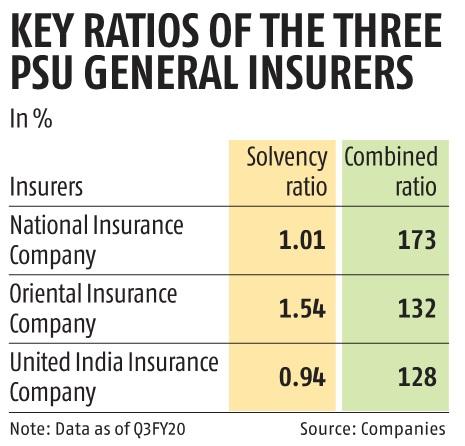
As of the third quarter of 2019-20, National Insurance had a solvency ratio of 1.01, against the regulatory requirement of 1.5. Solvency ratio is a key indicator of financial health. Its combined ratio — a measure of profitability for non-life insurers — stood at 173%. If the ratio is below 100, it indicates that the firm is making underwriting profits.
Oriental had a solvency ratio of 1.54 and reported a combined ratio of 132%. United reported a solvency ratio of 0.94, much below the regulatory requirement, with a combined ratio of 127.62%.
By arrangement with Business Standard.
This article went live on July ninth, two thousand twenty, at forty minutes past two in the afternoon.The Wire is now on WhatsApp. Follow our channel for sharp analysis and opinions on the latest developments.


