

In Bengal's Kolkata-Centred Politics, Darjeeling Has Always Been the 'Other'


Kolkata: On October 5, West Bengal chief minister Mamata Banerjee played the violin at Kolkata's Durga Puja carnival, casting the saying about Rome burning and Nero smiling into new light. Landslides and floods had by then ravaged North Bengal.
The chief minister is the guardian of every person in the state. The question arises, how could she remain so indifferent when such a massive disaster was unfolding in Bengal? But Banerjee's body language is symbolic of a reflection of the urban middle-class's attitude toward North Bengal that has been continuing for ages. There is pity, there is charity, but there is no place for empathy.
To supply the endless demand for Bengalis' routine trips to the tourist spots of Digha, Puri and Darjeeling, in the last few decades, innumerable hotels have sprung up everywhere in the hill town of Darjeeling, cutting through the heart of the hills and thumbing their nose at regulations. If one looks at the amount of water being wasted by those who stay in these hotels, it becomes clear that they have no idea about the water scarcity faced by Darjeeling's residents during the hot season.
In British times, Senchal and South Lake were built to ensure water supply for Darjeeling's 25,000 residents. Even today, there is no other source of water in Darjeeling town. Moreover, the population is at least 1.7 lakh, and on average, 30,000 outsiders stay throughout the year. After providing entertainment for these 30,000 people, three paths remain open for Darjeeling residents to procure drinking water: beg, borrow or steal.
Parimal Bhattacharya, in his book Darjeeling, writes to describe the picture of Darjeeling at the end of winter:
"...water theft incidents occur from municipal pipes, from private tanks; skirmishes linger in front of streams".
From the 1990s, the crowd of Nepalis has been increasing in Darjeeling. A large section of them have taken up cooking jobs in various restaurants in Kolkata. Bengalis from the plains, upon alighting at New Jalpaiguri station, call them "daiju", and upon seeing Nepali girls in the city, whisper behind their backs, "chinki". They have only one identity: they make good momos.
The daily life of hill people, let alone landslides in the hills, is outside the playbook of Bengalis from the plains. Because landslides mainly occur during the monsoon, and at that time, Bengalis from the plains do not head to the hills. From 1899 till now, at least 10 major landslide incidents have occurred in Darjeeling, but the urban Bengalis have not kept track of those as no such plains-dweller was harmed in those landslides.
As soon as normal life resumes, the construction of hotels and roads begins again by cutting trees and loosening the soil. Any construction taller than 11.5 metres in Darjeeling is illegal, but how many hotels have followed this rule? Any child in Darjeeling can count on their fingers and tell you.
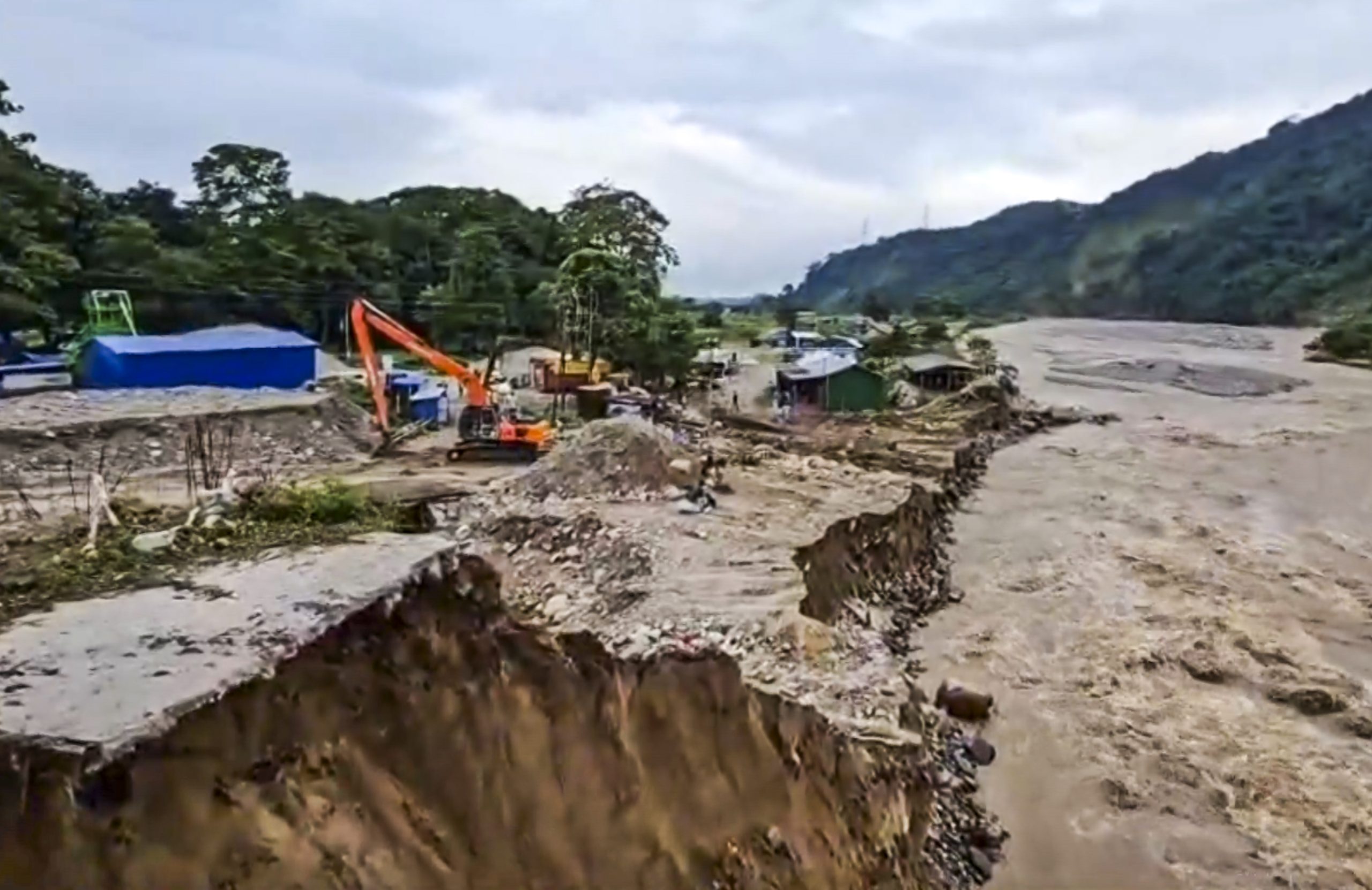
An aftermath of landslides in a disaster-hit area, in Darjeeling. Photo: PTI
A research paper, titled ‘PM10 within Indian standard is achievable by mitigating the sources of PM1: A thirteen years (2009–2021) long study and future prediction (2024) over the eastern Himalayas, India’, shows just how alarming Darjeeling's condition is. Its residents did not create this hellish chaos themselves. The researchers primarily blame uncontrolled tourist crowds and unplanned urbanisation for this situation. In a 13-year study, it has emerged that smoke from tourists' vehicles is responsible for 33% of Darjeeling's pollution.
According to the 2020 Pollution Control Act, it is the state administration's responsibility to control noise within 100 metres of any hospital or educational institution. This year, Darjeeling's most renowned schools approached the administration complaining that classes cannot be conducted due to the noise of horns from tourists' vehicles; students cannot concentrate on their studies.
A 2020 survey by Darjeeling Traffic Police highlights the ugly side of the plains' toxic love affair for Darjeeling. It shows that during tourist season, more than 4,000 vehicles come and go at Batasia Loop. At any time, 150 vehicles remain parked. But when the tourist season ends, 450 vehicles ply at the same place.
It's true, Darjeeling cannot survive without tourists from the plains. But Darjeeling also suffocates due to the noise of horns and the smoke emitted from tourists' vehicles.
On the other hand, a tourist-less Darjeeling lives with fear and loneliness in mind. Indra Bahadur Rai's Pahad ra Khola captures that fear:
"They all lived in the fear of the house being pulled down by a landslide or a storm. They began to worry about how strong were the foundations and ground on which the house stood or the bonds between the storeys."
To describe Darjeeling in the monsoon, Parimal Bhattacharya writes in his book Darjeeling:
"Incessant rainwater seeps into the crevices of metamorphic rocks, finds cracks, follows the root channels of felled trees, washes away soil, and then one day suddenly collapses houses, roads, trees, electric poles, sleeping people—everything. One gray morning, Darjeeling residents wake up to discover that the small settlement on the hillside is gone. Hundreds of feet below lies a pile of tin and planks. From within it, lifeless mud-smeared bodies are being pulled out, bodies wrinkled like crumpled paper. Those who survive find shelter in local school buildings or tents."
The Bengalis of the plains, fond of Keventers, Glenary's and the toy train, do not keep track of this relentless damage.
Politics
In Kolkata-centric politics, Darjeeling has always been the ‘other’. The Left came to power in West Bengal by implementing land reform laws – by abolishing the zamindari system and redistributing land among landless farmers. However, Darjeeling had no place in this plan. Leaders from the plains have created this distance with the hills decade after decade – throughout the 80s, if one paid attention to voices on Darjeeling's streets, one could hear slogans like ‘Hamro mang dinu parchha’ (grant us our demands), ‘Jyoti Basu hay hay, Bangla Sarkar hay hay’.
In 1988, through a tripartite agreement between the West Bengal government, the Union government and the Gorkha National Liberation Front led by Subhash Ghising, the Darjeeling Gorkha Hill Council was formed. Its main objective was the economic and cultural development of hill tribes. Whether due to lack of funds or the envy of plains Left leaders, the desired development never happened under this council's leadership.
In 2005, Subhash Ghising began demanding the Sixth Schedule. That year, an MoU was signed again between the UPA government led by Manmohan Singh, the West Bengal government led by Buddhadeb Bhattacharjee, and the Gorkha National Liberation Front. The aim was to dissolve the Darjeeling Gorkha Hill Council and form the Gorkha Hill Council where Bhutia, Lepcha, Sherpa, Tamang, Yolmo, Limbu would get representation rights, an overall hill tribes' socioeconomic progress would occur, land rights would be protected. The reality, however, is that year after year, the hill council has remained toothless and clawless.
Ruling parties have always either remained indifferent in response to Darjeeling residents' demands or labeled them as sedition. When the time comes, they have also used them extensively. Before the 2009 elections, the Bharatiya Janata Party (BJP) said they support the Gorkhaland demand. With Gorkha Janmukti Morcha's support, BJP candidate Jaswant Singh went to Lok Sabha. In the 2011 assembly elections too, Gorkha Janmukti Morcha won three seats in the hill council.
Mamata Banerjee knew very well the intensity of the Gorkhaland movement and the hill people's demands. That is why she hurriedly signed the GTA agreement. According to the agreement, the state government was supposed to hand over 59 departments to GTA. In 2017, Binay Tamang and others alleged that so far, 33 departments have been fully handed over to them. He complained that the Public Works Department, Information-Culture, Fire and Emergency Services, Land Reforms, Food Supply have not been fully given. The promise of a three-tier panchayat elections and forming development boards to grant administrative powers was also not kept.
Any politically curious person visiting Darjeeling will understand that the Trinamool Congress has no dominance in the hills. The party has sustained its existence by supporting the candidate of Anit Thapa's party, Bharatiya Gorkha Prajatantrik Morcha, for GTA chief executive. Meanwhile, Hamro Party and Gorkha Janmukti Morcha, labeling Amit Thapa as the ruling party's mouthpiece, continue to raise the Gorkhaland demand even today.
Mamata Banerjee's slogan of "smiling hills" has remained mere words on paper.
In this tug-of-war, the most othered, the most endangered, leading the most devastated lives are Darjeeling's ordinary people as they wait for another major disaster.
This article went live on October eleventh, two thousand twenty five, at zero minutes past eight in the morning.The Wire is now on WhatsApp. Follow our channel for sharp analysis and opinions on the latest developments.


