

Bison Kaalamaadan is a Familiar Tale of an Athlete’s Battles on a Pitch and Wars off it


Since his directorial debut with Pariyerum Perumal (2018), it’s been well-established that Mari Selvaraj’s primary weapons as a storyteller have been his singular point-of-view and guttural intensity. Whether it’s the symbolisation of Karuppi (a dog painted in blue) in his debut, or that interval-block from Karnan (2021), when the protagonist (Dhanush) destroys a public bus. Careful to not end up advocating for mob violence through the scene, Selvaraj uses Santosh Narayanan’s score to build up to the violence as an act of desperate assertion, rather than an accomplishment. In his latest, Bison Kaalamaadan, I kept waiting for a similarly sublime flourish, which arrived in the film’s final moments. Based on the struggles of a Kabaddi player, it’s in the final moments that Selvaraj zooms into what makes Kittan (Dhruv Vikram) such a potent athlete. For the first time in the 160-minute film, we see Kittan’s guile as a kabaddi player, deceiving his opponent by moving sideways and forward faster than his opponents can think. When he’s grabbed by an opponent – instead of trying to free himself, he grabs the opponent back, and spins both bodies around. A couple of twirls later, he’s back on his side of the pitch.
It’s the cleanest bit of sports choreography in Selvaraj’s film, which made me sit up as a viewer. As much as I understand why Selvaraj saved it for the final moments, I was hoping for such a level of keenness even in the earlier parts. A sports film is its own beast — a genre stacked with underdog stories, it takes keen observation to separate a film from the rest. Selvaraj’s film is adequate, well-acted for the most part. But one can also tell the difference between a great sports film like Pa Ranjith’s Sarpatta Parambarai (2020), a film so unique in its setting, flavour, characterisation, that it can make most sports movies seem like also-rans. Calling Selvaraj’s latest an ‘also ran’ might be harsh, but a downside of being Mari Selvaraj can be that innovation becomes a baseline expectation for any new venture. Bison Kaalamaadhan, while coherent and effective, doesn’t do a whole lot with the sports biopic playbook.
Also, I’ve been a bit skeptical of sports biopics (especially the ones being churned out in Hindi films – like Chandu Champion, Maidaan etc), where the screenplays often mimic the sequence of Wikipedia milestones. Also, I’m afraid most young actors see the physical transformation as a personal vanity project – learning a sport, shooting a training montage (a staple in such films), or just simply leaning into the ‘method’ of trying to look as much as an athlete as they can. As Kittan, Dhruv Vikram showcases the perseverance of a man rising from a tiny hamlet in Tamil Nadu to the national Kabaddi team. I wish there was emphasis to the psychological hurdles too.
One of the biggest issues plaguing Bison Kaalamaadhan might be the screenplay (written by Selvaraj himself). The film opens in an Asian Games being played in Japan, where Anuraag Arora – playing the mousy Indian bureaucrat, who has the imagination of a Chatbot on a bank website – is arguing over Kittan’s inclusion in the final list of players. It’s an India-Pakistan clash, and therefore emotions are running high. The coach overrules the captain, and Kittan remains on the bench. As the sweat dripping from his scalp and the tears from his eyes become indistinguishable, the film cuts to a flashback about his struggles to reach here.
It’s a familiar format for a sports film – where we start in the present and cut to flashbacks. But Selvaraj gets a bit carried away while handling all the exposition about Kittan’s journey, and all the obstacles he’s had to face as a Dalit boy emerging from a hamlet in Tamil Nadu. So, as much as he tries to visually distinguish the present (at the Asian Games) by turning them into a black-and-white track, I did get lost a couple of times, as we dove into a flashback within a flashback. For example: when Kittan’s father, Velusamy (played by the dependable Sethupathy) – recounts the violent gang wars between Pandiyaraja (Ameer) and Kandasamy (Lal). Another, when Raani (Anupama Parmeshwaran) professes her love for Kittan, and Selvaraj has to tell the audience about the time when he rescued her after a snakebite, when they were both in their adolescence.
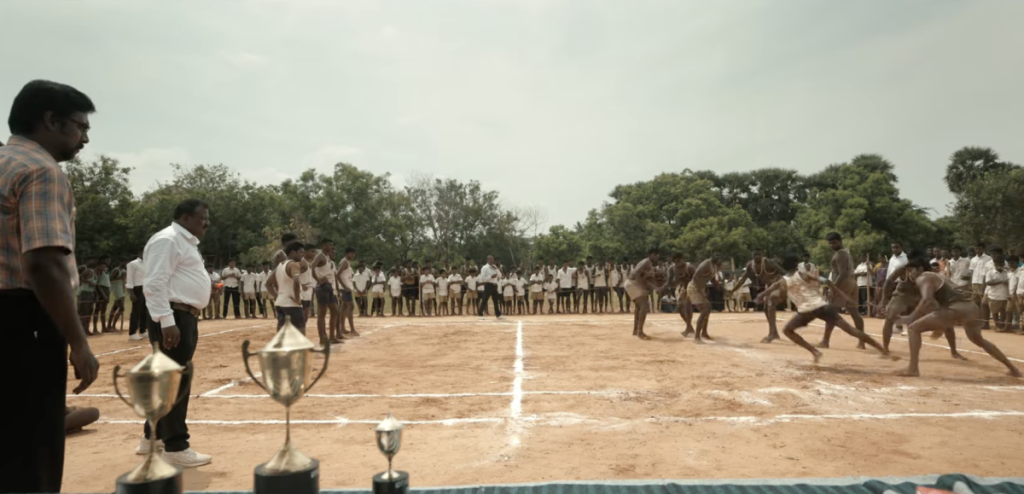
A still from 'Bison Kaalamaadan'.
Sports biopics have usually addressed class as an issue. It’s not surprising that Selvaraj openly discusses caste as a reason for an athlete’s inclusion in a line-up. But there are some neat touches here – Selvaraj doesn’t exempt implicating a section of Dalit people who are practising their own form of casteism.
At first, Kittan won’t be allowed into his own village team because of a past conflict between his father and the captain of the village team. This inter-generational conflict also spills over to the romance between Kittan and Raani (who is the sister of the captain). The two political leaders in the village – Pandiyaraja and Kandasamy — are both vital figures in Kittan’s rise as a Kabaddi player. Kandasamy offers him a position in his club’s team, after seeing outperform all other players with a fractured hand, meanwhile Pandiyaraja prevents Raani’s marriage against her wishes.
In a solid later scene, Ameer’s Pandiyaraja talks about how a section of Dalit people would start acting like their oppressors if they found someone beneath them in a social hierarchy. “Most of them seem to have forgotten why I picked up arms in the first place,” he tells a subordinate in one scene.
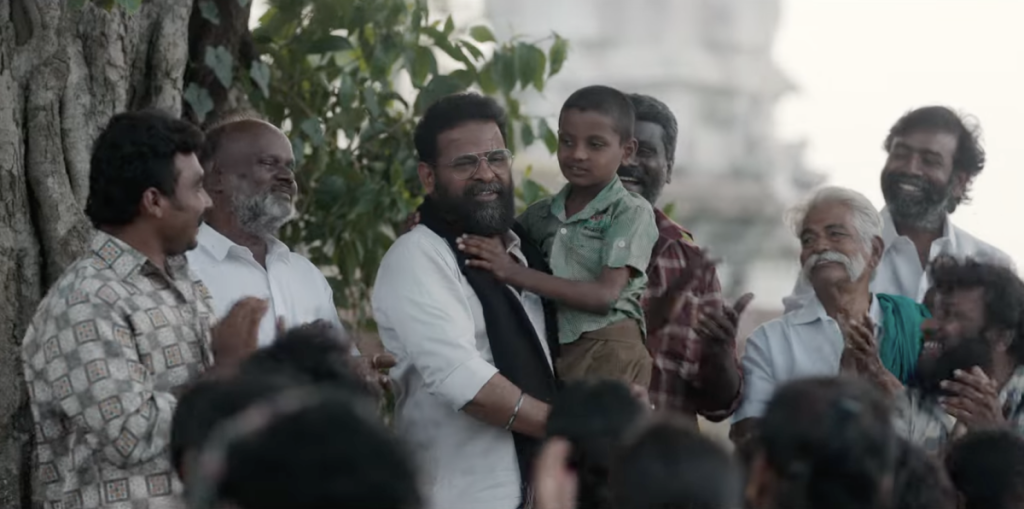
A still from 'Bison Kaalamaadan'.
Bison Kaalamaadan follows most of the beats of a sports drama, where we begin in Kittan’s school days, where a PT teacher senses his physical potential and sticks by him. The ups and downs of any potential superstar coming from limited means, how a literal village comes together to help a boy when they sense he’s got a chance to demolish the social compartment the rest of them are sentenced to commute in. Violence as a way of assertion remains a prime Selvaraj technique. The violence while grisly, is never glorified. There’s an air of inevitability about it – given the clashing social structures. The sheer amount of violence Kittan has to overcome to even be in the periphery of conversation for the national side, is presumably the focus of Selvaraj’s narrative.
Nagraj Manjule’s Jhund tackled something similar in its second half, when a player has to overcome the bureaucracy of getting a passport to showcase their skill on an international platform, thereby growing beyond their ‘predetermined’ social identity. Selvaraj glazes over these pressing obstacles, but it’s also hard to deny that he can see the poetry in a Dalit man’s emancipation coming through a series of swift touches.
*Bison Kaalamaadan is playing in theatres
This article went live on October twenty-second, two thousand twenty five, at ten minutes past five in the evening.The Wire is now on WhatsApp. Follow our channel for sharp analysis and opinions on the latest developments.


