

'Homebound' is Neeraj Ghaywan’s Searing Portrait of Thwarted Youth in a Callous Nation


It’s been a while since a contemporary Hindi film reminded me of Salim-Javed without trying too hard. I wouldn’t be surprised if the duo weren’t even on director Neeraj Ghaywan’s mind, when he wrote the opening scene to his second feature, Homebound.
Adapted from journalist Basharat Peer’s piece, 'Taking Amrit Home' (2020), which appeared in the New York Times at the height of the pandemic, Ghaywan’s film opens with a startling visual. A railway platform is brimming with a crowd of young adults, applicants for a police public service examination. It’s so overwhelming that it momentarily breaks the spirit of Chandan (Vishal Jethwa).
The scene reminded me of Shashi Kapoor’s character in Deewar (1975) saying, “Yeh duniya ek third-class ka dabba bann gayi hai. Jagah bohot kam hai, aur musafir bohot zyada (Our world has turned into a third-class compartment. There’s little space, and too many passengers)."
A scene later, when Chandan says, “Hum log exam likhne jaa rahe hai, ya jung ladne? (Are we going to write an exam, or fight in a war?)" – the dialogue (by Varun Grover, Shreedhar Dubey and Ghaywan) seemed to have echoes from films around disillusioned youth like Rahul Rawail’s Arjun (1985) and J.P. Dutta’s Hathyar (1989).
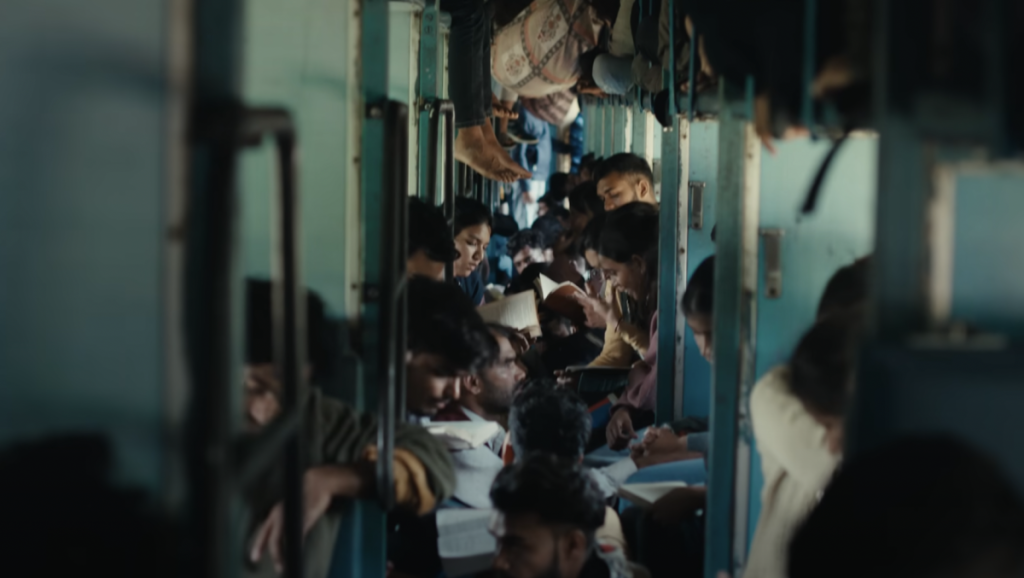
A still from 'Homebound.'
This is mainstream Hindi cinema of a certain vintage, where the dispossessed would often drive the stories. However as the gulf between the urban and rural population has increased, the narratives have forgotten or ignored an entire demographic of the youth. Over the last three decades, the Hindi mainstream has been obsessed with success stories of IITians, or the one-in-a-million fairytale of someone (with limited means) clearing the UPSC – which was also the main criticism against Vidhu Vinod Chopra’s otherwise excellent 12th Fail (2023). What about the rest, who don’t make it? One of the sparkling achievements of Ghaywan’s film is how it shines a light on the thwarted youth of a nation that has been enduring dystopian levels of authoritarianism, majoritarianism and callous cruelty. And still holding on to their right to dream, somehow.
Young men like Chandan Kumar and Mohammed Shoaib (Ishaan Khatter) don’t even register as distinct individuals anymore. They might be among the million perplexed faces at a government office, when news of a paper leak is announced. They’re faces we might come across on social media, where they’re probably lip-syncing to a Kumar Sanu banger or being interviewed about the state of the affairs of the country. They could also be faces, getting beaten up by a mob because of their religious/caste identities. Chandan and Shoaib (based on real-life people Amrit and Saiyub) were two among the million migrant labourers, abandoned by civil society and the state at the height of a virus outbreak, as they were forced to walk back to their villages for thousands of kilometres – during North India’s peak summer.

A still from 'Homebound.'
But (to borrow from Christopher Nolan’s vocabulary) the ‘prestige’ of Ghaywan’s film lies in how it offers dignity to the two men’s life-stories, thereby making us empathise (and then crushing us) with their eventual tragic fate.
Chandan and Shoaib have grown up as childhood friends in a village, presumably in Uttar Pradesh. Chandan, growing up in a Dalit family, whose parents work as construction labourers and with an elder sister who works as a caretaker in the local municipal school, knows a government job is his way out. Similarly for Shoaib, having been at the receiving end of everyday Islamophobia, a police uniform might be the way to distract those who can’t look beyond his religious identity.
Two young men, with dreams in their eyes, the world as their oyster, are however both jolted back to reality. In two separate scenes that take their time getting under your skin, both Chandan and Shoaib are reminded of their social standing. Grilled by an initially-courteous government officer, who has a few uncharitable feelings towards ‘quota’ applicants delivers a cutting farewell line to Chandan. Starting work as a peon at a water-purifier office, Shoaib is similarly shown his place, when the HR head (played brilliantly and mercilessly by Yogendra Vikram Singh) tells him to not fill his water bottle, and asks him to bring his parents’ ID proofs as a part of ‘procedure’. Both Jethwa and Khatter are remarkable in both scenes, especially in the manner they absorb the humiliation with grace, but the hurt lingers on their faces.
There were a few moments during Ghaywan’s film when I felt the Islamophobia and casteism depicted was unsubtle. But then I opened my social media, moments after watching the film, and found a former Chief Justice of India using passive language to defend a mosque’s demolition. Given its stark nakedness, I suppose Ghaywan and Co. have their work cut out while depicting bigotry (even hiding behind splendid, sophisticated English) in a nuanced manner.
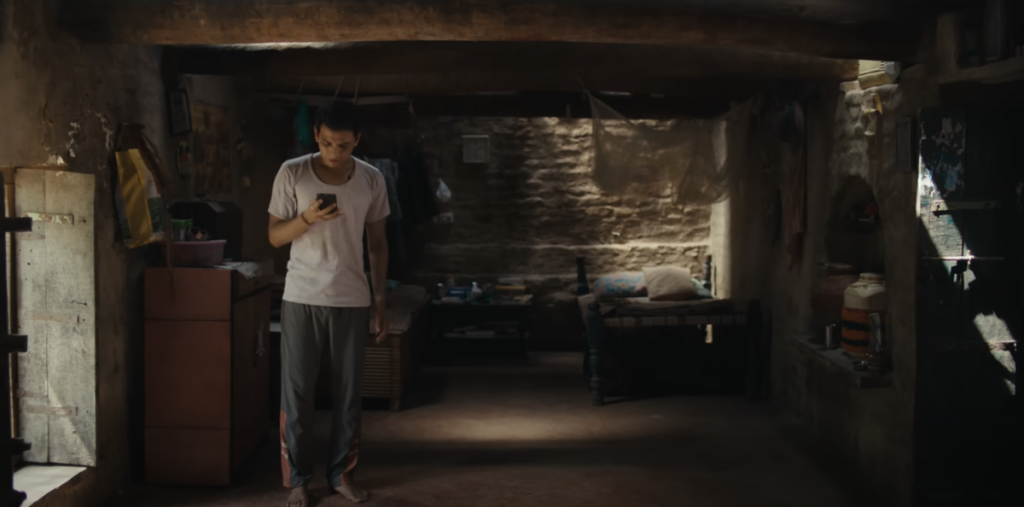
A still from 'Homebound'.
Produced by Karan Johar’s Dharma Productions, it took me some time to look beyond the neatly-pressed visuals of the film. Starting out with the polish of an A24 film (quite the opposite of the gritty look of films based in the hinterland), particularly during this hand-held sequence around a cricket match, which put me at a distance with it, I found my way into the film during a confrontation between Chandan and Shoaib – after one of them has passed the police exam. Both Jethwa and Khatter are sublime in the scene, as they use their familiarity to hurt each other like no one else in the world can. No better example to measure the intimacy between two characters than this.
There’s another scene during an India-Pakistan final, to which Shoaib has been invited by his office superiors. As anyone familiar with the news cycle of the last decade will already know, it’s not going to end well. But there’s a primal, definitive scream that Shoaib lets out after suffering taunts throughout the evening. It reminded me of the scream that Nilesh (Siddhant Chaturvedi) let out in the climax of Dhadak 2 (also produced by Dharma) – but here, it’s followed by the tragedy of Shoaib having to walk away from his livelihood, as the well-intentioned folk stand around like mute spectators.
Apart from his two leads, Ghaywan makes some counter-intuitive choices by casting Janhvi Kapoor as a Dalit character, Sudha Bharti. One can see the intent is to counter the narrative around Dalit characters being depicted in a certain light. However, it results in a couple of the film’s stilted scenes, especially how Kapoor says ‘motivason ki pudhiya’ – not rolling off her tongue unlike the free-flowing Jethwa and Khatter. It’s not a bad performance per se, but it surely does feel like the performative bits in a film that otherwise feels almost life-like. Ghaywan casts the always excellent Shalini Vatsa as Chandan’s mother, who delivers one of my favourite lines in the film. “These bruised feet are all the inheritance I have from my mother-in-law.” Vatsa, who appeared in Khauff earlier this year, has most expressive eyes. How they light up, when a school principal agrees to having a plate of the food she’s prepared (a Dalit woman).
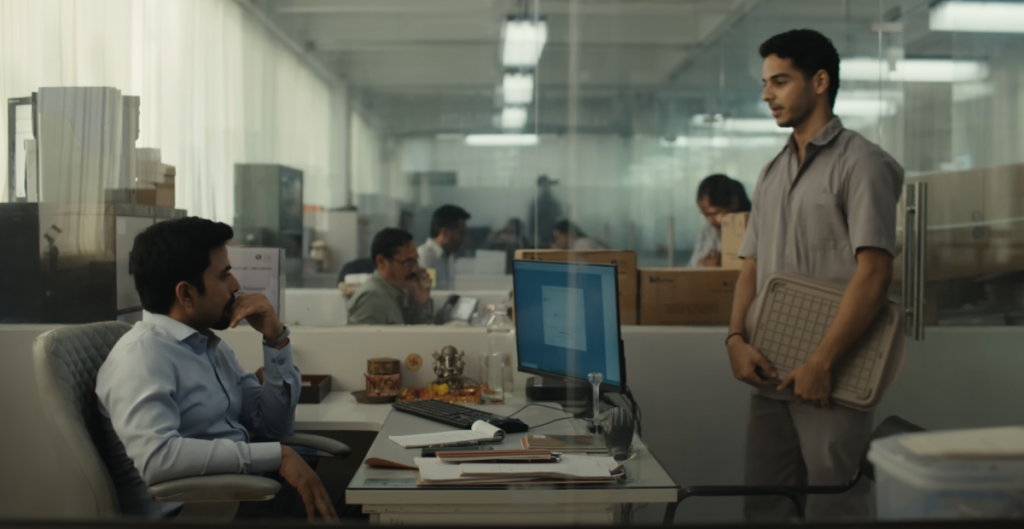
A still from 'Homebound.'
Homebound might be the rare mainstream Hindi film that documents a nation at crossroads. It showcases the failure of bureaucracy, at a time when citizens of the country were dropping like flies. While we were busy getting ‘bored’ inside our gated societies, and the government looked the other way, thousands of people died with no witnesses. Despite its predictable run-in with the CBFC, which has asked Ghaywan to trim contents in 11 scenes and get rid of footage worth 77 seconds, I’m glad Ghaywan’s film exists and is getting a wide theatrical release.
It’s the only way to honour – and mourn – the lives of those who dared to dream. Despite the repeated reminders from ‘civil’ society, and the indifference of an elected government. If Ghaywan’s film offers a face to the migrant labour crisis, which many have already chosen to forget, then Dharma Productions may have, at last, lived up to its name.
*Homebound premiered in the Un Certain Regard section of the 2025 Cannes Film festival, and is currently playing in theatres. It is India’s official entry for the Oscars.
This article went live on September twenty-sixth, two thousand twenty five, at thirty-nine minutes past four in the afternoon.The Wire is now on WhatsApp. Follow our channel for sharp analysis and opinions on the latest developments.


