

In Delhi, a Film Festival Turns Resistance and Censorship into a Conversation


New Delhi: When censorship tightens its grip on art and truth, it is often cinema that slips through; luminous, rebellious, impossible to contain. The film festival And Cinema Goes On, held from October 10 to 12 at Niv Art Centre, New Delhi, stood as a testament to that defiance.
Curated by Labanya Dey and supported by Niv Art Centre, the three-day festival brought together filmmakers who have lived through bans, censorship and exile: Jafar Panahi, Sreemoyee Singh, Dibakar Banerjee, Basel Adra, and Yuval Abraham. Their films, long suppressed or under-distributed, found an audience that was eager to engage with difficult questions around freedom, truth and control.
“In today’s India, it’s getting harder to talk about suppression,” Dey told The Wire after a packed screening. “Because if we talk about suppression, we are further suppressed. Yet people came, knowing exactly what this festival stood for. That gave me hope.”
A festival of resistance
The festival’s line-up: No Other Land (2024) by Basel Adra and Yuval Abraham, Taxi (2015) by Jafar Panahi, And, Towards Happy Alleys (2023) by Sreemoyee Singh, and Tees by Dibakar Banerjee, reflected a shared spirit of defiance. Each film, often talking about censorship and state scrutiny, asked what it means to remain human under regimes of control.
“Art is the last refuge when truth is policed,” Marie Kuriakose, a Delhi University student attending the festival, told The Wire. “These films are what democracy should feel like; messy, honest, alive.”
Bearing witness: No Other Land
The festival’s opening night screened No Other Land, the Palestinian-Israeli documentary that has stirred audiences worldwide. Co-directed by Basel Adra, a Palestinian journalist from Masafer Yatta, and Yuval Abraham, an Israeli journalist, the film chronicles four years of demolitions in the occupied West Bank; homes, schools and lives reduced to rubble.
The collaboration itself was an act of resistance: one filmmaker with the privilege of free movement, the other confined by checkpoints and military law. “In Basel, I see my brother; but we are unequal,” Abraham had said in his Oscar acceptance speech; words that resonated deeply in the Delhi hall.
“The audience was silent long after the credits,” Dey recalled. “That silence, that shared grief, is also a form of dissent.”
Despite winning both the Berlinale Documentary Award and the Oscar for Best Documentary, No Other Land faced backlash in Israel, where screenings were cancelled and its creators received threats.
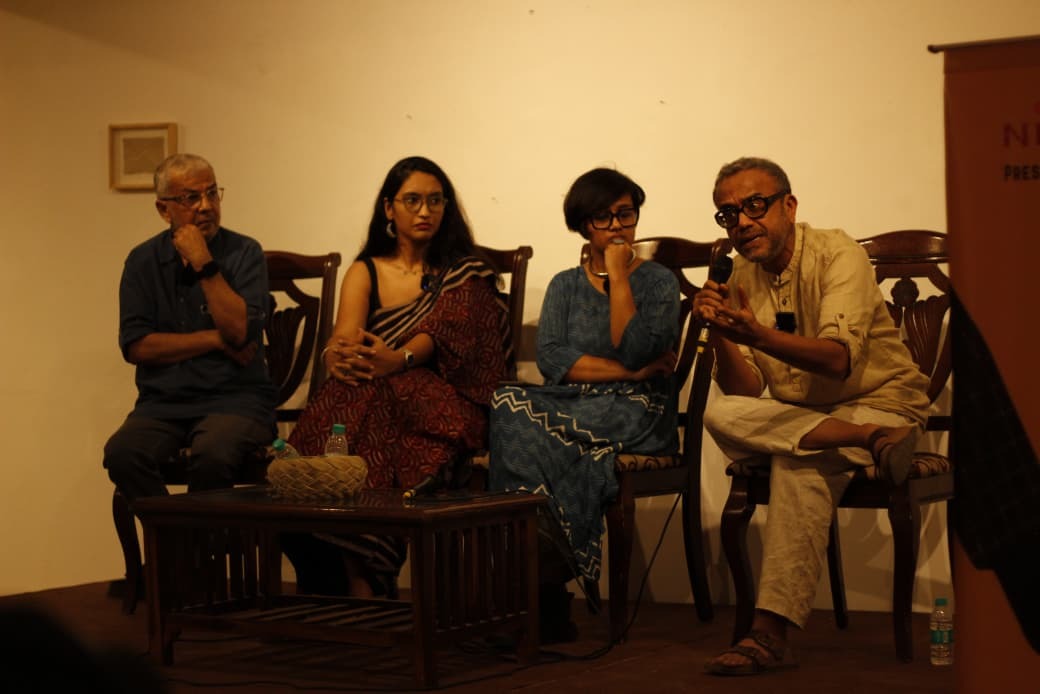
(L to R) Saibal Chatterjee, Sreemoyee Singh, Labanya Dey and Dibakar Banerjee at a panel discussion during the festival. Photo: Souparno Ghosh
Jafar Panahi’s ‘Taxi’: A ride through repression
Iranian filmmaker Jafar Panahi, banned from making films for two decades, shot Taxi in secret. The film turns a car into a moving confessional where Panahi, posing as a cab driver, records conversations with passengers, from human rights activists to DVD sellers, revealing Tehran’s undercurrent of quiet rebellion.
“Panahi’s courage is a reminder that even when silenced, storytelling finds a way,” said Lubdhak Chatterjee, filmmaker and programme director at Niv, speaking to The Wire. “People sat on the stairs for hours just to watch. Festivals like this are sanctuaries for truth.”
Sreemoyee Singh’s And, Towards Happy Alleys
Shot over seven years, Sreemoyee Singh’s And, Towards Happy Alleys journeys through Iran, a nation that simultaneously inspires and constrains its artists. Through intimate conversations with Iranian filmmakers, scholars and former child actors, Singh captures the poetry of defiance: how people create meaning and beauty under surveillance.
“It’s about people who choose courage when everything around them collapses,” Singh has said of her film, which premiered at Berlinale 2023.
For Shaji Mathew, founder-director of Niv Art Centre, the screening was an extension of that courage. Speaking to The Wire, he said, “We’ve always supported fearless voices in art. Hosting Dibakar and Sreemoyee was our way of standing by truth-tellers.”
Dibakar Banerjee’s Tees: A mirror to a nation
The most talked-about screening of the festival was Dibakar Banerjee’s long-shelved political epic Tees. Set across three timelines – 1989 Srinagar, 2019 Mumbai and a dystopian 2042 Delhi – the film examines identity, displacement and the tightening boundaries of freedom.
Shelved by Netflix and unseen elsewhere, Tees imagines an India where memory itself is controlled. “Tees is a mirror held to a country that forgets too easily,” said Prerna Parashar, a film student from JNU. “The future it imagines feels dangerously near.”
Writer Shomi Gupta, another attendee, called it “a rare opportunity to see a film that may never be released, and to interact directly with the filmmaker”.
In a conversation with The Wire, Banerjee reflected on the politics of watching itself: “Film watching is not an act of defiance. But a film may carry thoughts, ideas and concepts that can some day crystalise into defiance – something that even a book, poem, or a chat or a lover can do as well. So real defiance is something that’s a decision, not a reaction.”
His words underscored the essence of the festival: “Cinema doesn’t overthrow power; it prepares us to imagine how we might.”
Piracy, access and the politics of control
Beyond the screenings, the festival also sparked discussions about censorship’s shadow twin – piracy.
“Why is piracy important in times of censorship?” a question was raised to initiate a conversation during the Q&A session. “Because it’s proof of denial. Piracy exists because there are films we’re not allowed to see. It’s how the public reclaims what should belong to them.”
The statement resonated with younger audiences who have grown up in a digital landscape marked by bans and restricted access. “We talk about censorship in whispers now,” said Kaushik Bose, an attendee. “Spaces like this remind us that art can still tell the truth.”
When watching becomes resistance
At And Cinema Goes On, viewers filled the halls, steps and corridors, unwilling to miss a frame. Speaking to The Wire, Chatterjee said, “To see people throng like this, not for celebrity but for conscience; that’s special.”
“If it inspires even one person to express themselves in truth, the vision succeeds.”
Dey described the festival as a “passion project” and expressed plans to take it to other cities. “Every day, more films face suppression. They need homes, not shelves,” she told The Wire. “This festival gave them that.”
Cinema that outruns control
In an era where censorship grows more sophisticated and fear seeps into the creative space, And Cinema Goes On stands as proof that cinema still resists; quietly, powerfully, collectively.
Through films like Taxi, Tees, And, Towards Happy Alleys, and No Other Land, the festival blurred the line between viewing and witnessing.
As audience member, Masood Akhtar, told The Wire, “These films remind us that silence is a privilege, and watching them is an act of protest, an act of solidarity. And like every protest that matters, cinema must go on.”
This article went live on October fourteenth, two thousand twenty five, at eight minutes past one in the afternoon.The Wire is now on WhatsApp. Follow our channel for sharp analysis and opinions on the latest developments.


