

‘Nuremberg’ Correctly Asserts that the WWII Trial Was Not a Victory Lap


In Frederic Raphael’s book, Eyes Wide Open – on the making of Stanley Kubrick’s Eyes Wide Shut (1998), which Raphael co-wrote with Kubrick – at one point, they discuss Schindler’s List. The much-revered, Oscar-sweeping 1995 film by Steven Spielberg is cut down to size by Kubrick for its triumphant, hopeful climax. Something that betrays the way Kubrick sees the Holocaust essentially as a tale of failure. Even though I don’t fully concur with the thesis, I do see where Kubrick was coming from. That the Holocaust was a singular example of systemic moral failure is something that is acutely understood by James Vanderbilt’s Nuremberg – a film named after the infamous trial where the Allies prosecuted the surviving officers of the Nazi high command for crimes against humanity. What’s surprising about Vanderbilt’s film is its awareness isn’t instantly apparent. But how it reveals itself slowly.
In the first scene, an American soldier is shown to be urinating on the Nazi swastika flag – not a particularly subtle precursor of the rest of the film. The year is 1945, and what was described as a 1000-year Reich has come to a mundane end (after the suicides of Hitler and Goebbels). Trying to escape with his family after stuffing as much as he can (including more than a million dollars, and about 40,000 pills of opioids – which he claimed were for a ‘heart condition’) in the boot of his slender car – Hermann Göring (Russell Crowe) surrenders when some American soldiers identify him, and threaten to kill his family. Like Göring, four other high-ranking Nazis are arrested, and held by the Allied forces (comprising the USA, UK, France and others). The idea is to systematically define ‘evil’ for the world, so that such an event doesn’t repeat itself ever again. It’s a holier-than-thou mission by a nation that obliterated two cities with A-bombs – using the rhetoric ‘we had a right to defend ourselves’ – a statement whose similarity to the real world might be entirely coincidental.
At first, Nuremberg seemed like the chirpy, self-congratulatory Hollywood studio film that beams with American patriotism. But Vanderbilt’s film also drops small hints at being disinterested in a glittery depiction of how ‘America brought the monsters of WWII to justice’. When psychiatrist Douglas Kelly (Rami Malek) is given the opportunity to psychologically profile the Nazi high command – his first thought is his professional curiosity, soon followed by the kind of money one might be able to make from writing a book on them. “Wouldn’t you like to dissect evil?” Kelley asks an interpreter accompanying him. It’s an intriguing question.
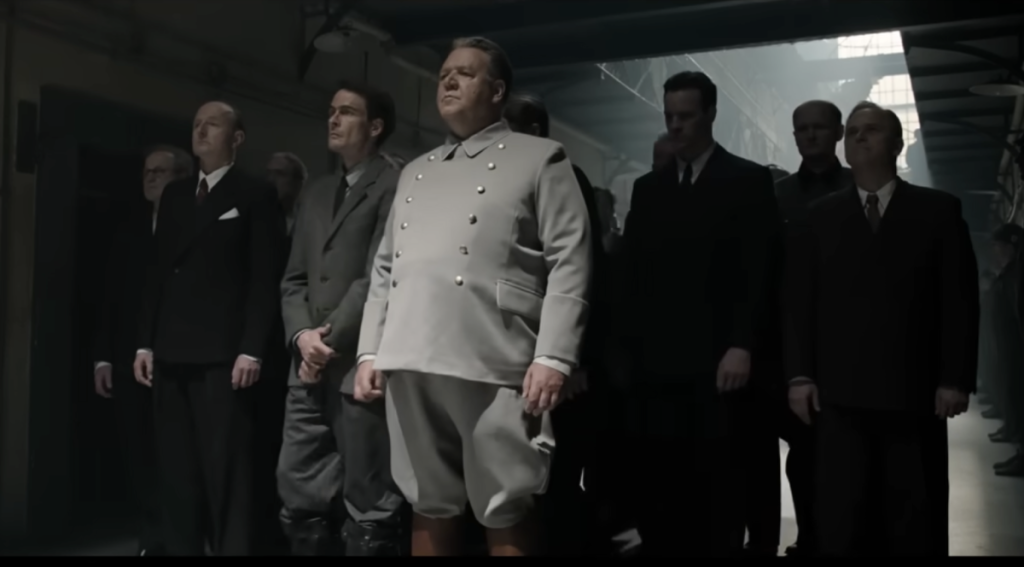
A still from Nuremberg.
The few instances between Kelley and Göring shows reminded me of A Few Good Men (1992) – another razor-sharp courtroom drama. Both smart men, weighing each other out, trying to decide if they can trust one another. Göring, who Crowe initially plays like a vain, cold German tank, only eventually conceding and showing signs of a petty, loving, ordinary man. The starkness between Crowe’s large build and Malek’s reptilian physicality works wonderfully during the confrontations. But I was more charmed when Göring and Kelley shared a genuine laugh in the midst of mind games to gain a fraction of an edge during the trial.
Crowe, one of the most formidable actor-stars of his generation, gives a performance for the ages as Göring. A sharp, meticulous general with a chest full of evidence of his glory-seeking, Crowe plays Göring as an overfed war hero, who was too occupied with his comfort and luxury to truly think about Germany’s war-time efforts. However, only an actor with the charisma of Crowe can convince his audience to sympathise with a Nazi undertrial without resorting to cheap manipulations. Malek and Shannon are a relatively staider presence in the film, plotting against the Nazi general — trying to find a way to get the man to admit to the Nazi leadership’s barbarism.
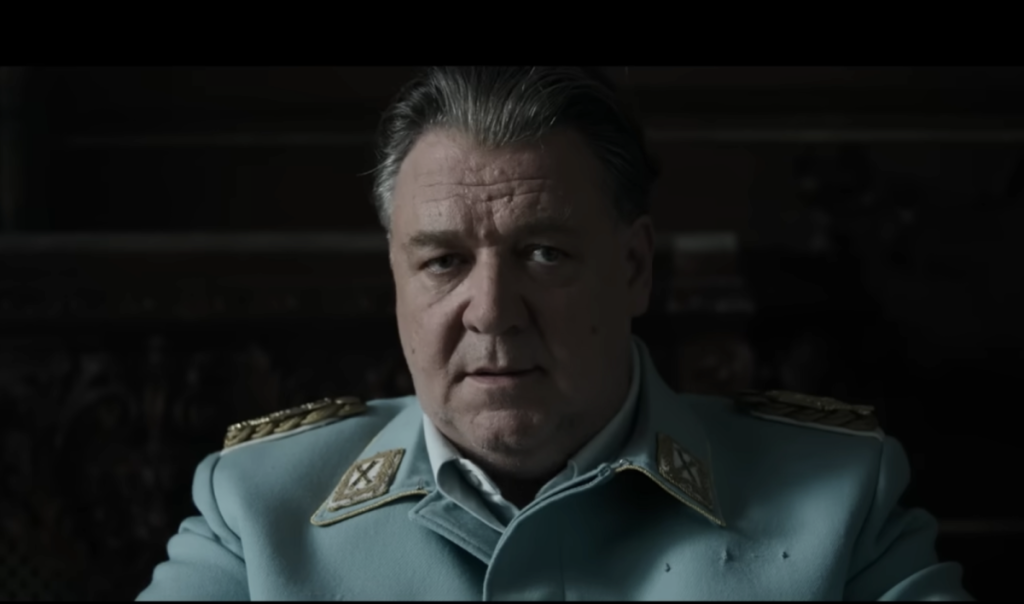
A still from Nuremberg.
The realisation that Kelley reaches with his conversations with Göring is that the Nazis weren’t all that different. Sure, there were cultural specificities and a lot many superficial distinctions, but the real ‘monsters’ in the Nazi regime were those willing to look away to protect their privilege. Göring, who had fallen out of favour with Hitler towards the end, enjoyed the luxury of the Reich, using it to provide the most comfortable existence to his wife and daughter. Considering he’d fought in World War I, there was a degree of delusion in him that entitled him to shaping his politics around whatever fed into his personal ambition. Vanderbilt’s film contends radicals like Hitler might be less harmful for a country than Göring – who will mould their ideology in favour of whatever helps them accumulate power. Even signing death warrants of millions of Jews, while enjoying the sun hitting their face in their plush office.
The sheer mundanity of the truth probably shook Kelley – as he realised that such apathy and convenient compartmentalisation could exist in any society with enough discontent. It’s not surprising that Kelley’s book, which warned us about the dangers of a fascist emerging from anywhere, wasn’t widely read. Everyone was too consumed by the triumph of the Nazis being prosecuted and sentenced to death. But Vanderbilt’s film's biggest success is it knows that the Nuremberg trials were only the beginning – and far from the victory lap many people think it is. Kubrick might have approved – especially for the film’s refusal to mistake punishment for closure.
*Nuremberg is playing in theatres.
The Wire is now on WhatsApp. Follow our channel for sharp analysis and opinions on the latest developments.


