

'One Battle after Another' is a Father-Daughter Odyssey Through a Despotic America


In one of the funniest scenes in Paul Thomas Anderson’s One Battle After Another – Pat Calhoun (Leonardo DiCaprio) — is navigating the bureaucracy of a revolution. Spending over a decade abusing drugs and alcohol, he’s trying to remember a password for a hotline operator – the answer to the question ‘What time is it?’ – to find out about the rendezvous point of his 16-year-old daughter, Charlene (Chase Infiniti), as a crisis unfolds. Pat is trying hard – but he can’t seem to remember. His brain is fried, and he’s spent too much time as a jaded former revolutionary, looking over his shoulder, trying to escape everyone’s attention. The fatigue in DiCaprio’s body language might hold true for any well-intentioned folk in 2025, scrolling through their phones and reading about one injustice after another happening around the world. It’s but natural that their outrage will be fully spent within the hour, and one will become numb to the atrocities being inflicted by the powers that be. Feeling any more than that will take a toll on one’s sanity. So, one shuts down – and gapes at the world crumbling in front of their eyes in real time.
Anderson mines the moment for all its despondency, absurdity and humour. DiCaprio acts the hell out of the scene, like he always has. “I got lazy, man!” Pat tells someone in another scene. It’s a peculiar form of helplessness and anxiety one is dogged with these days, no matter what side of the planet one may be. Constantly being reminded of how the powerful act with impunity, while also being hyper-aware about not being able to do anything concrete about it. I’m sure every generation has said this, but things haven’t been as bad as now. Anderson’s film knows this and stitches a father-daughter odyssey around these volatile times in a despotic America.
Before he became a washout, Pat used to be a part of a far-left revolutionary group called the French 75. It’s where he met the gloriously mercurial Perfidia Beverly Hills (Teyana Taylor). They take part in missions, where their group frees migrants from a detention centre at the Mexico border, bomb senators’ cars, and loot banks to fund their operations. It’s clear that the group, while driven by ideology and excellent intentions, also doesn’t comprise the most centered folks. Unlike the characters depicted in Daniel Goldhaber’s How to Blow Up A Pipeline (2022) – where the counter-culture activists are relatively staid and very disciplined — Anderson’s characters are more wild and cinematic. Especially Perfidia, who empties a rifle while being noticeably pregnant, and then struggles to adapt to her new role as a mother and a caregiver.
I’m not sure I’ve seen a character as physical as the one essayed by Taylor. She’s so driven, has so much agency and is so viscerally convincing (even when she’s sprinting on the road), even the IMAX screen I watched the film on, found it hard to contain her presence. It’s a performance that is only rivalled by Sean Penn’s Col. Stephen Lockjaw – a meat headed soldier, overseeing the detention centres at the border, when he meets Perfidia, and is instantly smitten by her.
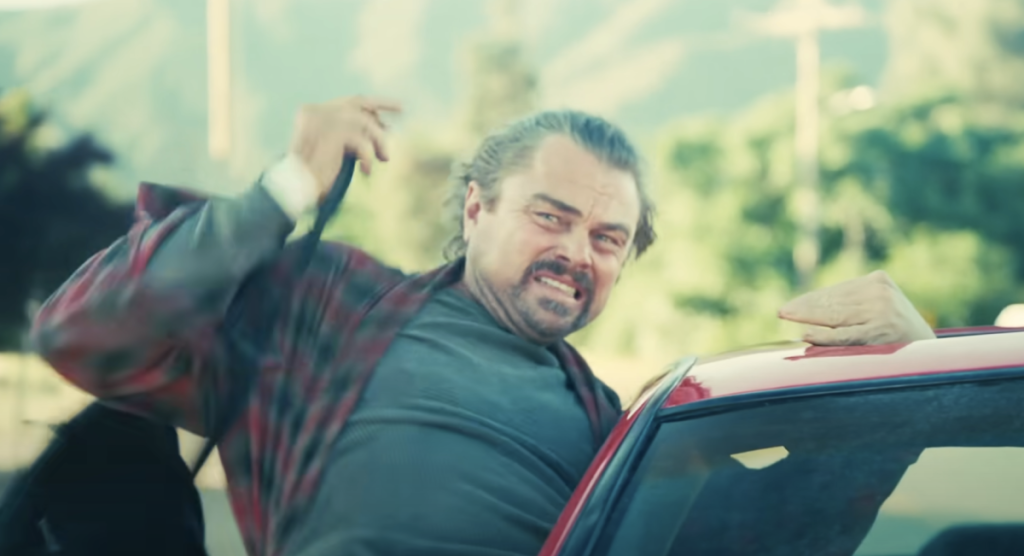
A still from 'One Battle After Another.'
Penn is committed to playing the fool, as an army person who wishes to be accepted by a White Supremacist group called The Christmas Adventurers’ Club – comprising billionaires, politicians, highly-decorated retired army personnel — who sound eerily like the scientology cult. “Once you join us, I want you to remember you’re a higher being,” a member tells Lockjaw, during his interview. Only one hindrance — Lockjaw has to take an oath that he’s never indulged in an inter-racial sexual relationship. And thus, the colonel is forced to track down Charlene, to confirm if he’s her biological father. This seed of doubt emanates from Lockjaw’s one-night stand with Perfidia, in exchange for letting her continue with her activism, despite catching her red-handed in one instance. If Charlene is indeed Lockjaw’s daughter, he has to find her before the club members do and it ruins his chances of admission.
On a premise as frivolous-seeming and disjointed as this, Lockjaw’s army raids Baktan Cross – a sanctuary city, where most of the ‘retired’ members of the French 75, including Pat and Charlene reside. As Charlene, Chase Infiniti is a revelation. The daughter of a perpetually intoxicated Pat, she’s understandably wise beyond her 16-year-old self. In one scene, she interrogates her own father, asking him ‘where were you last night? What time did you get in? How did you get home?’ – flipping the very notions of a father-daughter dynamic. However, Pat is still a caring father — we know this from how he’s trained her since a young age. And how he insists on telling her to carry a tracking device, which is handy in case of a crisis.
The second half of the 170-minute opus sees both Charlene and Pat trying to avoid capture by Lockjaw, and fail. It follows these two characters through a city ravaged by military police, which looks eerily like the arrests by the ICE (Immigration & Customs Enforcements) officials. We go through basements harbouring illegal immigrants by samaritans, school students being rounded by and intimidated by the military, a sisterhood away from the city run by former French 75 members. It’s a whimsical, prescient, urgent, intimate film on political violence
One Battle After Another works as a stoner-comedy, a father-daughter odyssey, a paranoid thriller – all in the same breath. All plotlines culminate in a surreal, thrilling highway chase scene, which is going to be cited and discussed for years to come. Using 35mm Vista Vision, Anderson luxuriates in framing his characters in close-ups through most of the scenes, however, it’s in this final highway sequence that the equipment transcends the medium. As three separate cars chase each other, the camera ebbs and flows on the highway, mimicking the rollercoaster that life has become in 2025.
This is only Paul Thomas Anderson’s second film set in the 21st Century (after Punch Drunk Love, 2005) – and this might be the most ‘reactive’ he’s seemed to Trump’s America. For a film this funny, I was surprised by the sombre ending – an unexpected, gruesome death; and the baton of activism being passed down from one generation to the next. The revolution might not be televised anymore, but it’s reached our devices where we spend our days scrolling without a thought. It’s good to switch off sporadically, however, there are many, many battles to be fought. Losing hope is not an option.
*One Battle After Another is playing in theatres.
This article went live on September twenty-ninth, two thousand twenty five, at twenty-three minutes past twelve at noon.The Wire is now on WhatsApp. Follow our channel for sharp analysis and opinions on the latest developments.


