

The Taj Story is an Eighth Wonder of Gaslighting, Half-Truths and Saffron Victimhood


I don’t think anyone working in The Taj Story is acquainted with ‘confirmation bias’ as a concept. Or they’re deliberately ignorant – which is worse. I gauged this from a scene, where a noted lawyer character’s reaction to the declaration “I have evidence that the Taj Mahal wasn’t built by Shahjahan” is not “what is the evidence?” Instead, the lawyer’s voice sounds almost jubilant – like it’s some personal victory. The goal isn’t to find the ‘truth’. The ‘truth’ has already been ascertained in one’s imagination – so one simply needs to cherry-pick facts, poke inane holes in the widely-accepted version of history – to plant a seed of doubt. This isn’t a conclusion arrived at after rigorous thought – it’s shameless, weightless contrarianism for its own sake.
I’m not a historian, and I’m as gullible as the next person. Sure, I have my personal biases (I was wary of Tushar Amrish Goel’s film before stepping in) but, as the lights dimmed, I had the niggling self-doubt most individuals seeking some version of truth can have. “You don’t know what you don’t know,” I thought to myself. It’s similar to a feeling most self-respecting critics have as the opening credits begin for films they’re least enthused about. “What if it’s actually good?”
I sat upright, and paid attention. I wasn’t going to miss anything, I would hold on to every kernel of information provided by the film. I would take copious notes to determine the subtext of every line, every aesthetic choice.
And dear reader, I’d like to tell you that The Taj Story is an insanely incoherent and incompetent film. Now, before the makers want to colour me as a ‘leftist’ (who are the reason behind independent India’s doom, as the protagonist says in one of his many tirades) that this pronouncement is more than ideological. I’m not slamming the film merely because it differs from widely-accepted knowledge around the Taj Mahal. It’s because of how unconvincing, shallow and half-hearted it is. I’d like to remind the makers that as a watcher of mainstream Bollywood every week, suspension of disbelief is not the problem here. Instead, all we get is empty rhetoric, gas-lighting, half-truths and the most embarrassing form of victimhood.
Vishnu Das (Paresh Rawal) is a state-approved tourist guide at the Taj Mahal in Agra for over 25 years. Barely eking out a living with his son Avinash (Namit Das, also a tourist guide at the Taj), he repeats the love story between Mughal ruler, Shahjahan and Mumtaz – whom the monument is dedicated to. When Vishnu’s drunken tirade about the ‘undiscovered truth’ about the Taj Mahal goes viral on social media, he’s terminated by a laughably suspicious-looking ‘Muslim’ management committee. In the film, the Agra tourist association is overrun by men in long beards, kohl-eyes and skull caps. Nothing specifies the film’s target audience quite like the keffiyehs worn by the men – who harass Vishnu and his family after he files a public interest litigation challenging the history of Taj Mahal.
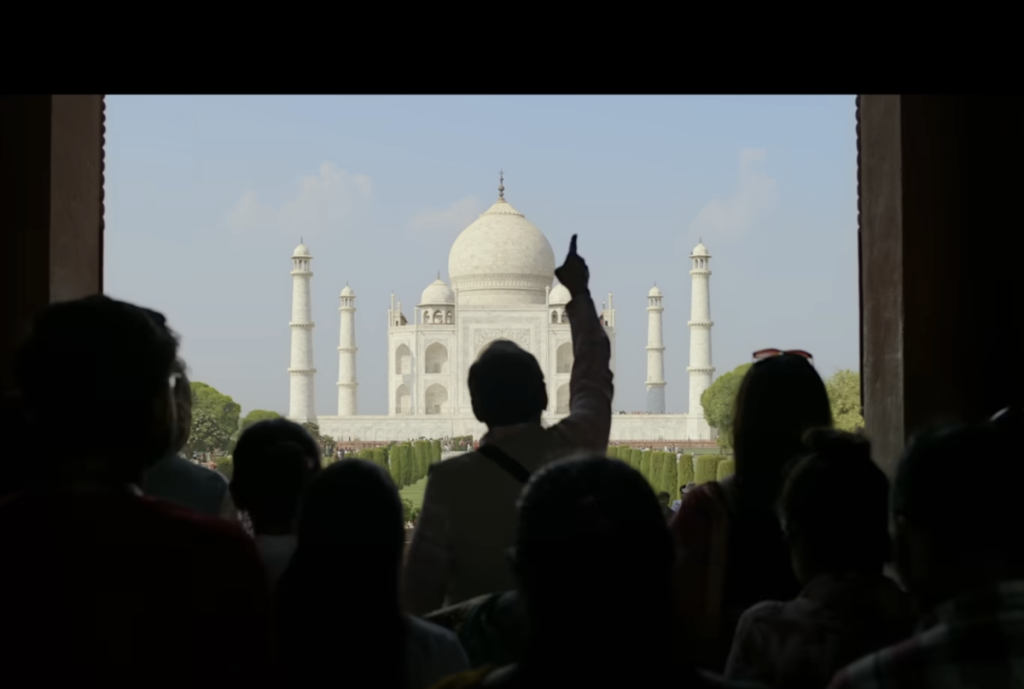
A still from 'The Taj Story'.
Borrowing from one of his earlier films, OMG (2012) — a film that would in all probability not get past the censor board today for criticising Hindu religious practises – Rawal plays Vishnu like an aspiring stand-up comedian. He delivers WhatsApp rhymes as a part of his arguments in court, which are so hollow in substance that I couldn’t fathom how the opposing counsel (Zakir Hussain) wasn’t seeking an objection to each and every sentence. Hussain, who only recently perceptively played the part of a Muslim principal in Shazia Iqbal’s Dhadak 2, whose hands are tied in a society fanatical about social hierarchy, humiliates himself by playing the punching bag to the hollow assertions of Rawal’s character. As Rawal’s Vishnu goes off on tangential tirades – pitting ‘Bharatiya sabhyata’ with ‘Mughal tradition’ – not once does Hussain’s character object seeking relevance to the case. He’s not meant to do that. And yet, he drives into court in a Mercedes, aided by a team of four-five young lawyers, none of whom know how to systematically negate and shut down Vishnu’s verbal poison inside the courtroom.
Instead of being a truth-seeker, Rawal’s character is a post-truth seeker. Anyone seeking truth possesses the humility to accept facts that betray their long-held belief system. Vishnu, on the other hand, has already made up his mind on the basis of a few stray anecdotes and some trivial contradictions. Any person who validates his theory is a ‘good man’ – not a single question is posed to these people. How do they know this? How reliable are they? No rigour. And anyone posing sensible questions, is speaking against Bharat’s tradition.
I’m not opposed to films based on conspiracy theories. I’ve enjoyed Nicholas Cage’s National Treasure films, which talk about a mythical treasure passed down by Knights’ Templar, Freemasons and America’s founding fathers. It’s silly, but it has fun bits of a heist comedy, historical adventure film – which were a thing in Hollywood during the 2000s. The Taj Story, on the other hand, is so flimsy that for even the kindest Bollywood fan, it might be just plain unbelievable. I laughed out loud in one scene towards the end, where an expert historian, an architect with know-how of the Taj Mahal, and an academic (presumably from a public university like JNU) – were all seated next to the film’s Muslim mafia. According to Goel, Muslims = leftist academics = Urban Naxals. In a not subtle scene — a Muslim goon announces that the Taj Mahal should not be touched because it is ‘Jamaat ka haq’ (the right of the Muslim community).
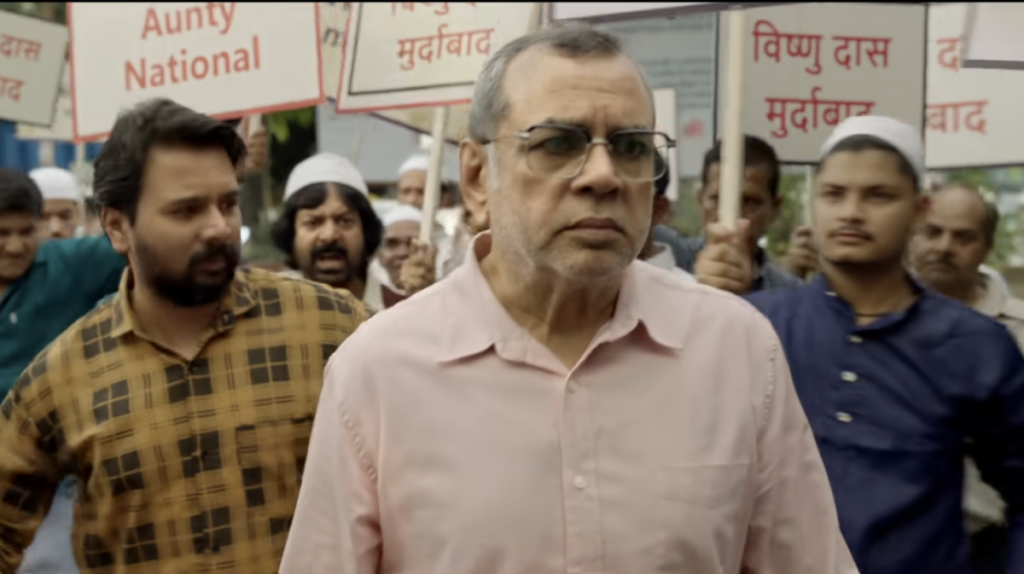
A still from 'The Taj Story'.
At an excruciating runtime of 166 minutes, The Taj Story wants to play both victim and crusader. The aim is simply to plant a doubt about a once-great Hindu nation, plundered by the Mughals – which has been the narrative for many Hindi films in the past decade like Padmaavat (2018), Tanhaji (2020), Chhaava (2025). At the screening I was in, a handful of the audience members were enthusiastically responding to Rawal’s smug WhatsApp trivia. The agenda is not to understand a complicated, multi-faceted version of history. It’s to poke holes in existing knowledge, which can disseminate into harmless rumours, but which will one day be weaponised to demolish every ‘Mughal’ structure in India. It’s a shrewd, callous and dangerous thing to do – a path paved by the success of films like The Kashmir Files (2021) and The Kerala Story (2023).
However, even in the midst of all these falsehoods and disingenuousness, there are times when the Paresh Rawal-starrer ironically reflects some real life truths. A judge seeing ‘merit’ in a flimsily argued case, grants it hearing after hearing in a country where undertrials languish in prison for years on end. Also, an attention-seeker like Vishnu gets vindication from the judiciary. It feels plausible in a nation where people have mobilised against a YouTuber’s requests to not burst fire crackers and have thereby taken the Air Quality Index (AQI) to record levels in many cities. It’s a curious cocktail of ego and ignorance, something Goel’s film is only trying to feed.
The Taj Story begins with four disclaimers being read aloud – emphasising that this is meant to be ‘fiction’ and any resemblance to characters in real life, are purely coincidental. It also says ‘No animals were harmed during the making of the film’ – only common sense then. For a film built on the monument of love, The Taj Story curdles into a monument of unchecked venom.
*The Taj Story is playing in theatres
This article went live on November fifth, two thousand twenty five, at thirty minutes past twelve at noon.The Wire is now on WhatsApp. Follow our channel for sharp analysis and opinions on the latest developments.


