

UP: Most Funds Allocated For Kanya Sumangala Yojana Remain Unutilised in the Last Three Years, Finds RTI Query


New Delhi: The Yogi Adityanath government in Uttar Pradesh has made numerous promises concerning women's welfare over the years. However, the ground reality starkly contrasts these claims. Under the government's ambitious Mukhyamantri Kanya Sumangala Yojana, approximately two-thirds, or 63%, of the sanctioned budget over the past three financial years (2021-22 to 2023-24) has not been utilised.
Moreover, the allocation of funds for this initiative has also decreased. While the budget for other programs has seen a rise, the funding for this scheme has been slashed by 56.25%. In the fiscal year 2022-23, an amount of Rs 40,000 lakh was approved for the scheme, but in the subsequent year, 2023-24, it was drastically reduced to Rs 17,500 lakh, reflecting a cut of nearly 56%. A further reduction occurred in the financial year 2024-25, with a total budget of Rs 16,716.67 lakh being sanctioned.
This initiative is the flagship social welfare program of the Uttar Pradesh government, inaugurated on October 25, 2019, by chief minister Yogi Adityanath, Governor Anandiben Patel, and then Union minister Smriti Irani. The primary aim of this scheme is to offer financial support to the girl child in the state from birth all the way through her higher education, thereby preventing unlawful practices such as female foeticide, child marriage and social discrimination against girls.
आज लोक भवन, लखनऊ में 'मुख्यमंत्री कन्या सुमंगला योजना' के शुभारंभ कार्यक्रम में माननीय राज्यपाल @anandibenpatel एवं मुख्यमंत्री @myogiadityanath जी के साथ भाग लिया।
यह योजना बेटियों को शैक्षणिक रूप से सशक्त बनाने एवं उनके मान-सम्मान को बढ़ाने में सहायक सिद्ध होगी। pic.twitter.com/VsS5q514Az
— Smriti Z Irani (@smritiirani) October 25, 2019
The program offers financial support in six phases – a lump sum is provided to beneficiary families at different points such as birth, vaccination and enrolment in class 1, 6, 9 as well as in graduation or diploma courses. In the last phase, female students who are enrolled in college or diploma programs receive assistance of up to Rs 7,000. This benefit is available exclusively to families with an annual income of less than Rs 3 lakh and a maximum of two children. In certain exceptional cases, families with twin daughters are eligible for this benefit.
The official data for families with an annual income below Rs 3 lakh in Uttar Pradesh is not available. However, according to the Multidimensional Poverty Index (MPI) of NITI Aayog, approximately 22.93% of the state's population lives below the poverty line.
In August 2022, Uttar Pradesh chief minister Yogi Adityanath stated that the state's population was 25 crores. Based on this figure, the estimated number of individuals living below the poverty line in the state could be around 5.73 crores.
As per the Uttar Pradesh government, as of June 6, 2025, a total of 2,500,867 girls in the state have benefited from this scheme.
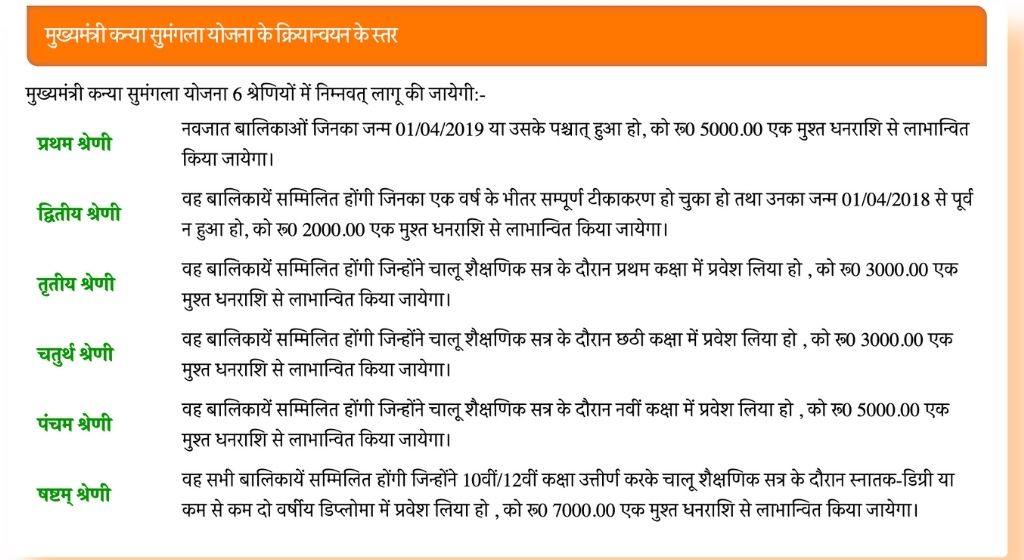
As per the UP government, as of June 6, 2025, a total of 2,500,867 girls have benefited from this scheme.
Allocated funds not utilised, budget declining
In response to an RTI query filed under the Right to Information Act, 2005, it has come to light that a significant portion of the budget allocated for this scheme has not been spent. According to data provided by the Women Welfare Department of Uttar Pradesh, in reply to an RTI on May 8, 2025:
In the fiscal year 2021-22, an amount of Rs 20,000 lakh was allocated, yet only Rs 8,092.94 lakh was utilised.
For the fiscal year 2022-23, Rs 40,000 lakh was approved, with only Rs 7,516.60 lakh being spent.
In the fiscal year 2023-24, Rs 17,500 lakh was sanctioned, of which merely Rs 7,467.18 crore was expended.
It is important to note that during the fiscal year 2023-24, the allocated budget drastically decreased to Rs 17,500 lakh, while the expenditure remained consistent with previous years. The fiscal year 2022-23 recorded the highest budget allocation of Rs 40,000 lakh, yet only Rs 7,516.60 lakh was utilised.
Consequently, a cumulative budget of Rs 61,750 lakh was sanctioned, but only Rs 23,076.72 lakh was spent, representing a mere 37.37% utilisation rate.
However, the UP government has asserted that a total budget of Rs 16,716.67 lakh was sanctioned for the Kanya Sumangala Yojana for the financial year 2024-25. As of March 2025, Rs 16,450.05 lakh has been disbursed from this budget.
42% decline in the proposed budget
In addition to the sanctioned budget, the proposed budget for this scheme is also witnessing a continuous reduction.
During the financial year 2021-22, the proposed budget for this scheme was Rs 1,200 crore, which has come down to Rs 700 crore by 2025-26, indicating that over the past five financial years, the budget has diminished by Rs 500 crore, representing a decline of approximately 42% in the proposed budget.
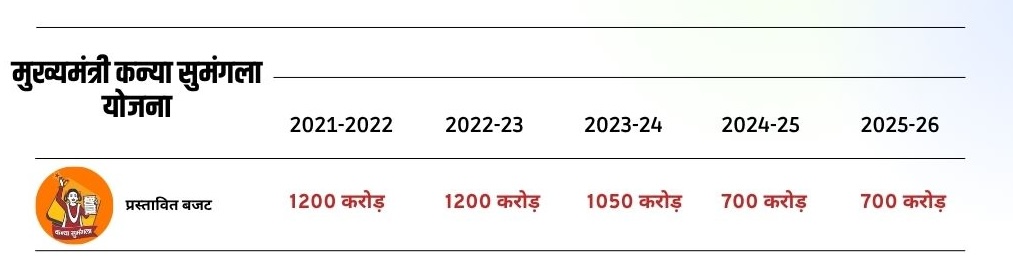
Illustration: The Wire Hindi
Amount spent on publicity not disclosed by the government
The RTI application also requested information regarding the expenses related to the publicity of the scheme. However, the women welfare department failed to provide any details. This is particularly concerning given the scheme has been prominently promoted, with the chief minister himself frequently mentioning it in his speeches.
The Wire Hindi reached out to the UP government’s women welfare department to find out the department's position on crucial information regarding the scheme. A list of questions was sent to the signatory and deputy director of the department, Ashutosh Kumar Singh, regarding the RTI response.
These inquiries included the reason for not utilising the approved budget for the scheme, details of the publicity expenditures, categorisation of beneficiaries according to social groups and issues encountered in the scheme's implementation. However, at the time of writing this report, no responses to these inquiries had been received.
What do experts say?
Speaking to The Wire Hindi, economist and IIT Delhi professor Ritika Khera said, “It is not new that the allocated budget for welfare programs has remained unspent, which is unfortunate as individuals, particularly women, are in dire need of such assistance. For instance, the budget for the central government's Pradhan Mantri Matru Vandana Yojana has been significantly lower than what is required, and it has also not been fully utilised.
“On the other hand, had pregnant women received this aid, they could have addressed their specific needs during pregnancy and the childbearing period.”
Professor Khera, who has written a research-based book titled Rewadi Ya Haq, which focuses on public welfare initiatives, further said, “When a new program is launched, it takes time for the public to become aware of it – for example, in the case of the Pradhan Mantri Matru Vandana Yojana, we observed that in the initial 1-2 years, the budget was underutilized due to insufficient information. However, by the third year of the Uttar Pradesh initiative, its utilization should see an increase.
“A significant factor contributing to the underutilisation of the PMMVY budget is the extensive and challenging paperwork that women must navigate to access the benefits. This issue may also be present in the Uttar Pradesh program,” she said.
This article was first published on The Wire Hindi.
This article went live on August eleventh, two thousand twenty five, at fifty-eight minutes past nine at night.The Wire is now on WhatsApp. Follow our channel for sharp analysis and opinions on the latest developments.


