

Explainer | What do the Labour Codes Mean for the Indian Worker?


On Friday, November 21, 2025, the Union Ministry of Labour and Employment notified the rules for four Labour Codes. This overhaul absorbs and repeals 29 existing central labour laws.
These Codes – the Code on Wages, 2019; the Industrial Relations Code, 2020; the Code on Social Security, 2020; and the Occupational Safety, Health and Working Conditions Code, 2020 – represent the most significant restructuring of India’s labour jurisprudence since Independence.
While the government asserts these reforms will improve, not just the “ease” but also, the “speed of doing business” by simplifying compliance and universalising social security, trade unions and opposition parties have launched nationwide protests. They have called the move a unilateral imposition that dismantles the hard-won rights of the working class.
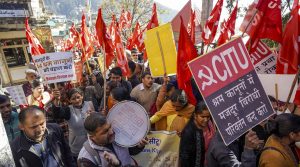
Centre of Indian Trade Unions (CITU) activists raise slogans during a protest against four labour codes, outside DC office, in Shimla, Himachal Pradesh, Wednesday, Nov. 26, 2025. Photo: PTI
What is the context of this notification?
The Codes come into force nearly six years after their parliamentary passage, ending a prolonged administrative limbo. Their legislative history is rooted in political contention. The Code on Wages passed in 2019, while the remaining three – Industrial Relations, Social Security, and OSH – were passed in September 2020.
Notably, the parliament cleared the 2020 Codes in a truncated session while the opposition boycotted proceedings over the Farm Bills. This period also coincided with widespread civil unrest regarding the Citizenship Amendment Act (CAA) and the pressures of the COVID-19 pandemic.
Critics cite the lack of tripartite consultation as a primary flaw. The Indian Labour Conference (ILC) – the apex mechanism where government, employers and workers deliberated policy – has not convened since 2015. This omission has drawn criticism even from within the ruling establishment.
In March 2025, Basavaraj Bommai, senior Bharatiya Janata Party (BJP) leader and chairperson of the Parliamentary Standing Committee on Labour, publicly criticised the Union government for failing to hold the ILC, noting that such omissions undermine the democratic legitimacy of labour reforms.
Why ‘Codes’ and what are the implications for federalism?
Shifting from specific “Acts” to consolidated “Codes” is not just a tweak but a structural overhaul. By amalgamating 29 diverse laws, the parliament has effectively delegated substantial legislative powers to the Executive (both Union and state governments) through “Rules”.
Substantive details – such as the specific calculation of the floor wage, safety limits, or social security thresholds – previously embedded in the hard text of Acts now sit within “Rules” that the government can alter by notification without immediate parliamentary scrutiny.

Representative image. Photo: PTI
Since ‘Labour’ is on the Concurrent List, both the Union government and states must frame rules for these Codes to function. While the Union government has notified the Codes, the legal landscape remains fragmented. “Business-friendly” states like Uttar Pradesh, Karnataka, Andhra Pradesh, and Gujarat have pre-drafted rules increasing daily working limits and introducing self-certification.
Conversely, states with strong union presence like Tamil Nadu and West Bengal have delayed finalising rules. This creates a “compliance asymmetry,” where labour standards could vary drastically across states. Analysts fear this may trigger a “race to the bottom,” where states compete to attract capital by framing the most “flexible” or deregulated rules, eroding uniform worker protection.
How has the State-Labour relationship evolved?
This notification marks the Indian state’s philosophical shift from “protectionism” to “facilitation”.
After 1947, labour jurisprudence – exemplified by the Industrial Disputes Act, 1947 and the Factories Act, 1948 – was built on the premise that the relationship between capital and labour is inherently unequal. The state intervened to ensure tenure security, regulate retrenchment and mandate welfare, serving as a check on capital’s arbitrary power.
However, post-1991 liberalisation saw a paradigm shift. International financial institutions like the IMF and World Bank argued that India’s “rigid” labour laws, particularly regarding retrenchment and closure, impeded investment. The Second National Commission on Labour (SNCL), appointed in 1999, formalised this view.
The SNCL recommended “rationalising” labour laws, a euphemism for easing hiring and firing restrictions, while proposing separate “umbrella legislation” for the unorganised sector. The current Codes realise the SNCL’s roadmap. They institutionalise the view that labour rights must be calibrated to market needs, fundamentally altering the social contract between the worker, the employer and the state.
What do the four Codes entail?
The Code on Wages, 2019
This Code absorbs four laws, including the Minimum Wages Act, 1948 and the Payment of Bonus Act, 1965. A central ambiguity lies in the “Floor Wage”. The Code mandates the Union government to fix a floor wage, below which no state can set its minimum wage. However, it does not statutorily bind the government to the nutritional and consumption standards laid down by the Supreme Court in the Raptakos Brett case (1992). Critics fear this discretion could institutionalise poverty wages rather than a living wage.
Structurally, Section 2(y) introduces a uniform definition of ‘wages’, mandating that allowances (like HRA or conveyance) cannot exceed 50% of the total remuneration. If they do, the excess is added to the basic wage for calculating PF and Gratuity. While this increases the social security kitty, it may reduce the monthly “take-home” pay for many employees.
Administratively, Section 51 replaces the traditional “Labour Inspector” with an “Inspector-cum-Facilitator”. This name change signals a functional shift from enforcement to advisory, prioritising “web-based” and “randomised” inspections over physical verification. Furthermore, the Code allows for the “compounding” of offences, where employers can pay a fee to avoid prosecution. Critics argue this monetises illegality, transforming wage theft from a crime into a manageable “cost of business”.
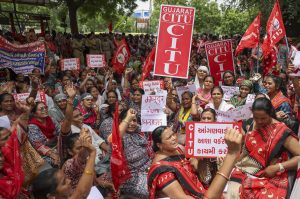
Members of various trade unions take part in a protest rally during a 24-hour nationwide general strike called by trade unions against the central government's alleged anti-labour policies, in Ahmedabad, Wednesday, July 9, 2025.
The Industrial Relations (IR) Code, 2020
Consolidating the Trade Unions Act, 1926 and the Industrial Disputes Act, 1947, this Code radically alters dispute resolution and tenure security. Most contentious is the expansion of ‘Hire and Fire’. Under the previous regime, establishments with 100 or more workers required government permission for retrenchment or closure. Chapter X raises this threshold to 300 workers. According to the Annual Survey of Industries, this exempts over 90% of India’s industrial units from scrutiny, effectively allowing employers to retrench workers at will.
To balance these easier norms, Section 83 establishes a “Reskilling Fund”, requiring employers to contribute 15 days of wages for every retrenched worker. Unions dismiss this as a meagre, one-time payment replacing long-term job security. Further diluting security, Section 2(o) gives statutory recognition to “Fixed Term Employment”, allowing employers to hire workers for specific durations for any work, including core perennial tasks. This allows management to renew contracts repeatedly without committing to permanent tenure.
The Code also impacts collective bargaining. Section 62 mandates that workers in all industrial establishments must provide a 14-day notice prior to a strike. Crucially, strikes are prohibited during conciliation proceedings. Since conciliation commences immediately upon receipt of a strike notice and the state can prolong it indefinitely, the legal window to stage a lawful strike is effectively closed. Additionally, the requirement to frame “Standing Orders” now applies only to establishments with 300 or more workers (up from 100), effectively removing the rule of law from the factory floor for smaller units.
The Code on Social Security, 2020
Merging nine laws, including the EPF Act, this Code recognises “gig workers” and “platform workers” for the first time (Section 2(35)). However, it stops short of defining them as “employees”. Consequently, aggregators like Uber or Zomato are not liable for standard contributions like PF. Instead, the Code proposes a welfare fund financed by a levy of 1-2% on the aggregator’s annual turnover. This creates a welfare model based on cess rather than rights. Furthermore, Section 142 mandates Aadhaar for registration. Given prevalent documentation errors among the migrant workforce, critics argue this creates a technological barrier or “digital exclusion”.
The Occupational Safety, Health (OSH) and Working Conditions Code, 2020
Replacing 13 laws, this Code redefines the ‘Factory’ (Section 2(w)) by increasing the threshold from 10 to 20 workers (with power) and 20 to 40 workers (without power). This deregulation removes thousands of small manufacturing units, often sites of poor safety standards, from the purview of stringent regulations. Similarly, the Code now applies only to contractors employing 50 or more workers (raised from 20), incentivising principal employers to fragment their workforce to escape compliance.
While the Code retains the 8-hour daily work limit, it introduces the concept of “spread-over” time, left to be defined by Rules. Unions fear this will allow state governments to legally stretch the workday to 12 hours under the guise of longer breaks. Additionally, Section 128 empowers the government to exempt any establishment from the Code through a simple notification, essentially allowing the Executive to suspend safety laws for sectors like Special Economic Zones without parliamentary approval.
Why are trade unions opposing the Codes?
The notification triggered immediate protests by the Joint Platform of Central Trade Unions (CTUs) and the Samyukt Kisan Morcha (SKM).
They base their opposition on three pillars.
- First, they cite procedural illegitimacy, arguing that passing laws without debate and notifying them without convening the ILC violates ILO conventions.
- Second, the CTUs contend that by effectively banning strikes, diluting standing orders, and removing security of tenure, the Codes reduce workers to a state of “virtual slavery”, stripping them of collective bargaining power.
- Finally, unions like the AIPEF contend these Codes are a prerequisite for privatisation, arguing that dismantling labour protections in the public sector is a strategic move to lower liabilities, making state assets more attractive for private buyers.
The Wire is now on WhatsApp. Follow our channel for sharp analysis and opinions on the latest developments.


