

For Kasimedu's Women, Selling Fish Is More Than Just a Livelihood


Chennai: For an outsider, it is an unlikely Sunday morning at Kasimedu – a fishing harbour in Chennai. While the rest of the city is yet to wake up from its slumber, the 300-year-old Kasimedu fish market situated to the north of Chennai is bustling with activity. Women are busy selling the fresh catch, while rickshaw drivers keep loading and unloading the fish from the boats. Young men can be seen washing the baits in large barrels to send them off in containers. Amidst all this, vendors on bicycles are selling piping hot tea.
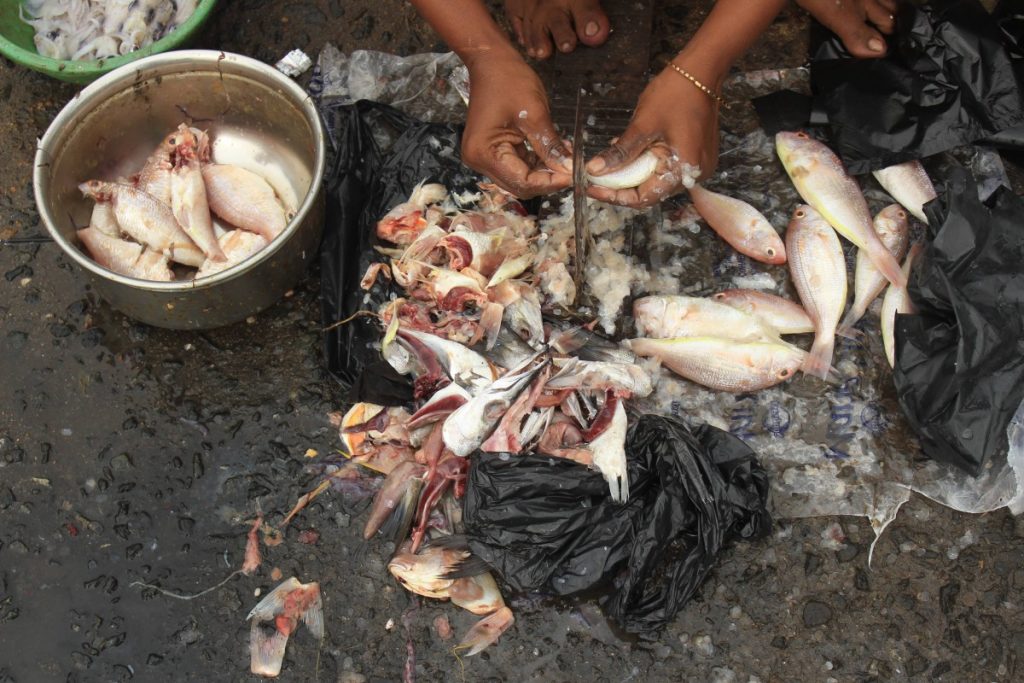
Fish being butchered at Kasimedu. Credit: Krithika Srinivasan
While men bring fresh catch from the seas, it is mostly the women who handle the sales. Muffled yet distinct voices that shout the names of fish varieties attract customers can be heard everywhere across Kasimedu on any given Sunday. For 38-year-old Vanja Raghu, a widow, this has been her vocation for a decade now. “I live in Thiruvotriyur (approximately five km away from Kasimedu) and come here to sell fish only on Sundays,” she says. Vanaja prefers selling prawns and on that particular morning, she had bought prawns worth Rs 10,000 through auction. “At the end of the day, I will probably earn Rs 1,000 after clearing all the dues.”

Muffled yet distinct voices that shout the names of fish varieties attract customers can be heard everywhere across Kasimedu on any given Sunday. Credit: Krithika Srinivasan
Fifty-year-old Shanthamma has been coming to Kasimedu fish market ever since she was a child. “We grew up together so there is no sense of competition between us” she says pointing out to other women selling fish.
Concurring with her is 40-year-old Kanchana Maran. “I used to come with my mother when I was a child. I would sit next to her and shout to draw customers. I have been coming since then.” Kanchana too buys fish at auctions and sells it at the market. The sales didn't seem to be particularly good on that day. “It is a full moon day. People don’t eat non-vegetarian dishes. We will have to preserve the fish in ice boxes and sell them the next day. The big challenge will be to tackle the money lenders who helped us with money at the auction.” If Kanchana sounds extremely determined about one thing, it is about her children's future. “They will not end up selling fish. If I work hard now foregoing my Sundays and other off-days, it is because they will grow up educated and lead better lives.”
Full moon days are not the only issue plaguing these women now. More recently, news reports about the presence of formalin in the fish sold in Chennai hit the livelihoods of these women hard. But, Kanchana is certain: “I can assure you that the fish you get in Kasimedu are clean and live than in any other market.”
Fifty-year-old Kasiyammal who has always lived in Kasimedu sees an upper class ploy in this. “We feed the same fish we sell to our families also. My grandson eats the same fish. If it was laced with the chemical, will we give it to our children?” she asks. “Our men go to sea not knowing if they will come back. People don’t realise our struggles they are quick to spread rumours. This is our livelihood, around which our families are knit together” she says.
Sales returned to normal only after fisheries minister D. Jayakumar announced that tests had confirmed that there was no formalin in fish sold in Chennai markets.
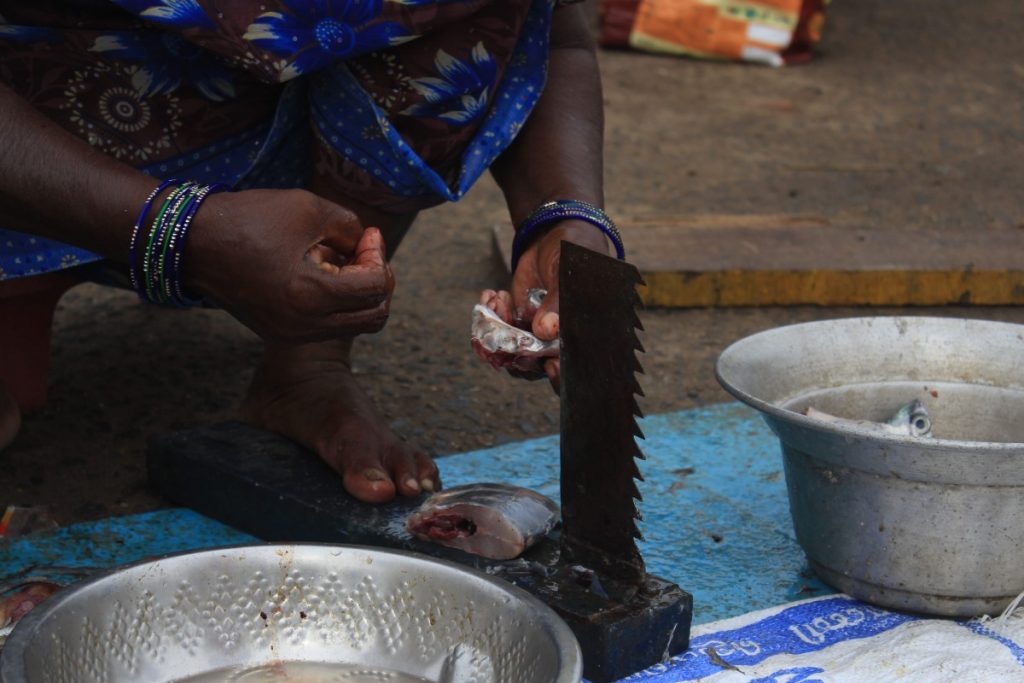
Besides hundreds of women selling fish at Kasimedu, there are numerous other women doing odd jobs. Credit: Krithika Srinivasan
But soon enough, there were the Kerala floods. “It has affected our market badly. We feel sorry for them but we hope things will look up soon,” says 40-year-old Rani Arumugam.
Besides hundreds of women selling fish at Kasimedu, there are numerous other women doing odd jobs. There are mini stalls selling salt, plastic covers, knives and blades. Women also clean and cut the sea food for customers. There are women who sell clothes, slippers and ornaments using the swelling crowds. Thirty-seven-year-old Saroja Kuppuraj earns a meagre Rs 400 helping customers cut and clean fish. “I have been doing it for the last four years. I come at seven in the morning and do it till noon on weekends.”
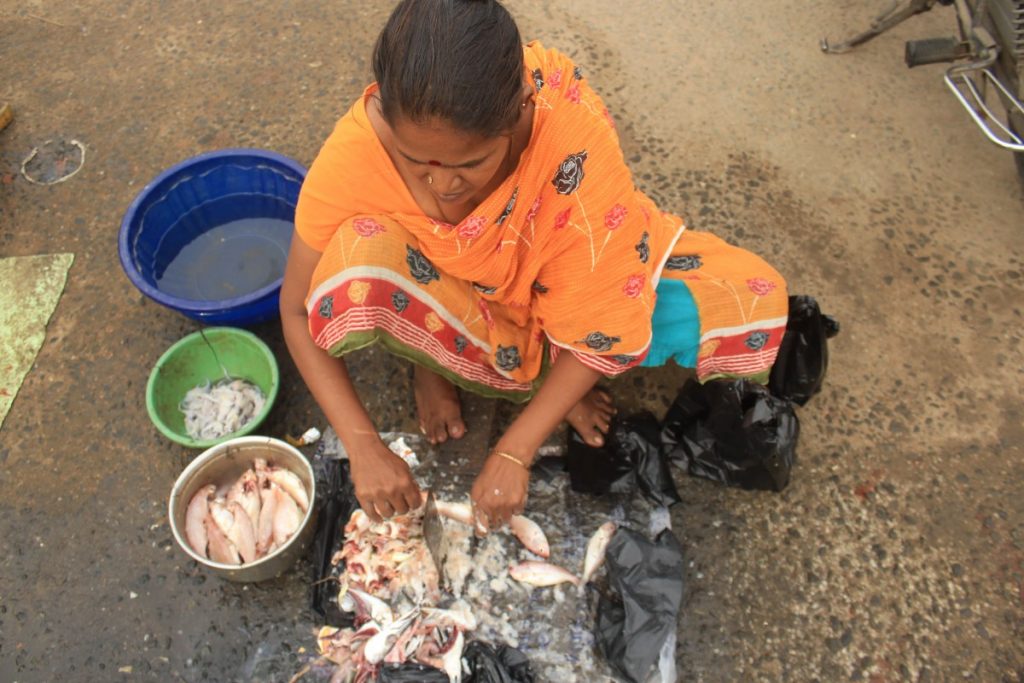
Saroja Kuppuraj. Credit: Krithika Srinivasan
Through its 300 years of existence, Kasimedu has supported hundreds of women in earning their livelihood – however meager. But to most women there, it is more than livelihood. It is an entity that helps keep their lives intact and together despite the crises they have had to face.
Krithika Srinivasan is a Chennai based journalist with a sociology background. She is a trained shadow puppeteer.
Kavitha Muralidharan is an independent journalist.
This article went live on September fourth, two thousand eighteen, at zero minutes past seven in the morning.The Wire is now on WhatsApp. Follow our channel for sharp analysis and opinions on the latest developments.


