

The Life of Labour: Kerala Farmers Face Shortage of Seeds; Unrest in Chennai's Oragadam


Women’s groups challenge IMF, World Bank on labour deregulation
Over 35 women’s groups and labour rights organisations have criticised the World Development Report (WDR) 2019 and issued a statement against the efforts of the International Monetary Fund (IMF) and World Bank to further deregulate the labour market in fragile developing economies.
The Bretton Wood twins had their annual meetings from October 8-14 in Bali, Indonesia. One of the items on the agenda was to submit recommendations to the upcoming WDR 2019 report. In this draft report, they have argued for shifting the cost of labour welfare and protection from the employers to the government. They have also called for the reform of ‘colonial laws’ that regulate labour to improve the flexibility of hiring and ease of business to improve formal jobs. Coming from institutions that have time and again argued that governments are inefficient, it is ironic that they should ask the government to take on the work of labour protection.
This has been criticised by various organisations that are part of the Asia Pacific Forum on Women, Law and Development (APWLD) which has affiliates in 22 countries. APWLD argues against the report’s proposal to do away with regulations such as minimum wage and employee retention and dismissal in favour of ‘flexicurity’ in the market.
While the World Bank argues that increasing or retaining regulations would lead to an ‘informalisation of work’, APWLD advocates the implementation of direct and progressive taxes, such as corporate taxes and taxes on capital as well as the strengthening of global tax cooperation through the establishment of a global tax body instead of putting pressure on the poor to finance public services.

Illustration by Aliza Bakht
The attempt to ‘advise’ national governments to ditch human rights obligations in the pursuit of a development model that has been revealed to be highly unequal and even violent exposes the true intent of IMF and World Bank. The statement demands that these international institutions give up their sponsoring of corporate greed in the name of developing low-income economies.
Putting a happy face on capitalism’s ‘climate catastrophe’
Climate change has been causing a havoc on coastal communities for several decades now. Being poor and invisible, their plight seldom makes it to prime-time discussions or the front page of newspapers. Many of these communities, mostly poor fishing and farming villages, have been facing the social and economic costs of the increased frequency and intensity of natural disasters. They have been forced to migrate and seek low-income employment.
A Financial Express article titled 'As climate threats drive migration, Indian women find opportunities' attempts to play down the crises, focusing on a couple from Sundarbans in West Bengal that earns Rs 17,000 a month by working two jobs in Odisha. It focuses on how the two have been able to pay back the debts incurred due to crop losses, send their daughter to school – including a private tuition, and pay for their son's congenital health disorder. It further discusses how women have been able to gain a greater say in managing household incomes, work life and even enjoy benefits of higher income.
While balancing the positive spin with a note of concern about the possibility of exploitation of women, the article fails to discuss that these communities are bearing the cost of the gains made elsewhere and by others. Thus, a painful experience of exploitation, structural and otherwise, is presented as an empowering tale of ‘adaptation’.
Stone quarry owners sentenced to 11 years imprisonment for employing workers in bondage
A lower court in Tamil Nadu sentenced three people who own a stone quarry in Thiruvannamalai, Tamil Nadu to 11 years and months in prison for employing bonded workers and using violent force on them. The workers had been rescued in 2012. Despite the low conviction rate in such cases, the workers had pursued a case against their employers. The verdict has come as a pleasant surprise to the rescued workers while also invigorating efforts to fight these cases legally. There is also hope that such judgements will dissuade similar practices, which have been banned by law since 1976.
Ground staff at Mumbai airport to be paid wage dues after a five-day hunger strike
Five days after 800 workers of the Cambata Aviation Private Limited (CAPL) started an indefinite hunger strike at Mumbai's Chhatrapati Shivaji International Airport demanding payment of dues, the Maharashtra government on October 14 acted to assuage the workers.
The workers were employed by the Mumbai International Airport Limited (MIAL) through a contractor. As many as 2,100 workers of CAPL at the airport had lost their jobs after the company declared bankruptcy in 2016, Indian Express reported.
The wage dues were from February-August 2016, amounting to nearly Rs 120-130 crores. The Maharashtra government has asked MIAL to pay the workers from the Rs 40 crore security deposit of CAPL. It has also agreed to pay the workers their dues and take action against the company. After discussions, the workers withdrew the fast while stating that the struggle will continue through other forms.
Kerala farmers facing shortage of seeds
The floods that devastated Kerala recently also caused a severe shortage of seeds for future cultivation. According to farmers, the government had promised to provide them seeds free of cost by mid-October. However, it has managed to distribute only 30 tonnes of seeds. The government maintains that it can only fulfil distribution by November 15, causing panic and anger among the farmers who have already suffered huge losses due to the deluge. Farmer's organisations have announced massive protests to pressure the government into fulfilling its promise.
Trump’s new rule leaves tens of thousands of Indian IT workers in limbo
Indians working in the US are likely to be affected by Trump administration's decision to curb H1 visas and withdraw H4 visas that permit dependent spouses to work in the country. Estimates suggest that such a move would affect over 70,000 Indians, leaving them in a limbo. It would also disproportionately affect Indian companies as Indians benefit significantly from these visas. IT stocks have taken a bit hit in recent sessions.
Updates and other stories
#MeToo impact: MJ Akbar resigns
This week saw the resignation of Union minister M.J. Akbar as a consequence of sexual harassment accusations against him. This has been the biggest impact of the ongoing #MeToo movement in India. The minister, also a well-known editor and journalist, has denied the allegations and even initiated a defamatory action against one of his accusers.
However, amid increasing charges, the government had to let the minister go. He continues to pursue the defamation case.
The ongoing workers' struggle in Oragadam, Chennai
The labour struggles that began a month ago in the ‘Detroit of south India’ have not subsided. After the agitating workers were evicted from factories and forced to protest from a distance, the initial momentum among the state agencies to resolve the issues seems to have ebbed.
The companies violated labour department advisories, forcing workers to choose litigation, an attrition tactic. Even though the labour department had advised against the use of contract workers to fill up posts of permanent workers deliberately kept out of the factories, the companies are threatening recruitment. Here is an update on the current situation.
A Reuters article analyses the current unrest, its underlying causes as well as its likely impact on the upcoming general elections.
National Fishworkers Forum calls for west coast protest against dedicated shipping corridor
The National Fishworkers Forum has called upon fishing communities from Kutch to Kanyakumari to protest against the proposed shipping corridor which it believes will adversely affect coastal fishers that depend on the region for the best catch. The government has proposed a dedicated maritime shipping corridor along the west coast extending from 15 nautical miles to 35 nautical miles as a means to prevent ship-boat collisions that have caused numerous deaths and loss of property recently.
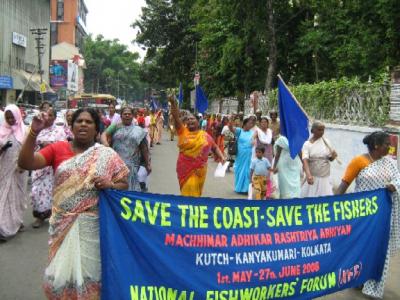
National Fishworkers' Forum members at a "Save The Coast, Save The Fishers" Campaign. Credit: National Fishworkers' Forum.
The fishworkers forum has, however, claimed that this would adversely impact the coastal fishers that fish along these waters. They claim that rather than finding ways to restrict maritime accidents through greater monitoring, tracking and guidance from the coast guard, the government is proposing to curtail their rights to the sea.
Sugarcane farmers on protest force trains to be rescheduled
Over 1,500 sugarcane farmers from Punjab squatted on the Amritsar-Pathankot railway line forcing many trains to be cancelled or rescheduled. They were protesting against the pending dues from sugar mills. They were also demanding that the crushing capacity of mills be increased to absorb the production of cane.
After it became clear that the farmers had come prepared for a drawn-out struggle, the officials negotiated a settlement in which Rs 40 crore of the outstanding Rs 74 crore would be settled soon. After consultation among farmers, they decided to lift the dharna which lasted for 36 hours.
UAPA in the age of industrial unrest
The state arms itself with ever-powerful legislations that might even violate provisions of the constitution. They are supposed to protect the citizens from ‘terrorism’ and ‘violence’, but the excesses often are committed to curbing ‘dissent’, ‘speech’ and ‘free association’.
Groundxero has published a few articles regarding the Unlawful Activities (Prevention) Act and its use against workers and unions. One documents the stories of workers of Reliance Energy who attempted to form and sustain a union. Their leaders have been charged and incarcerated under the UAPA for the past nine months and their families are paying the cost of their attempt to win workers their rights.
International news
Refugees forced to endure exploitative labour and flesh trade
The Rohingya crisis has been unfolding over many years now. With refugee camps in Bangladesh overflowing and many other neighbours, including India, reluctant to house more refugees, the situation is dire for the Rohingya, persecuted for their religious orientation. The international community has failed to force the Myanmarese government to provide protection for its citizens as per the conventions of international law. A report by the International Organization for Migration depicts that abysmal conditions in the refugee camps in Bangladesh, the lack of income for the refugees and the exploitation by locals, forcing young men and women into human trafficking.
Weekend reading
Prisoner’s art as a challenge to modern slavery
Inmates of US prisons, often forced to work for capitalist profits in a modern version of slavery, have to take to art to express their challenge to this system. Here is a Guardian article on prisoner’s art exhibition, 'Capitalizing on Justice', which is on display at the Urban Justice Centre in New York.
How hungry is India?
The production of food crops has been rising every year and remains at record levels, and yet India ranks 100th among 116 countries, barely higher than Afghanistan and Pakistan, on the hunger index. The answer to this paradox is simple. An article in The Citizen explores the causes of India’s hunger.
This article went live on October twenty-first, two thousand eighteen, at zero minutes past four in the afternoon.The Wire is now on WhatsApp. Follow our channel for sharp analysis and opinions on the latest developments.


