

Three Years, a Court Order, Zero Work: The MGNREGS Void in West Bengal


On June 18, 2025, Calcutta high court directed the Union government to resume the implementation of the 100 days of wage employment under the Mahatma Gandhi National Rural Employment Guarantee Scheme (MGNREGS) in West Bengal, effective from August 1. However, while the months of August and September have passed, and October is also coming to an end, neither the Union government nor the state government has taken any initiative to execute the high court’s directive and restart the MGNREGS work.
The scheme has remained suspended for the past three years. In this situation, the Paschim Medinipur district committee of Paschimbanga Pradeshik Krisak Sava (a division of the All India Kisan Sabha) filed a case on September 17 in the Calcutta high court demanding the resumption of the MGNREGS work.
“Simultaneously, a state-wide movement is underway in all blocks demanding work” said Amal Haldar, secretary of the state committee.
Following the case, on September 25, the acting chief justice of the high court, Sujoy Pal, directed the state and central government to submit affidavits to the court by November 7 during the next hearing. Lakhs of poor and marginalised workless people in Bengal’s Jangalmahal area, as well as in other parts of the state, are awaiting the order.
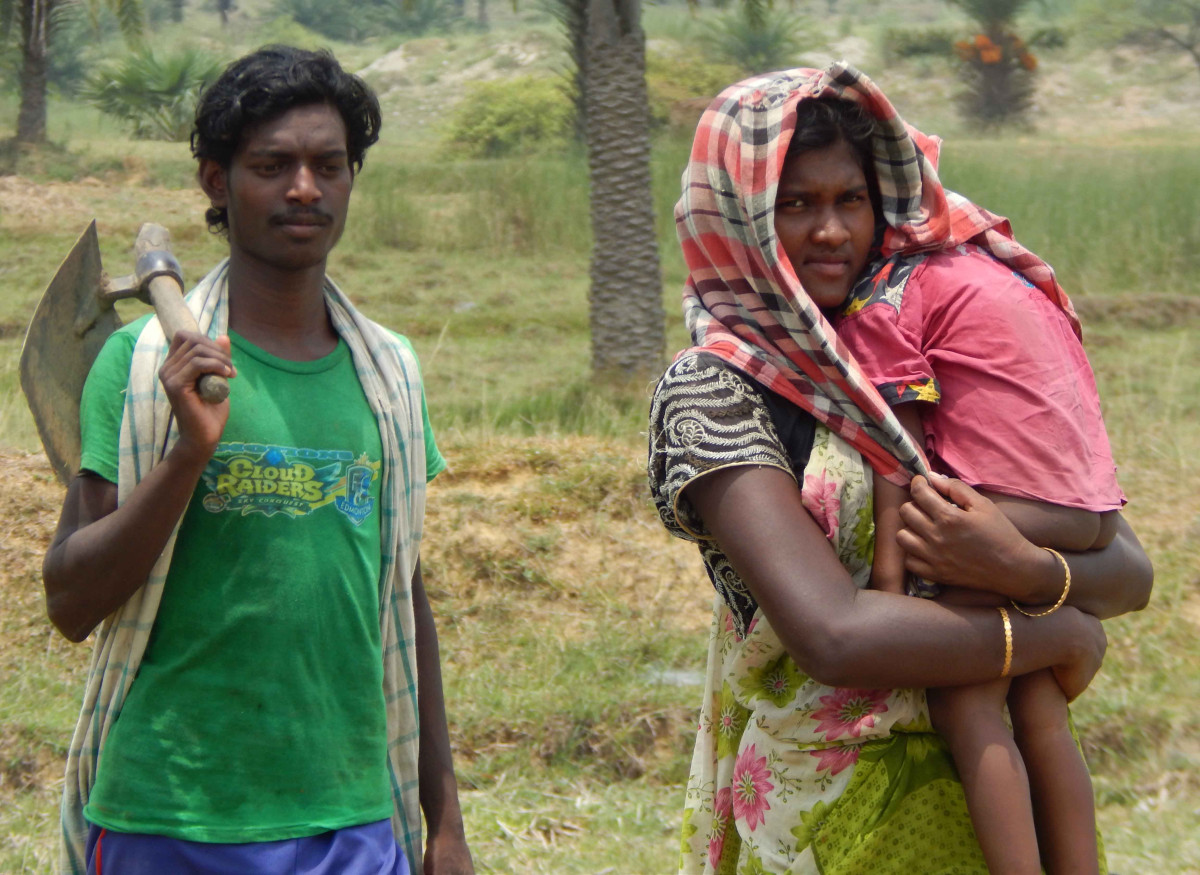
A couple with their child sets out from Susunia village in West Bengal to find work.
The 100-day employment under MGNREGS had been one of the main sources of livelihood for poor and marginalised communities across Bankura, Purulia, Jhargram, and Paschim Medidipur districts, which fall under the Jangalmahal region.
Without it, survival has become increasingly difficult. Here are two scenarios:
Scene 1
Inside their dilapidated home, 35-year-old Arjun Shikari and his 65-year-old mother, Thakurmoni, sat in silent despair. It was raining heavily. A few handfuls of rice were left in the house but there was no dry wood to light a fire to cook. Their faces could no longer hide their helplessness.
“Khider jontrona boro jontrona re baap. Sob din bhalo kore khabar jotena. Rojgar kothai aamader? Ganye aage matikatar kaj chhilo, setao uthe gechhe. Ki kore chal, sobji, mosla kinbo? (The pain of hunger is immense. We do not get enough food every day. Where is our income? Earlier, there was work like cutting soil, levelling land and building morrum roads, but that has disappeared now. How will we buy rice, vegetables or spices?)” lamented Thakurmoni Shikari.
The signs of malnutrition were etched across her frail body. Struggling to breathe, she looked up and asked, “We heard that the 100 days’ work would resume. Can you tell me when it will restart?”
This is also the fate of 29 families in Mahultanr village of Purulia district. The village, surrounded by hills in the Hesahatu gram panchayat of Jhalda 1 block, about 33 kilometres from Purulia town, and entirely inhabited by members of the Birhor community, identified as a Primitive Vulnerable Tribal Group (PVTG).
Arjun Shikari said, “I used to work as a mason’s helper in Tamil Nadu. From morning to late evening, I would toil for just Rs 300 a day. I fell ill but heard that the 100 days of work was supposed to restart in Bengal from August 1. I returned home with hope, but when I came back, I saw there was no work. Will we not get the MGNREGS work? Do I have to return again in this condition?”
As Arjun spoke, a group of young men with weary faces and bags slung over their shoulders arrived in the village. They, too, are residents of Mahultanr. Among them was Buddheswar Shikari, who recounted his ordeal:
“Two days ago, I, along with Mangal, Nilkamal, Mitton and Rasbihari (fellow workers), went to Jhalda – seven kilometres away – to look for work. We did not find any unskilled labour. For two days, we survived only on muri (puffed rice). Now we have no money to buy anything to eat. So we are returning home, although we don’t know if there is any food even there.”
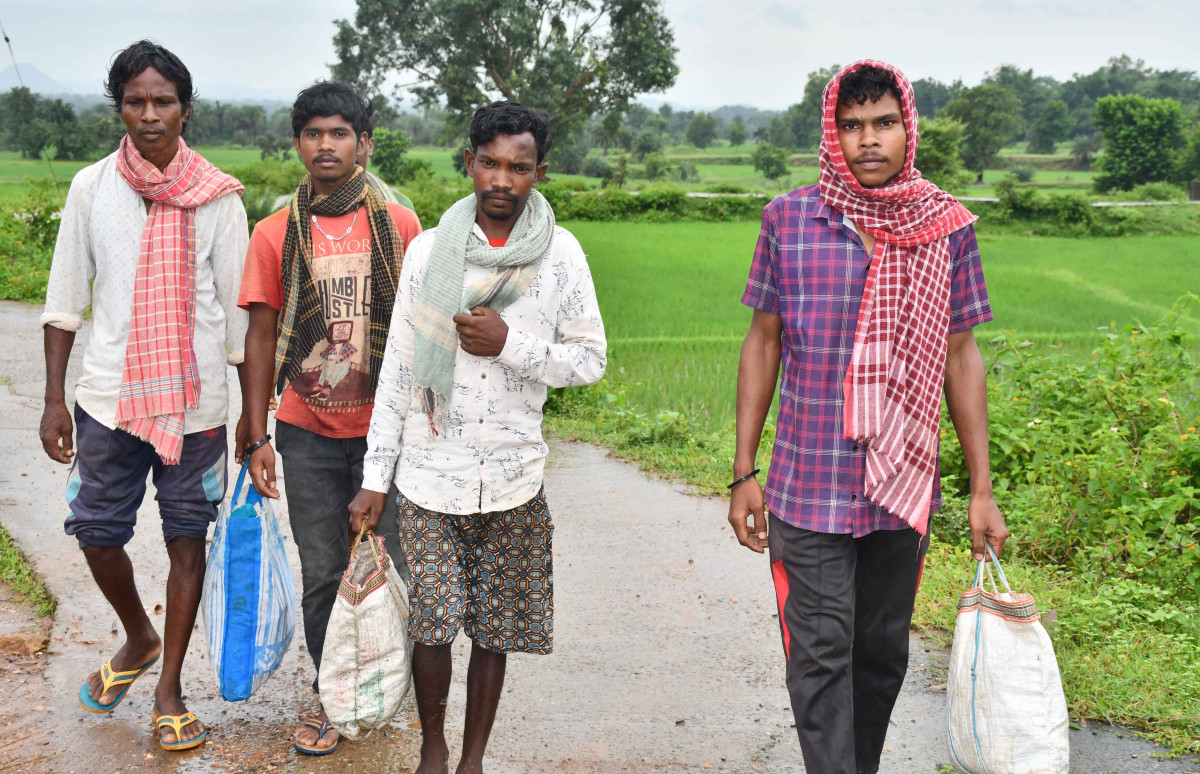
Buddheswar, Mangal, Nilkamal and Mittan Shikari returning home in Mahultanr village, Purulia district, after being unable to find work.
Scene 2
The work of transplanting Aman paddy seedlings, the largest cultivation during the Kharif season in West Bengal, was completed three months ago. With that, villagers once again found themselves with no work because the paddy harvesting had not started yet. It’s a few weeks away.
One morning, a group of women from Pingrui village, located near the Damodar riverbank in Barjora block of Bankura district, set out for Maliyara gram panchayat, about four kilometres away. Among them were Patul, Rati, Shibani, Torubala and Sadhana Bauri – all daily wage labourers and holders of MGNREGS job cards.
Each of them carried their card, along with a filled-out Form 4 (A), requesting employment under the scheme. They had to stage a dharna at the panchayat office, supported by the Sarabharat Khetmajur Union, which has been organising demonstrations and deputations across the state demanding work under MGNREGS.
During the protest, several labourers – including Putul Bauri, elderly Shibani Bauri, Jiten Kalindi, Kalo Das and Santo Lohar – spoke of the financial crisis in their families.
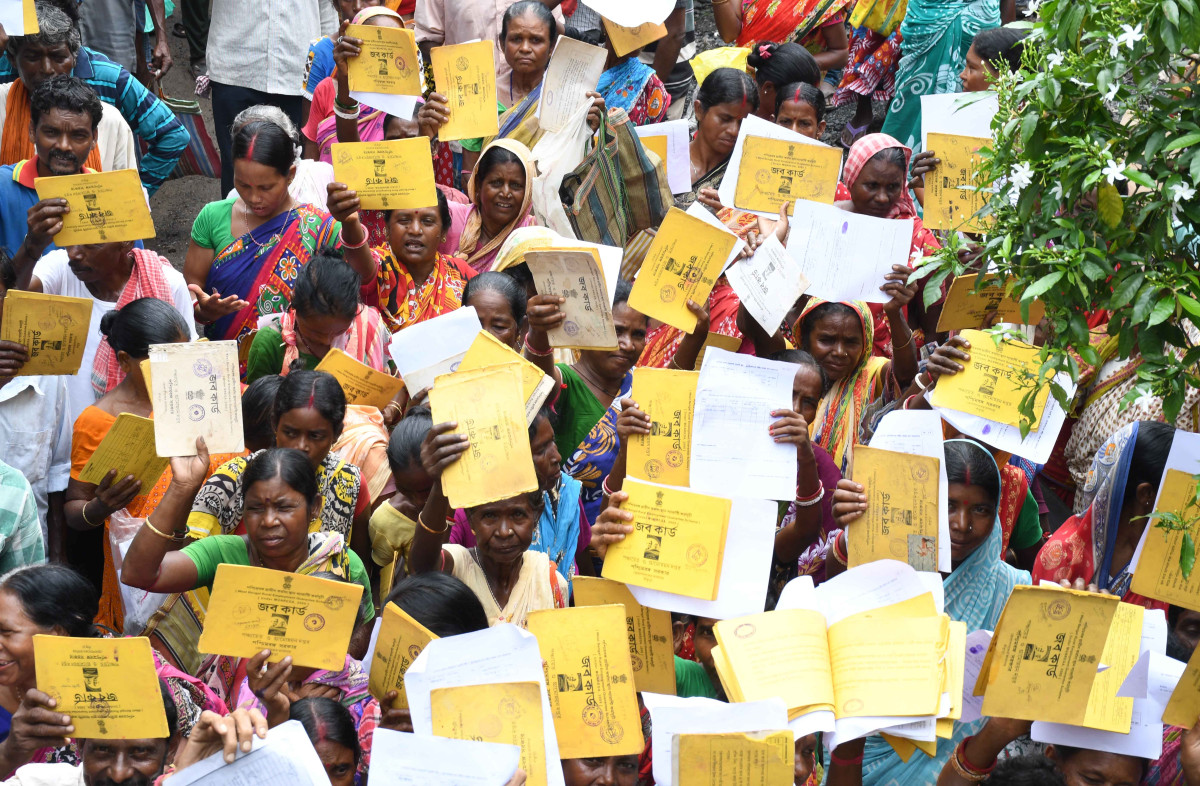
Land labourers in Maliyara gram panchayat under Barjora block, Bankura, protesting for the resumption of 100 days of work under MGNREGS.
“My husband has no job. My son Bappa has left his studies and now travels to Durgapur in search of work. Most days, he does not find anything,” said Putul Bauri.
Sadhana and Shibani Bauri narrated similar hardships. They also pointed out that they had not even been paid all their wages from previous MGNREGS work.
“We had heard the court has ordered the resumption of 100 days’ work. That is why we came to ask the pradhan (gram panchayat head) for work,” said one of the protesters.
But the Maliyara pradhan, Sathi Lohar, told them plainly that she could not provide employment, alleging that no directive had yet been issued by the district administration.
“Since the high court order, most of the 190 gram panchayats in Bankura district have seen deputations by the Khetmajur Union demanding MGNREGS work. These demonstrations are continuing, but no assurance has been given at the panchayat, block, or district level,” said Sagar Badyakar, joint secretary of the Khetmajur Union, West Bengal.
He added that the situation is the same across Jhargram, Purulia and other districts too. Poor labourers with no work have been continuously approaching panchayats, block offices and district administrations demanding jobs.
Why did the MGNREGS work stop in West Bengal?
There are 1,36,58,944 MGNREGS card holders in West Bengal. The job card is issued in the name of the head of the family, while other members of the household work against that card. In total, 2,56,32,151 individuals have worked under the scheme in the state.
Notably, the Jangalmahal region alone has a large share of these workers: 6,86,015 job card holders in Bankura, 2,31,018 in Jhargram, and 5,24,022 in Purulia. As many as 15,38,222 people in Bankura, 4,70,527 in Jhargram, and 11,27,075 in Purulia have worked under the scheme. A majority of them belong to Scheduled Castes and Scheduled Tribes.
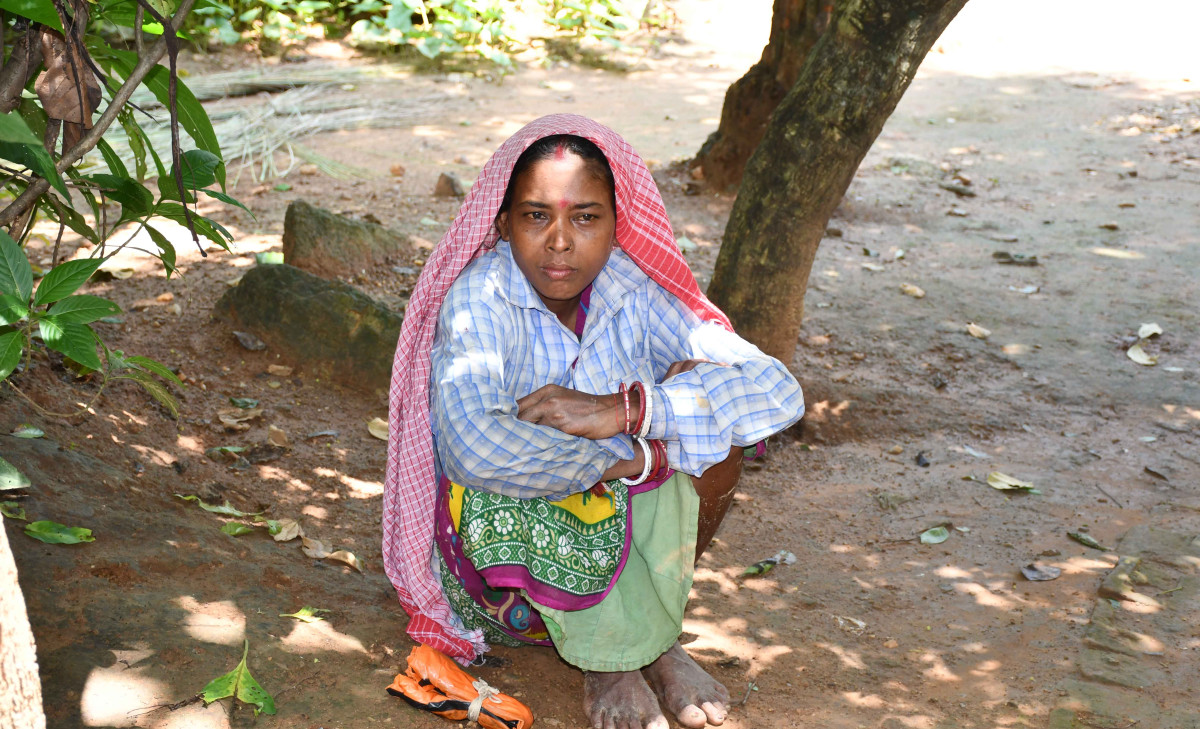
Sukuntala Shabar sits with no work, in Darra village, Jhargram district.
Launched in February 2006, across 200 districts of India, MGNREGS included Bankura, Purulia and Jhargram from the beginning. It quickly became one of the main sources of income for rural families in these districts.
“Although there were allegations of political loyalty in the project after the Trinamool Congress came to power in 2011, many poor people in the area still got work. This meant that many young people did not have to migrate to other states for work,” said Debalina Hembram, former minister of backward welfare in West Bengal, and a resident of Ranibandh, Bankura.
“But for the last three years, the work has completely stopped,” she added.
Three years ago, the Union rural development ministry decided to withhold MGNREGS funds for West Bengal by invoking Section 27 of the Mahatma Gandhi National Rural Employment Guarantee Act, 2005, which allows stoppage of funds in case of violations in implementation. West Bengal is the only state against which this section was applied.
“The Union government first invoked the rule in December 2021 after a ground survey by its Panchayat and Rural Development Department revealed large-scale corruption and violation of the scheme’s guidelines,” said Ullas Chattopadhyay, former block development officer of Ranibandh.
After receiving complaints, the Union government’s survey team first visited Bankura district. During its field investigation, the team allegedly found corruption mainly in works such as orchard creation, social forestry, and reservoir construction and renovation.
“Even after finding corruption in these works, the central team did not file any FIR against the identified culprits. Instead, it stopped the work of poor and marginalised people who were dependent on this project,” said Amiya Patra, Joint President of the All India Khetmajur Union.

Land labourers in Maliyara gram panchayat under Barjora block, Bankura, are demanding the resumption of 100 days of work under MGNREGS.
He argued that under the rules of MGNREGA, people cannot be deprived of this constitutional right to work. According to him, both the TMC and BJP are busy blaming each other, while poor people remain the victims.
“If the Trinamool government can file cases in court even for minor issues, then why when nearly three crore people of the state are deprived of MGNREGS work has it not taken the Union government to court over this? What is the mystery here?” he asked.
Political and administrative silence
On June 18, a division bench headed by Chief Justice T.S. Sivagnanam and Justice Chaitali Chatterjee (Das) ordered that the scheme must be resumed in West Bengal August 1.The court also permitted the Union government to continue its inquiries into past misuse and even to impose special conditions on West Bengal alone, if required, but clarified that indefinite suspension of the scheme was not permissible under law.
As reported by PTI, the judges observed, “The scheme of the Act does not envisage a situation where the scheme would be put to cold storage for eternity.”
Despite this, there has been a delay by the state and the Union government.
In the last week of July, Union rural development minister Shivraj Singh Chouhan was asked in Parliament when the work would start. He avoided answering directly, and said, “We are thinking about the matter.”
By the third week of October, no central directive had been issued.
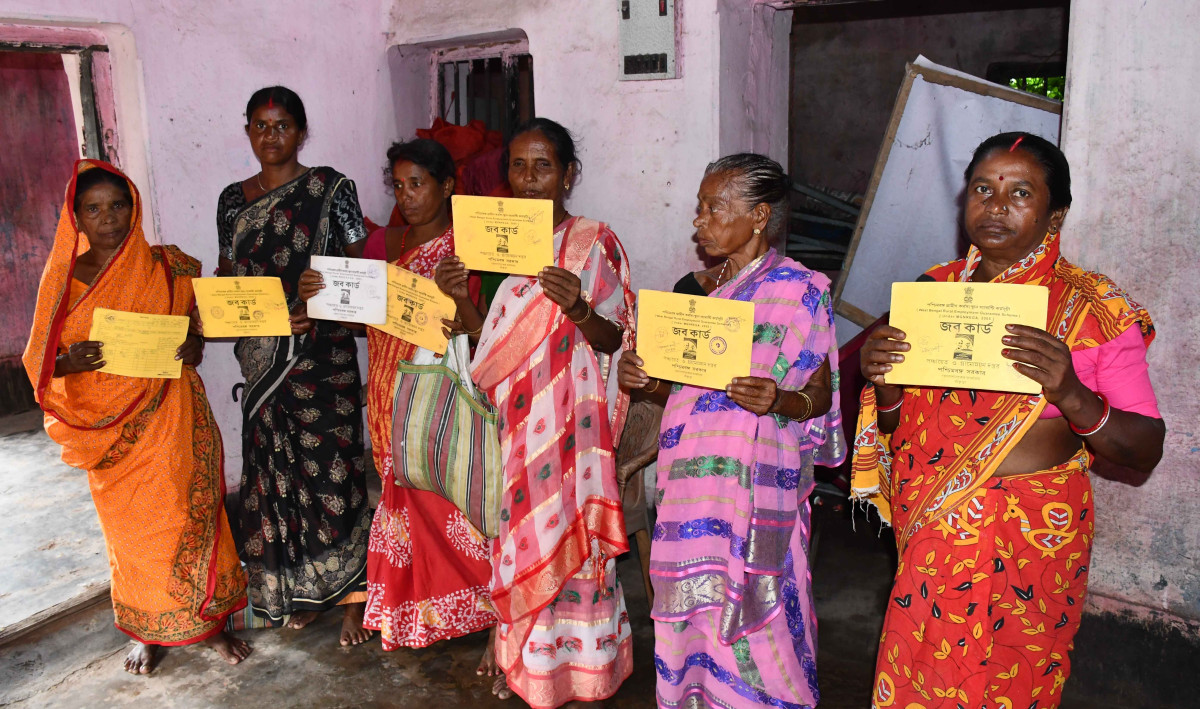
Land labourers holding up their MGNREGS documents as they demand resumption of the 100 days of work under the scheme.
On the other hand, the West Bengal government has also taken no proactive steps. Chief minister Mamata Banerjee has claimed that job card holders are already getting more than 50 days of work a year under the “Karmashree Prakalpa” – the state’s own scheme for wage employment, launched in 2024.
During the state budget announcement this year, claimed the creation of 61 crore working days under the Karmashree scheme at a cost of Rs 12,355 crore last year.
In contrast, three years ago, when MGNREGS was fully functional, its total operational cost was only Rs 4,000 crore. This raises questions about how Rs 12,355 crore was spent under the state scheme, as workers complain of no work.
Interestingly, there was no budget allocation for the Karmashree scheme in 2025-26, nor is it listed as part of the state’s flagship Duare Sarkar (government at your doorstep) initiative.
Ground reality
Several panchayat employees – including secretaries and nirman sahayaks (engineering supervisor) – in Bankura, Purulia, and Jhargram have told The Wire that contractors are currently carrying out works in villages with funds from the 15th Finance Commission, a fund provided by the Union government to states for their development activities. The money from the fund is received by the panchayats, blocks, zilla parishad( district level development elected authority) and the municipalities of urban centres.
According to them, contractors insist that the names of job card holders be listed as workers on paper. But in reality, contractors bring in skilled labourers from outside for projects like roads, bridges and buildings. Local job card holders end up being excluded from the work, though their names still appear in records, artificially inflating the job figures.
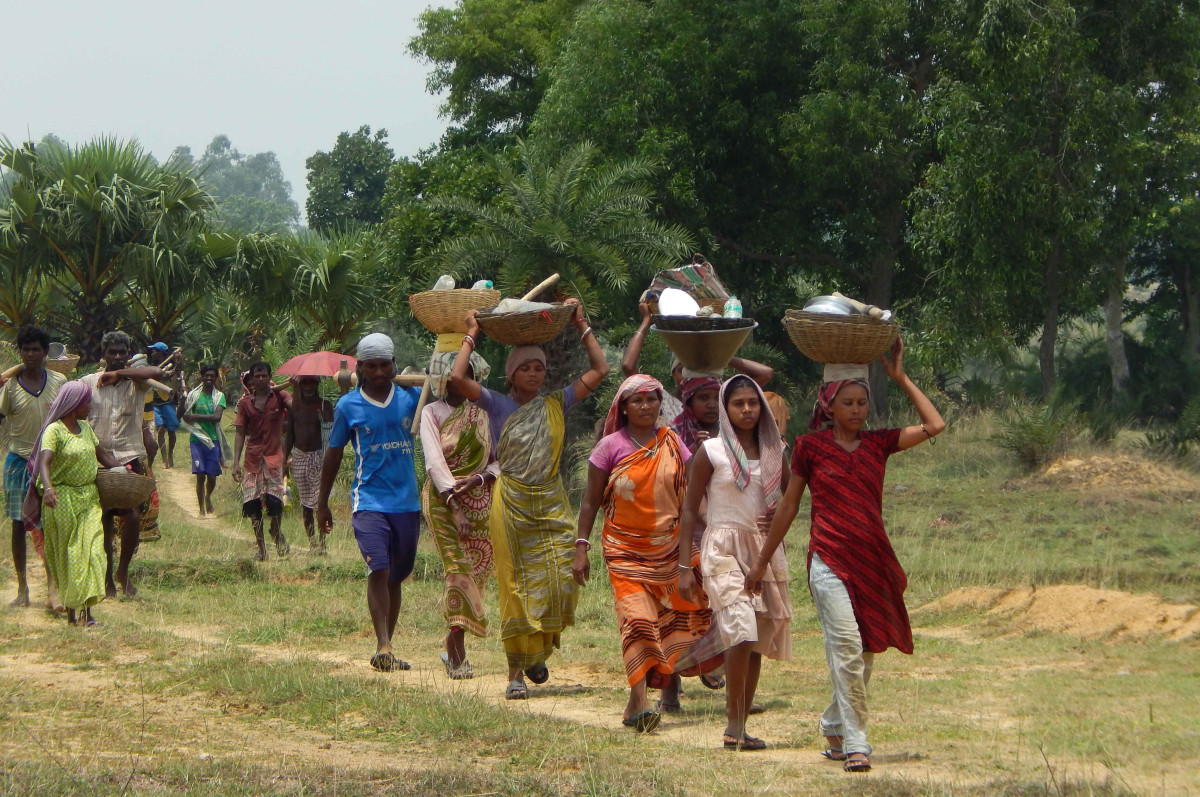
Villagers in Bankura travelling on foot for work.
A district-level officer in Bankura, who wished to remain anonymous, told The Wire, “The state government has not yet issued any instructions regarding resumption of the 100 days’ work.”
With the first phase of Aman paddy cultivation completed, people now have no work. Migration from the Jangalmahal region is once again on the rise, and many migrant workers are returning home in poor health.
As an incentive to work in the state, chief minister Mamata Banerjee has promised all migrant labourers who return home that they will get Rs 5,000 per month for a year.
But construction workers Shaheb Hossen Bayen, Aalauddin Khan, and Abdul Karim Khan of Pathardoba village in Simlapal Block, Bankura, who recently returned from Odisha, voice their concerns.
“Will our families be able to survive on Rs 5,000? And what will happen after a year? There is no work here, that is why we are forced to go outside,” one of them says.
If the MGNREGS work is actually restarted, they say, other family members would have jobs too. But today, their job cards remain packed away in boxes under their beds.
“Will they ever be useful again?” they ask.
All pictures are taken by Madhu Sudan Chatterjee.
This article went live on October twenty-sixth, two thousand twenty five, at zero minutes past seven in the evening.The Wire is now on WhatsApp. Follow our channel for sharp analysis and opinions on the latest developments.


