

Women Voters Rally Behind Nitish Kumar But Raise Questions Over Unemployment


Alinagar/Darbhanga: In Darbhanga district’s Alinagar, Rekha Devi credits chief minister Nitish Kumar’s 20-year tenure for improving her life.
“From electricity, roads, rations and now money to start our business, to cycles for school-going girls. What has Nitish Kumar not given us? He has done a lot for women. Even more than Modi, it is Nitish Kumar” who has done so, said Rekha Devi.
Since he first became chief minister in 2005, Nitish has cultivated a loyal voter base among women voters in Bihar. Just a year after coming to power, his government provided 50% reservations for women in local rural and urban bodies.
Since then he has expanded welfare schemes and interventions for women, which include the Mukhyamantri Balika Cycle Yojana where cycles are provided to school-going girls to increase their enrolment in secondary schools, 35% reservation for women in state government jobs, as well as financial assistance to female students until they finish their graduation under the Mukhyamantri Kanya Utthan Yojana.
These schemes have been credited for the high female voter turnout in recent elections in the state. This is a figure that has recorded a steady rise, with the last assembly elections in 2020 seeing 59.7% of women electors turning out to vote, surpassing their male counterparts who registered a 54.5% turnout.
Rekha Devi is among the 160-odd Jeevika Didis in her village of Putai. She has received Rs 10,000 under the Mukhyamantri Mahila Rojgar Yojana announced by the Nitish Kumar government just before the elections and bought a sewing machine to build a tailoring business.
She belongs to the extremely backward classes (EBCs) group, which includes the Kahar, Kushwaha, Teli, Nonia, Dhanuk and other castes that form Nitish’s core supporters, whom he separated from the Yadavs to provide targeted welfare schemes as well as reservations in local government bodies.
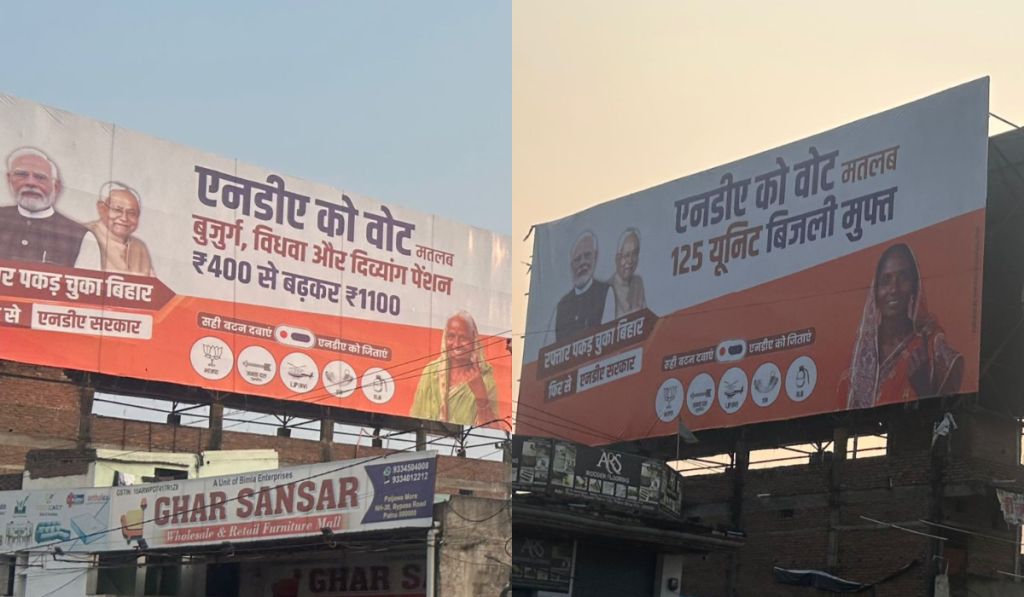
NDA posters targeting women voters. Photo: Sravasti Dasgupta.
The move to solidify his support among women voters just months ahead of the assembly elections this year by announcing the financial assistance of Rs 10,000 under the Mukhyamantri Mahila Rojgar Yojana for women to start their own businesses has faced criticism for its timing. The scheme was launched just in September, two months before the elections, in the presence of Prime Minister Narendra Modi.
So far, the government claims to have spent Rs 10,000 crore to assist 1.2 crore women and plans to extend the scheme to urban areas, for which self-help groups have been formed.
Supported by the World Bank, the Bihar Rural Livelihoods Project was launched in 2007. The self-help groups established under the project are now known as “Jeevika”. Bihar is known to have 1,144,421 self-help groups and up to 1.4 crore women – “Jeevika Didis” – affiliated with them.
To counter the National Democratic Alliance (NDA) and in a bid to woo women voters who have rallied behind Nitish, the Mahagathbandhan alliance too has announced its share of financial assistance to these women.
Last month, Rashtriya Janata Dal (RJD) leader and the opposition alliance’s chief ministerial face Tejashwi Yadav announced that Jeevika Didi and community mobilisers will be made permanent, granted the status of government employees and paid a salary of Rs 30,000 per month if his party forms the government in Bihar.
“When they [the RJD] were in government, they did not provide reservations to women. During their time, people would not even send their own daughters to schools, but now people are even educating their daughters-in-law by sending them to schools,” said Lakshmi Devi, a community mobiliser in the village.
While welfare schemes have allowed many women to send their daughters to school with the financial assistance received from the government, The Hindu has reported that as of 2019-2021, only 61% of Bihar’s female population had ever attended school.
The state has also recorded a higher infant mortality at 46.8 (the infant mortality rate is the number of infant deaths per 1,000 live births) against the national average.
Despite these figures, women have rallied behind the Nitish government for two decades.
“It is not just about women from EBC groups, women across caste lines have received help. Our children have gone to school; my daughter received a cycle, studied till class 10 and now she is married. This time they have given Rs 10,000, but they did not provide this sum before other elections. We voted for Nitish Kumar then and we will do so this time as well. Because it is not about the money. It is about how he has helped us,” said Shyama Devi.
These targeted welfare schemes for women have in recent elections boosted female voter turnout in the Nitish years, often across caste lines.
While the male voter turnout in the 2000 elections was 70.7% against a female voter turnout of 53.3%, women voters have increased their participation in the Nitish years, with their turnout rising from 54.5% in the 2010 elections to 60.5% in 2015 and 59.7% in 2020. The male voter turnout in these years was 51.1%, 53.3% and 54.5% respectively.
Following the contentious special intensive revision of the voter rolls in Bihar, however, there has been a drop in women voters, from 907 women per 1,000 men to just 892. An investigation by The Hindu found the higher a constituency’s female voter turnout, the greater the number of women who were subsequently deleted from its rolls, raising questions on the exercise's impact on this election.
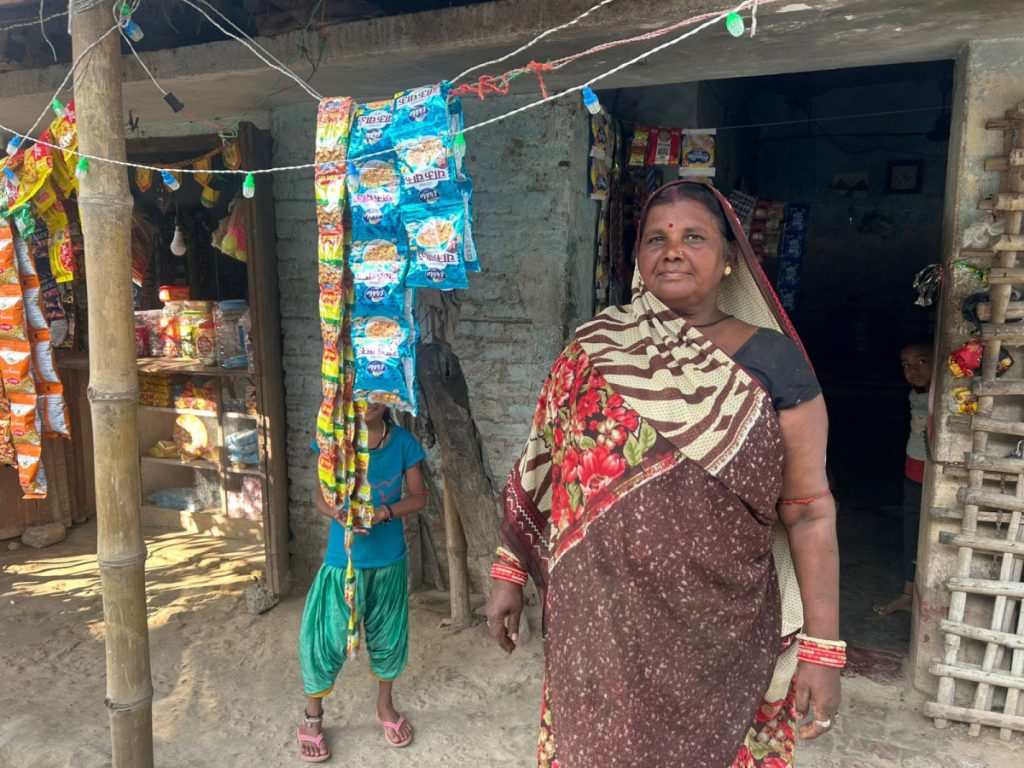
Sarita Devi, who runs a shop in Alinagar, Darbhanga has three sons, all of whom are unemployed. Photo: Sravasti Dasgupta.
Support for Nitish endures but questions over unemployment arise
The sum under the Mukhyamantri Mahila Rojgar Yojana is also facing criticism for being too little to set up any business, amid inflation and rising costs of living.
“What is Rs 10,000? It is nothing. I have used the sum on my fields. Kheti bari mein lagaye hai, dhaan ke fasal lagaye hai. Kaise business karenge? Is this employment?” asked Munni Devi.
Munni Devi's husband has been living and working in Delhi for 20 years as a cook.
“I live alone here with my three sons. They should provide employment here, so we can live with our men in our villages, but now they are leaving the villages to work outside,” she said.
Despite the support that Nitish enjoys among women voters, questions remain about unemployment in the state.
Sarita Devi, who runs a small shop in the village, is the lone breadwinner in her family, with her husband being paralysed and unable to work. While she said that schools and roads were built during Nitish’s tenure and she received food grains during the COVID-19 pandemic, unemployment remains a concern.
“I have three sons, all of whom have graduated. Bhatak rahe hai idhar udhar naukri ke liye [they are roaming here and there looking for jobs],” she said.
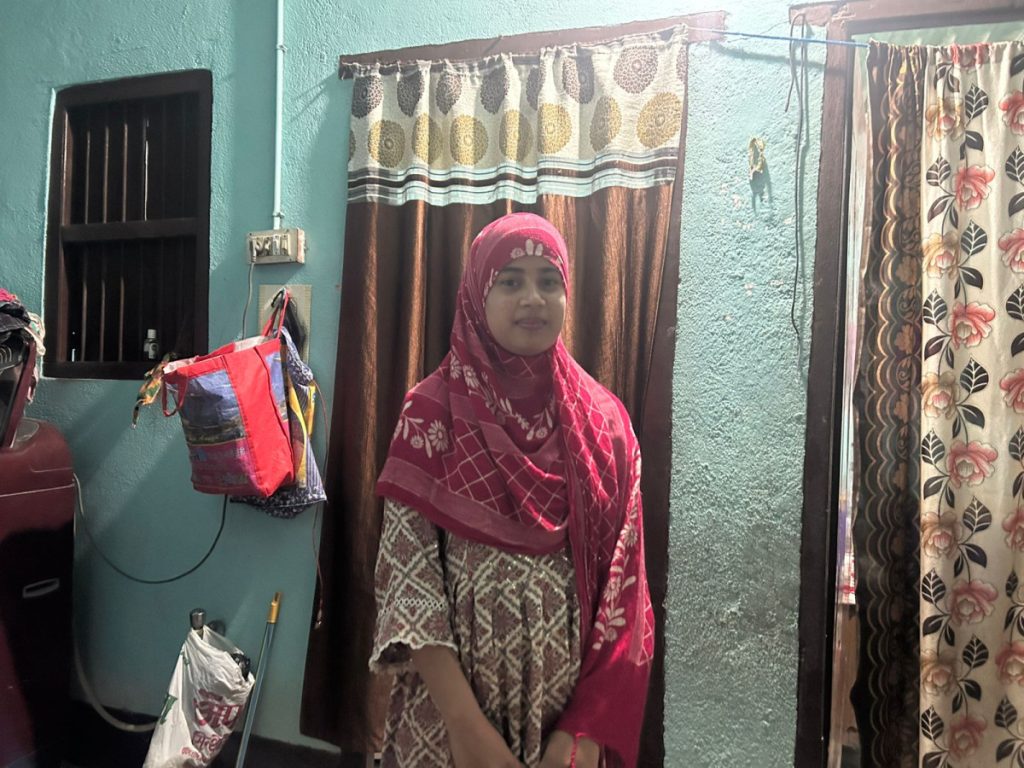
For Nausheen Imran, a first-time voter in Darbhanga town, women's safety and career opportunities remain concerns. Photo: Sravasti Dasgupta.
Concerns over unemployment however loom large over young voters, who see few career opportunities in Bihar.
“They say things have become better, but even now we cannot walk around on the roads safely. There is no safety for women anywhere. We feel scared to walk around alone. There are no career opportunities,” said Nausheen Imran, a college student in Darbhanga town who is a first-time voter.
“I want to become a professor, but how often do vacancies even come out? There are no good colleges; career opportunities are so few that people are constantly looking for options outside the state,” she said.
For many women, however, financial assistance provides means to feel empowered and contribute to the household financially.
“I wanted to help my husband with his automobile shop,” said Runa Sharma in Darbhanga town.
“I bought whatever I could to help him with materials for the shop. They told me, ‘why are you doing this? You will get further assistance only if you set up a business’, but I decided to do it anyway. Because I want to be able to help the household,” she said.
This article went live on November seventh, two thousand twenty five, at zero minutes past six in the morning.The Wire is now on WhatsApp. Follow our channel for sharp analysis and opinions on the latest developments.


