

Cracks in the BJP’s Hindutva Citadel in Eastern UP


The stunning and unexpected defeat of the Bharatiya Janata Party (BJP) in the Lok Sabha by-polls in Gorakhpur and Phulpur in eastern Uttar Pradesh on March 14 is of great significance for democratic politics in the country. The by-polls were necessitated after chief minister Adityanath and deputy chief minister Keshav Prasad Maurya vacated the Gorakhpur and Phulpur Lok Sabha seats respectively, following their election to the state legislative council.
The victory of the Samajwadi Party-Bahujan Samaj Party alliance by high margins in the seats vacated by Adityanath and Maurya a year after the formation of the new government, is a major victory. The Congress party performed poorly on both seats, with its candidates losing their deposits. While the Gorakhpur seat has been held by Adityanath since 1991, Phulpur has been a highly-contested seat, with tall leaders such as Jawaharlal Nehru, Vijaya Lakshmi Pandit and V.P. Singh occupying it; following Kamla Bahuguna’s victory in the 1970s, it became a socialist stronghold until it was won by Maurya.
Many political leaders and commentators have been quick to declare that the victory of the SP-BSP alliance with high margins signals the beginning of the reversal of the fortunes of the BJP in UP and the country. However, such a generalisation is premature; the BJP remains an invincible force, with no party or alliance of parties with the capacity to face it in the country. Nevertheless, we are witnessing significant cracks in the enormous Hindutva citadel built by Adityanath in eastern UP.
The real importance of the election results, particularly in the case of Gorakhpur, lies in the impact it will have on democratic politics in this region and the state. The BJP felt that it could win both seats by fielding relatively unknown candidates banking on the popularity of Adityanath, but they were mistaken. Adityanath himself has acknowledged his party’s “overconfidence”, conceding that it failed to understand the significance of an Akhilesh Yadav-Mayawati “combo”.
Local factors, good understanding between leaders, caste combinations and energetic campaigning by workers of both parties helped sustain the alliance, providing it a victory.
The results point to the breakdown of three factors that held sway: fear, communal vote-bank politics and the hope of development. They signify the defeat of the highly divisive agenda of the BJP, its attempt to spread fear based on communal polarisation and thereby control society and politics, and the vast promises of development made by Narendra Modi, Adityanath and other leaders during the campaigns of 2014 and 2017.
While it is true that the turnout in by-polls in India is not as high as in assembly or national elections, the low turnout in the two constituencies points to both fear and disillusionment. A third factor is the ability of the SP and BSP leadership to form an alliance, put up candidates with the right local caste combination and campaign effectively together, which provided the unhappy populace which the possibility of a winning combination and candidates against the BJP, which looked invincible to them earlier.
The fear factor and communal polarisation
Since at least the early 2000s, building on his electoral victories and control over local politics and the economy, Adityanath has created a fairly independent right-wing power centre in the Mau-Gorakhpur region to quietly obtain the support of not only the upper castes, but also the lower backward and non-Chamar sub-castes in the region, making the Muslim the ‘other’. This was possible as the Gorakhnath peeth (religious seat) does not follow Brahminical traditions, and the seat has been held by Rajputs or Thakurs.
Eastern UP, in fact, emerged as the Hindutva experimental laboratory of divisive communal politics much earlier than other parts of UP. This happened with the formation of the Hindu Yuva Vahini in 2002 and other groups such as the Hindu Jagran Manch, Sri Ram Shakti Prakoshtha etc., consisting mainly of the backward castes and some Dalits, as well as unemployed youth and petty criminals. Calling themselves cultural groups, they have been involved in activities spreading rumours and hate using the bogey of 'love jihad', cow slaughter, conversions and fighting alleged crimes against Hindus. Many have cases of rioting and criminal intimidation against them; many were involved in the Mau riots of 2005 and Gorakhpur riots of 2007.
Adityanath was able to extend his influence by 2017 to the entire terai (Himalayan foothills) region. The terai region has a fairly large Muslim population which settled here after the 1947 uprising and has a number of madrasas, leading to Adityanath and the BJP labelling the region as the hub of terrorism and breeding ground of Muslim insurgents.
Adityanath and his 'cultural' organisations have also been successful in defeating the earlier upper caste mafia that controlled the region in the 1990s such as Virendra Pratap Shahi and Shriprakash Shukla. This has provided space for the rise of communal politics; a shift from caste-centric to religious criminalisation which has given him control over land, property and business in the town and the region.
The Gorakhnath Temple Trust and its affiliates run at least 44 institutions located in Gorakhpur and adjoining districts. In a region which is very backward, with poor educational facilities and institutions run by the government, hardly any employment and poor governance, the Gorakhnath trust stands out as a well-organised philanthropic organisation. But it is tightly controlled by Adityanath, with few employees even willing to talk about it.
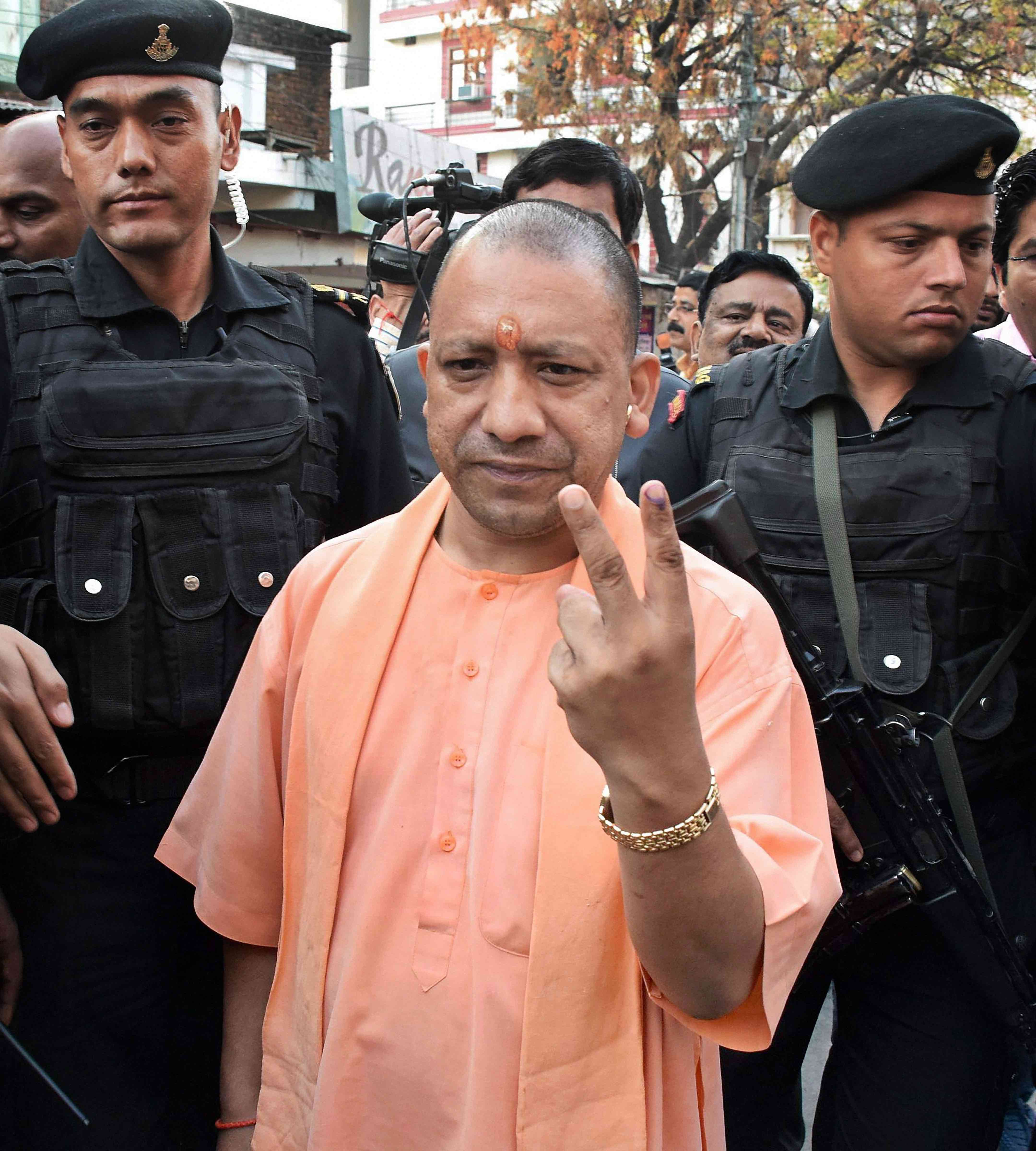
Uttar Pradesh chief minister Adityanath shows his finger marked with indelible ink after he cast his vote during Gorakhpur Lok Sabha by-poll election, in Gorakhpur on Sunday. Credit: PTI
On all four sides of the Math lie Muslim localities and small teashops which have come up over the years to cater to visitors. A significant change in the area is that since Adityanath became an MP, localities such as Alinagar and Urdu Bazaar near the Math have acquired new names – visible on many shops and homes – such as Aryanagar and Hindu Bazaar.
Adityanath has regularly held janata durbars at his office in the Math at which local and family disputes are resolved; letters are written by Adityanath to government departments seeking favours to the supplicant and even to the railways to ensure that those with waitlisted tickets travel the same day.
In sum, Adityanath is both respected and feared, and the Math has long run a Robin Hood parallel government. The defeat of the BJP candidates indicates the failure of communally-divisive politics to gain votes, particularly from the lower castes in the region.
Anger over unfulfilled aspirations
Both during the 2014 national and 2017 assembly elections, many promises were made by Modi and Adityanath to develop UP and make it “Gujarat”, which particularly appealed to the poor in eastern UP who migrate to earn a living to the better-off states in the country. But, as media reports have shown, the Adityanath government is about to complete a year in office but its development record has proved disappointing to voters.
As a recent article by Noor Mohammad points out in detail, the Adityanath government has not been able to put forward a strategy to address the numerous problems facing UP, such as infrastructural bottlenecks, chronic power shortages, broken healthcare and education systems, and unemployment. The state’s debt is almost 30% of GDP and the farm waiver, which has serious flaws, has cut into capital expenditure for police services, public construction and, ironically, various agriculture-associated sectors.
State expenditure on primary education increased by 47% between 2011 and 2015, according to the state government’s Economic Survey 2014-15, but learning and transition levels remain low. Healthcare has not improved, as the death of 30 children in the BRD Medical College Gorakhpur in two days in September 2017 due to a reported lack of oxygen revealed. Unemployment in UP is 5.6% in rural and 6.5% in urban areas, which is higher than the national average.
UP is a predominantly agricultural state and farming provides livelihood to a significant chunk of the rural population. But the BJP government has slashed allocation for the sector by nearly 60% in the 2018-19 Budget. A backward region, eastern UP has always suffered neglect on the part of the ruling dispensation in Lucknow; the local population is disappointed and angry that this has continued despite a powerful leader from this region becoming the chief minister.
Limited duration alliance and astute leadership
It is against this backdrop that the success of the limited SP-BSP alliance must be understood. BSP leader Mayawati, an astute politician, just a week before the Gorakhpur and Phulpur by-polls, asked her workers to campaign for the “strongest non-BJP” candidate, which in this case was from the SP. The alliance was dismissed by observers as lacking the power to take on the BJP, pointing to the old enmity between Mulayam Singh Yadav and Mayawati, and the class divisions in the support base of the two parties: the SP largely representing landowners and the BSP landless labour. It was also felt that the BSP had decided not to contest the by-polls and it was too late for the workers of both parties to campaign jointly on the ground.
However, Akhilesh Yadav, a younger generation leader, was able to persuade Mayawati to support the SP candidates, helped also by the feeling that both parties were fighting a battle for survival against an invincible adversary. A younger generation of workers from both parties, who had not seen the guest house incident of 1995, worked hard, their enthusiasm based on their recognition that the Adityanath government had become unpopular within a year of assuming office and joining hands could lead to victory; the use of the slogans “Jai Bhim” and “Jai Samajwad” shows this.
The victory of the SP candidates suggests that Behenji, popular among her cadre, managed to convince Dalit voters to shift to the SP. Equally important, class rivalry is no longer important on the ground as in the 1990s; sections of the backward castes and Dalits have moved to non-agricultural jobs, making it possible for them to come together. Moreover, the alliance won despite the presence of independent candidate don-turned-politician Ateeq Ahmed, who was expected to gain the votes of the 2.5 lakh Muslim voters in the Phulpur constituency.
Finally, the caste combination on the ground in both Gorakhpur and Phulphur helped the SP-BSP combine. The SP, by fielding Praveen Kumar, a prominent Nishad face in Gorakhpur, and Nagendra Pratap Singh, a Patel in Phulpur, was able to gain the votes of these communities, who form a large section of the population and were unhappy with the ruling BJP.
While both the BJP and SP fielded candidates from dominant OBC communities in eastern UP, the victory is also due to the support of the Dalits. There are around 5.5 lakh SC voters in the Phulpur constituency who have traditionally voted for the BSP. BJP leaders, caught unaware by the sudden announcement of the alliance, were wary of at least 50% of the Dalit vote shifting to the SP candidate.
Road to 2019
The seminal question of whether following this historical victory, the SP-BSP alliance will continue for future elections in UP, and larger anti-BJP opposition party alliances will be formed prior to the 2019 elections, remains open. The SP-BSP alliance has been described by Mayawati as an “agreement” not an alliance, both sides waiting to see how the experiment works prior to a larger alliance for the 2019 election. It is also part of a deal that includes the SP’s support for the BSP in the Rajya Sabha elections later this month, in which Mayawati hopes to send her brother to the Upper House.
Nevertheless, a template seems to be in place, and hope on both sides for a future alliance. There has been much bonhomie between leaders and workers of both parties, particularly in eastern UP, and a post-victory meeting of Akhilesh and Mayawati in Lucknow. The next test will be Kairana, and the duo will have to work harder, as the BJP leadership is already on a strong course-correction drive.
However, the victory of the SP-BSP alliance in UP does not mean that building a larger, pan-Indian opposition alliance against the BJP prior to the 2019 national election will be any easier. While it provides a pointer that pooling in resources and vote banks would help fight the BJP, the formation of a strong and credible anti-BJP alliance remains a formidable and complex task, given the ambition and egos of leaders of different opposition parties and their different ideologies and political agendas. If the Congress hopes to head such a pan-Indian alliance, it will have to work harder at building bridges, as a major take away from the UP experiment seems to be that the challenge to the BJP in 2019 might well be from regional players.
Sudha Pai, a former Professor of JNU, was the Rector (Pro-Vice Chancellor) from 2011 to 2015.
This article went live on March seventeenth, two thousand eighteen, at fifty-two minutes past one in the afternoon.The Wire is now on WhatsApp. Follow our channel for sharp analysis and opinions on the latest developments.


