

A Symptom of Modi's Tussle With Bhagwat and RSS, VP's Resignation Comes Amid His Trickiest Days as PM


In the backdrop of inner-domain disequilibrium in the Bharatiya Janata Party (BJP)-Rashtriya Swayamsevak Sangh (RSS) universe, or more precisely the Modi-Bhagwat dissonance that has dragged on for well over a year and shows no sign of let up, the sudden resignation of the Vice President of India, Jagdeep Dhankhar, appears to be triggering disquiet in the functioning of the state system as a whole under the leadership of Prime Minister Narendra Modi.
Is Modi himself seriously jeopardised? No one can say for sure as no firm information is permitted to come out – but probably not, at least for now. Nevertheless, a tremor in the governance ecosystem has been recorded. Processes are still unfolding.
Dhankhar's out-of-the-blue solo act shows up the fragility of an incipient totalitarian model of governance in which every single thing, every institution, including universities, holder of any office big or small, needs to be under the tight control of one leader and his coterie.
Even opposition parties and the media must be kept on a leash and be ready to accept a bribe or be brought to their senses through the various means of coercion at the state system’s disposal. Exceptions like Rahul Gandhi have to be hounded – not just by the sponsored and well-nurtured assembly line of trolls, but if possible by having him thrown out of parliament. One such attempt has been made already.
Holding the hapless citizen in the vice-like grip of state power is the ruler’s compulsion. To begin with, the citizen goes along willingly, lured by religious or chauvinist or culture-connected slogans whose end is to secure power, but begins to chafe as oppression commences and policies are tailored to benefit small coteries in private enterprise – coteries of big business magnates – leaving ordinary people uncared for.
The ruler therefore worries when the totality of control is even obliquely questioned from any corner of the political system – or any end of society. Protests – even of individuals – are not tolerated, to say nothing of organised groups. All questioning is in reality banned, whatever its appearance.
Even judges and courts mouth off pro-government inanities or holy nonsense, in line with the reigning catechism, as we saw the Bombay high court do recently on the matter of a political protest against the unfolding of genocide in Gaza that our regime supports if its actions in the UN are an indication.
Permitting questions to be asked threatens the very foundation of all-encompassing control by the Leader. It is thought that such things weaken the master and may expose him to the worrying concept of competition from within. Such thoughts unnerve the boss; hence, his image of the all-knowing feared one has been assiduously cultivated. To reinforce it, his service to the Nation is invoked, and a dissenter is labelled “anti-national”. His identity and that of his idea of Nation are made to look intertwined.
The functioning of parliament or a BJP-controlled state legislature is therefore sought to be rendered pointless or meaningless – a hoax in other words, since these are the highest discussion forums of policy and politics in a state and the country, and questions are bound to be asked by MPs and MLAs representing their constituencies made up of Indian citizens.
But the Supreme Authority conducts himself as though he is not answerable to anyone, least of all the people, and all must kowtow before him if National interest is to be held uppermost.
This is the context in which complete control over the functioning of both houses of parliament, where laws are made and people’s grievances aired everyday – to say nothing of state Raj Bhavans and the Rashtrapati Bhavan where laws are finally signed off – becomes significant to the overall narrative of the functioning of the state apparatus.
In this respect, the Lok Sabaha is under a trusted first-rate monitor; the Rajya Sabha was too until July 21, the day Dhankhar drove up Raisina Hill unannounced and put in his papers at 8:30 pm, catching the president wholly unawares – in a move that could be straight out of the Hollywood classic All The President’s Men, in which everything began over little details and in the end a president of the United States was toppled through inter-connecting circumstances. The film was a dramatised version of the true story of President Nixon’s downfall.
It is the shattering suddenness of things which is sending a fright signal across the nerve system of the body politic – and setting off perplexing questions that could potentially lead some to the tipping point in which sometimes strange decisions tumble out in a moment of nervous confusion.
Dhankhar was so far seen as a Modi minion (not much else), first as governor of West Bengal and then as chairman of the Rajya Sabha. The manner of his recurrent ripping off against Modi’s opponents was unbecoming and undignified, not worthy of the high constitutional position he held, next only to the president of India and ahead of the prime minister in the order of precedence. The key question is why did the worm turn?
There are no clear answers yet and only vague, suppressed, speculation. From the troika of parties governing at the Union level – the BJP, the Telugu Desam Party and the Janata Dal (United) – there is only silence.
But we do know the following:
1. On Dhankhar’s last day as Rajya Sabha chairman, J.P. Nadda, the BJP president and leader of the house, rose to announce that only what he said would “go on record” and nothing that the leader of opposition Mallikarjun Kharge said!
Deciding these matters is the prerogative of the chair, not of a member, even if he is the ruling party’s chief and a close confidant of the PM and has sided with Modi against the RSS chief Bhagwat.
At any rate, Dhankhar’s authority had been usurped, and he kept mum. That usurpation is a part of the proceedings of the house until it is scrubbed clean under orders. The vice president did not assert himself right there in the house, but later went and resigned.
2. A tight, cryptic post on X from Modi’s personal account followed, saying Dhankhar had the opportunity to serve in high positions and wishing him good health.
3. The boycott in all but name by Nadda and parliamentary affairs minister Kiren Rijiju of the Business Advisory Committee meeting chaired by Dhankhar just hours before he resigned.
These three pieces of information are concrete and on the record – not fed by speculation. They suggest that the ruling clique saw its battle line drawn with Dhankhar.
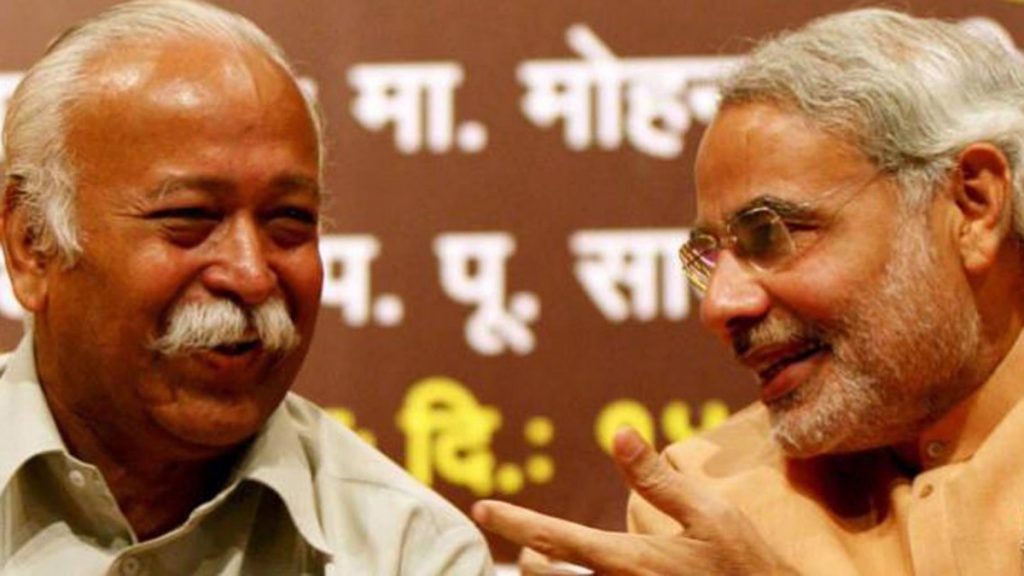
Had Dhankhar by any chance begun to be viewed as an agent of Bhagwat’s camp in the latter’s see-saw with Modi? Photo: PTI.
Everything else that’s going around has been fed by Modi’s political managers, including the so-called ‘allegations’ against Dhankhar which got the regime worried or upset.
The most important of these is that he was in touch with opposition leaders like Arvind Kejriwal, Kharge and possibly even Rahul Gandhi! Does this matter even if true? Are opposition leaders traitors and making contact with them an act of treason?
The trouble is that the answer in the book of the ruling clique is “yes” and not the “no” one would expect to hear in a democracy. That is why admitting a motion of the opposition parties on the issue of a high court judge who is sought to be impeached is seen as an act of betrayal!
In a build-up to totalitarian patterns of life, anything done without permission is considered way out of line – and pushes the ‘wrong-doer’ out of favour, if it may not place him in a worse form of danger.
All said and done, accepting a motion of the opposition parties may hardly be deemed to be the primary reason that would take a toll of the vice president of the country. The real question is: Why did Dhankhar begin to conduct himself differently from before, when he was nothing but a sweet, unquestioning instrument of the power wielders?
Had he by any chance begun to be viewed as an agent of Bhagwat’s camp in the latter’s see-saw with Modi? Although not of RSS background, Dhankhar has in recent months expressed his devotion to the RSS and its ideals in purple prose from various forums, including his high perch in the Rajya Sabha.
Whether or not the former vice president consciously pitched himself in a Sangh parivar factional confrontation against the power-wielders is immaterial. The material point is that he may have begun to be seen as doing this at a time when the office-holders are jumpy.
That makes his resignation a blood-on-the-carpet moment. Adani’s channel NDTV first reported that signatures of MPs began to be collected at the residence of defence minister Rajnath Singh, and this was purportedly on a no-confidence motion to be moved against the V-P – at least that was the impression conveyed to Dhankhar.
Perhaps apprehending further elaboration of Beria-style tactics, the vice president went up to Rashtrapati Bhavan.
Also read: The Fall of Jagdeep Dhankhar Signals a Deep Rift Within the Modi Regime
The plainest reason for the anxieties of the prime minister and those who cannot do without him in public life is the precipitous drop in the BJP’s Lok Sabha seats in the 2024 election – from 303 to 240, and this is widely seen to have been the result of the RSS cadres not fully cooperating in the BJP campaign, as it has traditionally done. This was most visible in a key battleground such as Uttar Pradesh.
As a consequence, there could be disquiet among BJP MPs generally. Their disgruntlement is spoken of in the open. The MPs realise that the supposedly all-powerful Modi has slipped from his perch on account of the RSS factor. He could not lead his party to victory in spite of controlling the Election Commission. Also, the newly elected BJP MPs were not given a voice in Modi’s election as the leader of the house.
In fact, a meeting of the BJP parliamentary party, mandatory under convention, was not even formally called to elect the leader before he officially staked his claim to form government. This conscious slighting of the MPs is apt to deepen factions, a sure sign that loyalty to a single individual cannot be taken for granted when circumstances turn unfavourable.
In this context Bhagwat’s regular references to the retirement age being 75 in the BJP – stipulated earlier by Modi himself to get rid of senior leaders – has not gone unnoticed in the BJP camp.
Will the axe fall in September? Will Modi fight back and what form will this take? These are open questions.
The Modi-Bhagwat imbroglio has another dimension. It is being suggested that the RSS supremo strongly desires that the next BJP president must only be someone he endorses – that the wishes of Modi alone won’t do. Since there has been no agreement on this so far, Nadda merrily continues, his term running into the sixth year, unprecedented for the BJP.
It is in these circumstances that the Bihar assembly election is slated to be held later this year, riding on the back of the dubious special intensive revision of the electoral roll. The exercise appears tailored for the BJP to fiddle the vote and could trigger a poll boycott by the principal opposition parties.
There is also talk of a possible coup against the Bihar chief minister, Nitish Kumar, before the election to enable the BJP to get into the driver’s seat so that it may be better placed to control any turbulence in politics that may ensue.
Essentially, we are in a moment of debilitating uncertainties in political terms, principally being precipitated by the dissonance between the PM and the RSS chief. No ordinary matter in its own right, the resignation of the vice president comes at exactly such a moment. This constellation of contradictions is exacerbated by a looming state election and the election of the BJP president. Never has the moment been so prickly in Modi’s 11 years as prime minister.
Anand K. Sahay is a veteran journalist.
This article went live on July thirtieth, two thousand twenty five, at twenty-four minutes past nine at night.The Wire is now on WhatsApp. Follow our channel for sharp analysis and opinions on the latest developments.


