

Chilean President Sebastian Pinera Faces New Protests After Firing Ministers


Santiago: President Sebastian Pinera faced new protests on Monday after he replaced eight cabinet members including his interior and finance ministers, a house-cleaning aimed at taming the biggest political crisis since Chile's return to democracy in 1990.
Protests last week that spun out of control had already prompted Pinera to pledge worker-friendly changes. The centre-right billionaire who trounced the leftist opposition in the 2017 elections vowed to boost the minimum wage and pensions, lower the prices of medicines and public transportation and assure proper health insurance.
On Monday Pinera sacked interior minister Andres Chadwick, his cousin and longtime confidant who came under fire last week for calling protesters "criminals." He replaced Chadwick, a right-wing politician, with Gonzalo Blumel, a 41-year-old presidency minister and liaison with the legislature.
Pinera also appointed Ignacio Briones, an economics professor, to replace finance minister Felipe Larrain.
"Chile has changed, and the government must change with it to confront these new challenges," Pinera said in a televised speech from the La Moneda presidential palace.
The shake-up followed a week of riots, arson and protests over inequality that left at least 17 dead. Thousands were arrested and Chilean businesses lost $1.4 billion. With Pinera's popularity at an all-time low, Chileans were calling for new protests and the United Nations was sending a team to investigate allegations of human rights abuses.
As Pinera spoke, protesters had already begun to gather outside the presidential palace in downtown Santiago, waving flags, honking horns and calling for his ouster. They were quickly dispersed by security forces with tear gas.
Later in the day, hundreds had begun to gather again for a rally at Plaza Italia, one of the city's central squares.
Chile, the world's top copper producer, has long boasted to be one of Latin America's most prosperous and stable economies, with low levels of poverty and unemployment.
But anger over entrenched inequality and spiralling costs of living had simmered below the surface. The protests that broke out last week resembled similar scenes around the world in recent months, with demonstrators from Hong Kong to Beirut to Barcelona angry at ruling elites.
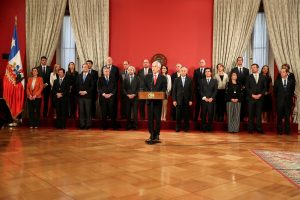
Chilean President Sebastian Pinera delivers a speech during a cabinet reshuffle at the government house in Santiago, Chile October 28, 2019. Photo: Reuters/Ivan Alvarado
Change of Tone
A Cadem poll published on Sunday found that 80% of Chileans did not find Pinera's proposals adequate, which he acknowledged in his speech on Monday.
"We know these measures don't solve all the problems, but they're an important first step," Pinera said.
The protesters do not have any one leader or spokesperson. Chile's fractured opposition parties have supported the demonstrations but have not led them.
The void has lent itself to increasingly extreme proposals from fringe groups, said Guillermo Holzmann, a political analyst with the University of Valparaiso.
"The power vacuum is allowing the political agenda to be overtaken by these demands, and this is where the government must take control," he told Reuters, adding that Pinera's cabinet changes were "necessary, but not sufficient."
Last Friday, a million Chileans of all stripes marched through downtown Santiago demanding a change to the social and economic model. It was the largest protest since Chile's return to democracy.
'Not over yet'
On Monday morning, people in Santiago returned to school or work to find traffic jams, a hobbled metro, graffiti and trash and broken glass littering streets from days of riots.
Jorge Sepulveda, a 33-year old truck driver, said the continuing unrest had hurt his bottom line.
"I don't dispute that people have the right to protest, but this is beginning to affect us all," he said as he smoked a cigarette on a street corner downtown. But, he said, Pinera's announcements had yet to satisfy him.
"He needs to listen to the people," Sepulveda said. "This isn't over yet."
Support for Pinera has plunged to just 14%, the lowest approval rating for a Chilean president since the return to democracy, the Cadem poll showed.
Many have critiqued Pinera's decision to place Santiago under military control, saying it hearkened back to the grim rule of dictator Augusto Pinochet. Pinera lifted the state of emergency at midnight Monday.
UN human rights chief Michelle Bachelet, a Socialist and former president of Chile, sent a fact-finding mission to the South American nation to conduct an independent investigation into allegations of abuse by security forces.
Pinera said on Monday he welcomed their visit, saying "we have nothing to hide."
(Reuters)
#div-gpt-ad-1552302797359-0{width:0px !important; height:0px !important;}
The Wire is now on WhatsApp. Follow our channel for sharp analysis and opinions on the latest developments.


