

Indonesia Elections: Jokowi Leaves, But Lives


“2024 is not just an election year. It’s perhaps the election year,” read Time magazine. At least 64 countries across the globe are scheduled to witness national elections. Of these 64, the fourth-most populous and the third-largest democratic country – Indonesia – elected a new president and vice president along with parliamentary and local representatives in the world’s largest single-day election on February 14.
The unofficial early results based on quick count tallies from independent survey agencies indicate a victory for Prabowo Subianto and Gibran Rakabuming Raka.
While the official results will not be known until March, they are not expected to differ significantly.
This election, Indonesia’s seventh, is particularly important as it witnesses a change of guard as President Joko Widodo concludes his second and constitutionally final term in office. Indonesia’s Istana Merdeka (its official residence) will have a new occupant soon. While succession is a certainty in Indonesia, there are questions as to its relative or absolute nature. At the centre of this conundrum is the ‘Man of Contradictions’ – Joko Widodo.
This draft will outline Widodo's impact on Indonesia's domestic political landscape and how he seeks to maintain an influence in Jakarta even after he steps down.
Also read: 200 Million Voters and 820,000 Polling Stations: Indonesia’s Massive Election in Numbers
Jokowi’s presidential raison d’etre
Joko Widodo, or Jokowi as he is popularly known, is Indonesia's fifth president since the initiation of the country's political reformation, Reformasi, in 1998. He is also only Indonesia's third democratically elected president.
A rank outsider, Jokowi was a furniture maker in Solo with no linkages to Indonesia's political and military elite. His rise to power captured the imagination and aspirations of the average Indonesian. Even today, as Jokowi prepares to leave office, he enjoys a 76% approval rating.
In 2005, Jokowi won a mayoral seat in Surakarta and in 2012 the governorship of Jakarta. He then set his sights on the presidency.
Jokowi's appointment as president challenged the dominant political powers in Jakarta. According to journalist Ben Bland, this once-furniture maker campaigned for a “country with faster economic growth, lower rates of poverty, more jobs, less corruption and a political system that served the people, not the powerful”.
Jokowi focused Indonesia on economic development and corruption-free leadership. In his 2019 inauguration speech, he laid out his ambition to make Indonesia a developed nation by 2045 and one of the top five world economies with a poverty rate nearing 0%.
However, if we look at the five key pillars of this plan – economic growth, poverty eradication, anti-corruption, ease of doing business and infrastructure development – we learn that not much has changed in Indonesia.
At the same time, Jokowi's bid to reform the political system has also fallen by the wayside. The system that serves the people now also serves the powerful more. They consist of the forces of conservative Islam, the party oligarchs, the military and Jokowi himself. Over the last ten years, Jokowi has done much to entrench himself in Indonesian politics.
The economic scoreboard remains moderate. As of 2024, Indonesia’s economy remains in the sixteenth position, the same as in 2019. This is also reflected in other economic parameters. According to the World Bank data, the country has made a fair bit of progress under Jokowi in bringing down the poverty rate – from approximately 11.3% to 9.5% in recent years.
Also read | Indonesia Elections: What You Need To Know
But the numbers have more or less remained static from the beginning of the second Jokowi administration – 9.4% in 2019.
The trend of static numbers is mirrored in Indonesia’s corruption perception index (CPI) as well. Data from Transparency International shows that the country's 2023 CPI score is similar to its 2014 score: 34/100. While the score remains the same, its ranking out of 180 countries has fallen from 107 to 115, except for in 2019 when it ranked 85th.
The unemployment rate has also ranged between 5% to 6% from 2014 to 2023, except for a rise to 7% in 2020 due to the pandemic.
Out of all the parameters, Indonesia under Jokowi has done the best in ease of doing business. From a rank of 120 in 2014, Indonesia rose to 73rd in five years.
Jokowi had also positioned himself as a “king of infrastructure”. During his tenure, progress on several big-ticket infrastructure projects such as the Trans-Sumatra toll road, the Pemalang-Batang Toll Road in central Java, the Jatigede Dam in west Java and the Jakarta Mass Rapid Transit (MRT) amongst others have allowed him to stand out.
While these numbers project an above-average outcome, they have been enough to keep Jokowi’s popularity intact.
Jokowi’s political manoeuvres
It is in the political arena though, that we see Jokowi’s serious successes. These include constitutional amendments, electoral manipulations and political manoeuvres allowing him to secure a powerful position.
In the run-up to the 2014 presidential elections, Jokowi was accused of being from a secret Christian Chinese community with communist sympathies. Given the historical tensions between the Indonesian Islamists and communists, these accusations dented Jokowi’s electoral ambition. This motivated Jokowi to co-opt Islamic hardliner positions.
At the very near end of his campaign, Jokowi even made a trip to Mecca. Two years into his presidency in 2016, Jokowi aligned himself with the ‘212’ movement led by religious extremists against the then-governor of Jakarta and Jokowi’s close ally, Basuki Tjahaja Purnama (Ahok).
The protests revolved around the alleged blasphemy against Islam by Jakarta’s Christian Chinese governor Ahok. The protestors were validated by the president’s presence on stage alongside the extremist leaders. Jokowi’s concern was so strong that he not only allowed his one-time ally Ahok to be thrown under the bus, but he also partnered with Ma’ruf Amin, the ex-head of Nahdlatul Ulama, who became his vice-presidential candidate in 2019.
Jokowi’s push for the military to re-enter Indonesian politics and business has also turned the political tables in Jakarta. Their re-entry has ignited conversations on the revival of the Suharto-era doctrine of the military’s dwi fungsi (or, “dual function”) which ended in 1998. Under Jokowi, the military’s dual role became apparent during the COVID-19 pandemic, when the military was deployed to enforce health protocols.
Jokowi’s tenure has also witnessed the appointment of military officials to political committees and their inclusion in Jokowi’s inner circle. Some powerful military appointees include minister of maritime affairs and investments Luhut Pandjaitan, the president’s chief of staff Moeldoko and defence minister Prabowo.
Prabowo’s inclusion in Jokowi’s cabinet is the most intriguing of them all. Peace with Prabowo, dictator Suharto’s son-in-law and a general with countless human rights abuses to his name, serves as a glaring example of the power infused into Islamists, party oligarchs and the military by Jokowi. It is this nexus that provides Jokowi continued influence in Jakarta.
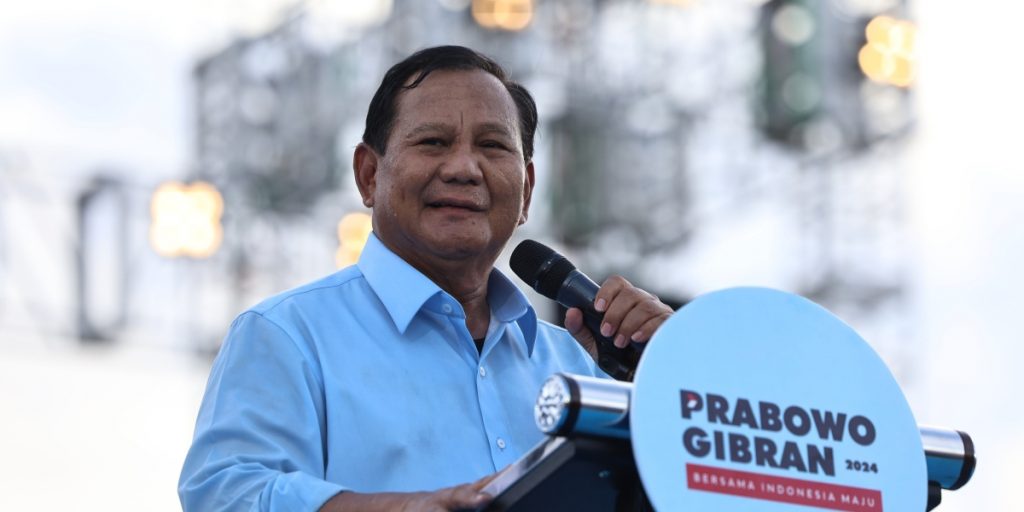
Prabowo has claimed the presidential elections with a commanding 58% of the vote. Photo: X/@Gerindra.
Prabowo, the incumbent defence minister and now the president-elect, has been a president-in-waiting since 2004. He was Jokowi's presidential opponent in 2014 and 2019. After realising that a smear campaign against Jokowi was insufficient, Prabowo aligned with the same hardline forces associated with the 212 movement to oppose Jokowi in 2019.
Prabowo was dismissed from his military duties after the 1998 Indonesian riots and was denied a US visa for almost 20 years. Today, he has succeeded in perhaps his last attempt at the presidency.
Standing alongside Prabowo as the vice president-elect is none other than Jokowi’s eldest son, Gibran Rakabuming Raka.
Raka, 36, is the incumbent mayor of Surakarta, a seat that his father once held.
He was not, however, eligible to run for these elections owing to the minimum age criteria of 40 years. A controversial ruling by the Constitutional Court of Indonesia under the leadership of Jokowi’s brother-in-law Anwar Usman allowed “someone who is not yet 40 years old to run for president or vice president as long as they have experience as a regional head”.
This led to a major uproar across Indonesia, but helped secure Jokowi’s influence in this year's elections.
What Jokowi leaves behind
Jokowi’s transformation from a rank outsider to a consummate insider has reached its final lap. His original raison d’être started to peel away as he built a big tent coalition.
Joining hands with the very parties he fought against shrank the opposition. Through these coalitions, he controlled almost 70% of the seats of the People's Representative Council (DPR) during his first tenure. He managed to control almost three-quarters of the DPR after his re-election.
Jokowi has also showcased authoritarian tendencies in several instances. Right in the aftermath of the 212 movement, he repressed radical Islamists through arrests and bans. The government’s crackdown on protests against the omnibus jobs law and against the new legislation that reduced the authority of the Corruption Eradication Commission are other examples.
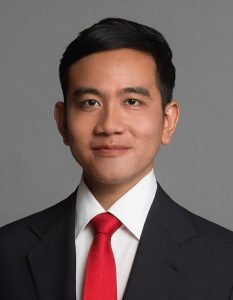
Raka's eligibility has helped secure Jokowi’s influence in this year's elections. Photo: General Elections Commission of the Republic of Indonesia/Wikimedia Commons. Public domain.
In the run-up to these elections, other presidential candidates have also called out the Jokowi government’s repressions. Anies Baswedan, for example, views Jokowi's political moves as a few among many others in his quest to erode democracy in Indonesia.
At the same time, Ganjar Pranowo has been quite vocal about the political intimidation of regional and civil society leaders by the Jokowi government. The combination of these political manoeuvres has provided Jokowi a strong hold on high-level Indonesian politics.
The roots of Jokowi's last lap were sowed in 2021, when Raka became the mayor of Surakarta while Jokowi’s son-in-law Bobby Nasution became the mayor of Medan on the same day.
Jokowi’s younger son, Kaesang Pangarep, has also been roped in as he, unlike his father and brother, joined the Indonesian Solidarity Party (PSI) in 2023 and became its head. It is speculated that Jokowi, who doesn’t possess party control, will aim to enhance his political dynasty through the PSI if the party manages to enter the DPR this year.
In any case, Prabowo has claimed the presidential elections with a commanding 58% of the vote. He has also delivered a victory speech with his supporters in Jakarta, vowing to “serve as the president and vice president for all Indonesian people [and] … to work for the best interests of the Indonesian people.”
With Raka at his side, we can expect the Jokowi legacy to live on. This includes shifting the capital to Borneo.
Thus, for Jokowi, even as he leaves the presidential chair, the 2024 elections remain monumental to the preservation of his legacy, influence and dynasty in Indonesia. Once held as “one of the most important leaders of our time” by former Australian Prime Minister Malcolm Turnbull, Jokowi is here to remain the most important leader of Indonesia’s present and the near future.
Ashutosh Nagda is a German Chancellor Fellow at the Konrad-Adenauer-Stiftung (KAS), Berlin. Siddharth Anil Nair is Researcher with the South East Asia Research Programme at the Institute of Peace and Conflict Studies (IPCS), New Delhi.
This article went live on February fifteenth, two thousand twenty four, at thirty minutes past seven in the morning.The Wire is now on WhatsApp. Follow our channel for sharp analysis and opinions on the latest developments.


