

In a Show of Force, North Korea Fires Three Ballistic Missiles


North Korea has test-fired a series of ballistic missiles in recent months, in defiance of the UN Security Council.
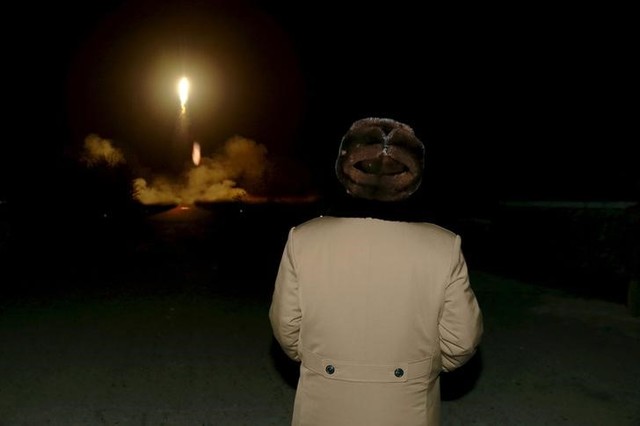
North Korean leader Kim Jong Un watches the ballistic rocket launch drill of the Strategic Force of the Korean People's Army (KPA) at an unknown location, in this undated photo released by North Korea's Korean Central News Agency (KCNA) in Pyongyang on March 11, 2016. Credit: Reuters/KCNA/File Photo
Seoul: North Korea fired three ballistic missiles early on Tuesday, July 19, which flew between 500 and 600 kms into the sea off its east coast, South Korea's military said, the latest in a series of provocative moves by the isolated country.
The US military said it detected launches of what it believed were two Scud missiles and one Rodong, a home-grown missile based on Soviet-era Scud technology.
North Korea has fired both types numerous times in recent years, an indication that unlike recent launches that were seen as efforts by the North to improve its missile capability, Tuesday, July 19 ones were meant as a show of force.
"This smells political rather than technical to me," said Melissa Hanham, a senior research associate at the US-based Middlebury Institute of International Studies at Monterey, California.
"I think the number and distance of the missiles lets them remind the ROK (Republic of Korea) of what they are up against," she said, referring to South Korea by its official name.
The launches came days after South Korea and the US announced a final decision to deploy the Terminal High Altitude Area Defence (THAAD) anti-missile system in the South to counter threats from the North, which had prompted Pyongyang to threaten a 'physical response'.
"Our assessment is that it was done as a show of force," a South Korean joint chiefs of staff official said at a briefing.
The missiles were launched from an area in the North's western region called Hwangju between 5:45 am South Korea time (2045 GMT Monday) and 6:40 a.m., the South's military said, an indication that the North was confident they would not crash on its own territory.
"The ballistic missiles flight went from 500 km to 600 km, which is a distance far enough to strike all of South Korea, including Busan," the South's military said in a statement.
Busan is a South Korean port city in the south.
North Korea has test-fired a series of ballistic missiles in recent months, in defiance of UN Security Council resolutions, including intermediate-range missiles in June and a submarine-launched missile this month.
"In addition to the basic goal of enhancing missile units' readiness to fight, it might be a way of reminding their southern neighbors that the site chosen for a THAAD battery in South Korea is within reach," Joshua Pollack, editor of the US-based Nonproliferation Review, said of Tuesday, July 19 launches.
South Korea announced last week the THAAD system would be deployed in the southeastern county of Seongju.
In addition to the decision to base a THAAD system in South Korea, the US recently angered North Korea by blacklisting its leader Kim Jong Un for human rights abuses.
"The threat to our national security is growing very quickly in a short period of time," South Korean Prime Minister Hwang Kyo-ahn told parliament on Tuesday, July 19.
Bombs, missiles and sanctions
North Korea conducted its fourth test of a nuclear device in January, and activity at its nuclear test site has increased recently, according to media reports in South Korea and Japan citing government officials, as well as a report by Washington-based North Korea monitoring project 38 North.
Following the latest nuclear test and a February space rocket launch that was widely viewed as a missile test in disguise, the UN Security Council imposed tough new resolutions that further isolate North Korea.
While China supported tougher sanctions against its neighbour and ally North Korea, it has sharply criticised the decision to base a THAAD battery in South Korea, saying the move will destabilise the security balance in the region.
China's foreign ministry did not immediately respond to a request for comment on Tuesday, July 19 missile launches.
Japan denounced the launches.
"The latest launch is a breach of the UN Security Council resolution and is extremely hazardous to shipping and aircraft and we have strongly protested," the Japanese government said in a statement.
(Reuters)
This article went live on July nineteenth, two thousand sixteen, at forty-nine minutes past eleven in the morning.The Wire is now on WhatsApp. Follow our channel for sharp analysis and opinions on the latest developments.


