

US Gun Control Debate: Is the Right to Own a Weapon Greater Than the Right to Live?


Americans own about 265 million guns – that is more than one gun for every American adult – but how many owners can use them responsibly?

Credit: Reuters
“Just focus on the target. It doesn’t matter if you miss the bull’s eye.”
I struggled to hear the soft-spoken instructor through my noise-cutting ear muffs. Around me, gunshots went off every few seconds.
The instructor then hung a big sheet of paper on a wooden frame, which moved away from us and stopped three yards away. This, he said, was the distance of most self-defence shootings. On the page were several concentric circles – I was supposed to take aim at the tiniest one in the centre.
“Pick one,” he said, laying on his open palms a revolver and a semi-automatic hand-gun. “What’s the difference?” I asked, like a bad student who had blanked out on everything she had learned minutes earlier. “The semi-automatic is easier,” he said. I kept that one for later and picked the revolver.
Heart racing, I did everything I had been taught: prised open the cylinder, loaded it with bullets, spread my legs hip-distance wide, extended my arms, closed one eye and aimed with the other before pulling the trigger. My shoulder jerked with the recoil, a deafening sound followed a whirling ball of sparks and the first bullet tore into one of the outer circles — all in a split second. The instructor gave me the thumbs up.
Since moving to the United States three years ago, my husband and I had attempted to understand first-hand the gun culture of the country. We visited gun stores and shows. A visit to a shooting range – which is often recommended to tourists, in addition to playing top golf – then seemed like an organic continuation, or even conclusion, to what we had set ourselves on.
We called one shooting range after another to see what was on offer. Most of them only offered a ten-minute crash course to beginners, what we thought was woefully inadequate for the exercise upon which we wanted to embark. About six attempts later, we found one on the outskirts of Houston that promised a robust hour-and-a-half training session before we could shoot.
The shooting range was a rather nondescript building that could easily have been missed if we hadn’t been on the lookout. After showing our IDs and coughing up $50 each at the gun store, we made our way to our classroom. The session had just begun, the room was teeming with people sipping coffee, taking notes and watching the instructor’s presentation. Most of the students had come for self-defence training, we would later find out, or for a certificate that would help them get a conceal-carry licence.
The tone was light-hearted as the speaker introduced us to the dangers of firearms, their technical differences and so on. “It takes a while getting used to guns,” he said, adding that his wife, overwhelmed by the experience, had fled the shooting range the first time he had taken her.
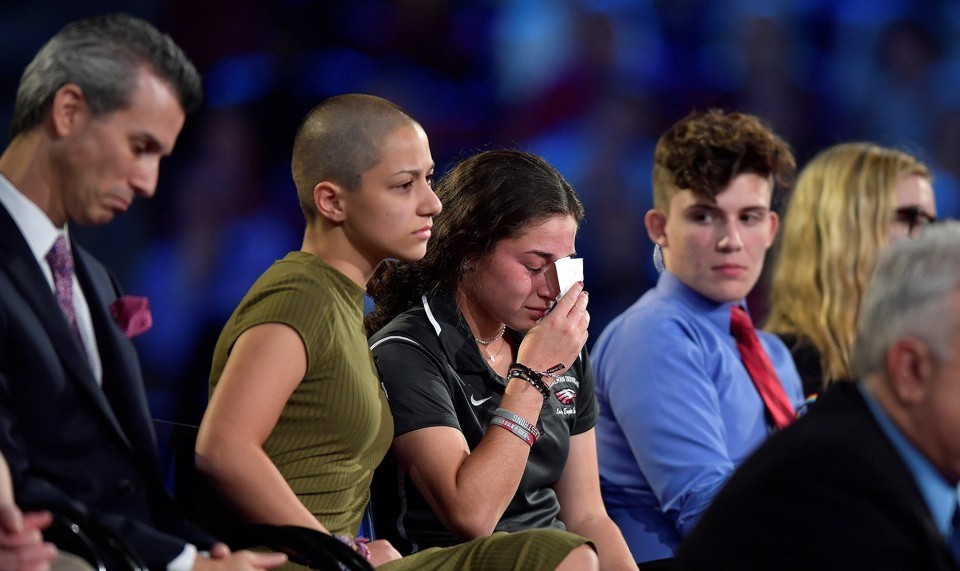
Survivors of the massacre at Marjory Stoneman Douglas High School in Parkland at the recent CNN Townhall held in Sunrise, Florida. Credit: Reuters
“Don’t forget to keep it on at all times,” the instructor said at one point referring to the security lock on a gun that helps prevent accidents. He told us about someone who was checking his handgun and shot himself at the back of his palm. Another time, a man inadvertently fired his rifle at home, the bullet of which made a hole in his wall and pierced the wall of his neighbour’s house.
These might look like rookie mistakes, and they probably are, which is what makes them doubly terrifying. Americans own about 265 million guns – that is more than one gun for every American adult – but how many owners can use them responsibly? I could have paid little attention during my class, and still been able to shoot and go home with a gun if I wanted – you don’t need to show any proficiency before buying a firearm.
For outsiders, America’s inveterate obsession with firearms beggars description. For me, the absurdity became a reality after I moved to Texas – a state with the most lax gun laws – and anxiety began to take hold of me when I found myself in crowds. Not only did I feel a visceral fear of someone possibly lurking in a corner with assault rifles and ammunition, but also the potential for accidental shootings.
And herein lies the danger: weapons can easily get into callow hands. In this year alone, the US Gun Violence Archive reports 249 unintentional shootings so far, that have killed eight and injured 19 people. There were 2,000 such incidents last year.
Instances abound of kids accidentally shooting their parents or classmates. In one case, a 9-year-old killed her instructor in a shooting range near Las Vegas in 2014 when she lost control of the rifle she was using. I chanced upon the viral video after my own experience at the shooting range.
By the end of the evening, I had ended up shooting ten rounds, both with the revolver and semi-automatic. That every shot fired was getting me closer to the end of the self-inflicted ordeal was the only thing that kept me going. It is impossible to imagine the full impact that shooting has on you until you shoot. Far from being a passive or casual activity, it requires focus and force; firing bullets is certainly not like playing top golf. There is no room for error.
The evening left me nauseated and with the most important lesson: I was simply not prepared to shoot, even though I had hit bull’s eye four times. This is what I told the instructor when he offered me a discount to buy a gun, “now that you know how to shoot.” And I am sure many left the room convinced they could.
Also read:
Why Trump’s proposal to arm teachers will miss the mark
Florida students launch gun control movement, may influence US midterm elections
US students plan protests, Washington march, to demand gun control after mass shooting
A few days later, I got an email from the shooting range breathlessly announcing a “big” sale: “In-Stock Firearms Marked Down $20-200 off!”. I had seen similar full-page advertisements for Black Friday sales in newspapers. Every incident that normalises firearms has been unsettling but has brought with it the awareness that for many, these sales are an incentive to buy that one firearm they have been waiting for, like perhaps buying a television set or a mobile phone. It is in moments like these that you come to realise how fully and insidiously guns have made their way into the collective consciousness of the country.
In as early as 1970, historian Richard Hofstadter in his essay titled America as a Gun Culture, pointed to how this very thing didn’t augur well. “Many otherwise intelligent Americans cling with pathetic stubbornness to the notion that the people’s right to bear arms is the greatest protection of their individual rights and a firm safeguard of democracy — without being in the slightest perturbed by the fact that no other democracy in the world observes any such ‘right’.”
We are talking about a country in whose constitution are enshrined the following words in the form of the Second Amendment: “A well-regulated Militia, being necessary to the security of a free State, the right of the people to keep and bear Arms, shall not be infringed.” Gun ownership then becomes the norm and not the deviant.
And so, any mention of the dark side of this gun culture is brushed off blithely, or worse, taken as a way of life. Gun violence causes around 96 people to die every day, of which seven are children and teens. Americans are ten times more likely to die because of a firearm compared with residents of 22 other high-income countries, according to a study published in the American Journal of Medicine in 2016.
But we mostly hear of only those mass-shootings that are of a scale large enough to make it to the news cycle. The Parkland school shooting in Florida was the 17th of this year; four more have taken place in the days that have followed.
The students’ resistance in the aftermath has been simultaneously heart-breaking and inspiring as they have taken on the behemoth National Rifles Association and its cavorting politicians. The generation that’s grown up on mass shootings has been forced to say never again. Will their movement force the rest of the country to see that the right to carry a weapon is not greater than others’ right to live?
Sukhada Tatke is a freelance writer. She tweets @ASuitableGirl.
This article went live on February twenty-eighth, two thousand eighteen, at thirty minutes past five in the evening.The Wire is now on WhatsApp. Follow our channel for sharp analysis and opinions on the latest developments.


