

US Threatens Iran With the 'Strongest Sanctions in History'


Washington: The Donald Trump administration’s new strategy on Iran is a series of tough demands and belligerent threats that is likely to bolster Iranian hardliners and increase instability in the Middle East.
In a widely anticipated speech, Secretary of State Mike Pompeo said on Monday the US is ready to impose “the toughest sanctions in history” on Iran if Tehran “does not change its course”.
Besides imposing unbearable economic costs, he also vowed to “crush” Iranian operatives and their proxies so Tehran will “never have the carte blanche to dominate the Middle East”.
It was a call for regime change in disguise – an end result sought by Israel and Saudi Arabia. Those with memory may recall a similar build-up before the George W. Bush administration launched a war against Iraq in March 2003.
Remarkably, Pompeo made no concessions to European leaders who want to salvage the nuclear deal and continue relations with Iran. “We will hold those doing prohibited business in Iran to account,” he said, dashing all hope of finding a way forward that doesn’t pitch Europe against Washington.
But then the Trump administration has repeatedly shown it will hurt both friend and foe, and ignore the larger geopolitical picture, in pursuit of disruptive policies.
Pompeo was already thinking beyond Europe. He called for a new coalition of the “Australians, Bahrainis, Indians, Japanese, Omanis” and others to mount pressure on Iran. It’s safe to say that while New Delhi will comply with the sanctions, it won’t be excited about being enlisted.
The speech didn’t clarify how Washington would go about imposing the toughest sanctions without the full cooperation of Russia, China and the EU. Given that US trade with Iran is only about $300 million, other trading partners are more important for the full impact of sanctions to be felt.
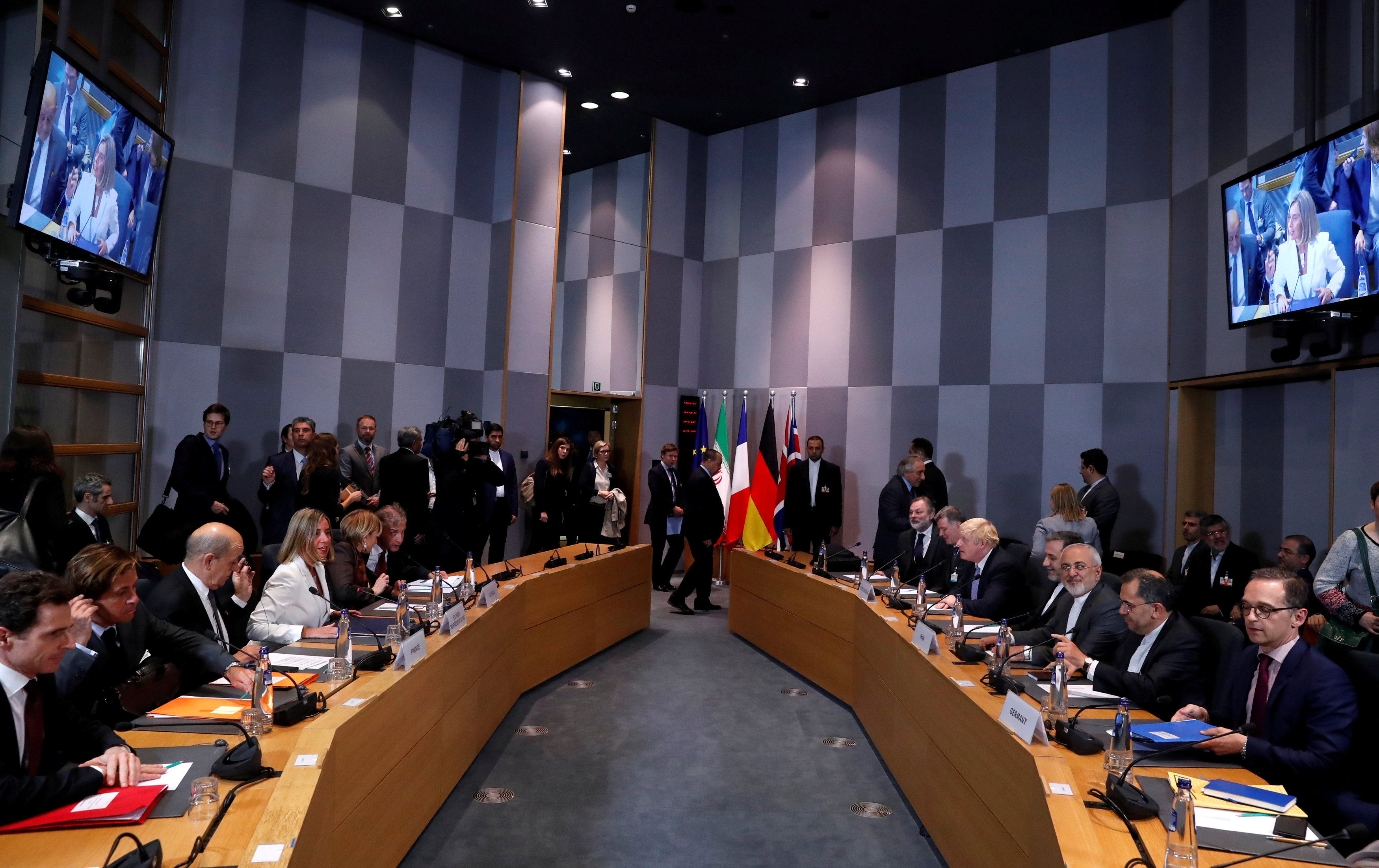
Britain's foreign secretary Boris Johnson, German foreign minister Heiko Maas and French foreign minister Jean-Yves Le Drian take part in meeting with Iran's foreign minister Mohammad Javad Zarif in Brussels, Belgium, May 15, 2018. Credit: Reuters/Yves Herman/Pool
If Iran wants to escape sanctions, it must comply on a range of issues that go beyond its nuclear ambitions. Pompeo has demanded that Iran end all uranium enrichment, close down its heavy water reactor, provide unlimited access to all nuclear sites, halt its ballistic missile programme, withdraw from Syria, end support for Houthi rebels and the Taliban, and stop threatening its neighbours.
In exchange, the US would be willing to lift all sanctions and normalise diplomatic and commercial relations.
It would not be an exaggeration to say that to meet US demands, Iran would have to transform itself into another country altogether and acknowledge a secondary status in the Middle East hierarchy. The demands are designed to shut the door on negotiations, not open it.
The current Iranian regime is unlikely to accede, which means that pressure from sanctions will keep mounting, which in turn may lead to street protests and wider unrest. But will it lead to regime change?
Pompeo virtually called on the Iranian people to rise against the regime. “At the end of the day, the Iranian people will get to make a choice about their leadership. It they make the decision quickly, that would be wonderful. If they choose not to do so, we will stay hard at this until we achieve the outcomes that I set forward today.”
He also called Iran “the largest sponsor of terror” and “a sanctuary for al-Qaeda”, in another echo of the Iraq playbook.
Pompeo’s sharp rhetoric follows Trump’s decision earlier this month to walk out of – or violate, depending on your point of view – the 2015 Iran deal known as the Joint Comprehensive Plan of Action (JCPOA), which had put strict and verifiable limits on Iran’s nuclear programme.
Iran was deemed in compliance of the JCPOA, including by the Trump administration. But Trump, under pressure from Israel, Saudi Arabia and a few key campaign donors, chose to blame the JCPOA for failing to solve the problems it was never meant to address – Iran’s interference in the region, support for various extremist groups and its ballistic missile programme.
As tough US sanctions kick in later this year, the global economy will have to brace itself for more instability and shock. As of now, the Trump administration appears adamant.
Pompeo gave no ground to European countries and companies to ease the impact of sanctions. “Anytime sanctions are put in place, countries have to give up economic activity,” he said bluntly.
Total SA, the French oil and gas giant, is already considering withdrawing from a multi-billion-dollar gas project in Iran because of US sanctions. The company has sought a waiver from the Trump administration, but after Pompeo’s speech, it seems unlikely.
Indian companies active in Iran can also see the writing on the wall. The Indian government, already hot and bothered under the collar by the impending sanctions on account of both Russia and Iran, is unlikely to ask for waivers.
In the end, most countries, including European countries, will have no choice but to reduce exposure to Iran, but the Trump administration will have only grudging, reluctant participation.
Seema Sirohi is a Washington DC-based commentator.
This article went live on May twenty-second, two thousand eighteen, at three minutes past twelve at noon.The Wire is now on WhatsApp. Follow our channel for sharp analysis and opinions on the latest developments.


